
Why Calendered PVC Film Sticks to Rolls and What to Check in the Stabilizer-Lubricant System
Read:45
Source:
When PVC film sticks to calender rolls, the fastest route to a stable line is to separate three possibilities: a process condition that prevents clean release, a deposit that changes the roll surface, or a formulation balance that makes the hot compound too adhesive. These mechanisms can occur together, so adding more external lubricant before checking the evidence can hide one symptom while creating plate-out, haze, migration, or slow fusion elsewhere.
Key takeaways
- Record exactly which roll, film side, width position, and production time show sticking before changing the formula.
- Verify actual roll surface temperature, bank size, speed, tension, nip, and cooling conditions against a qualified run.
- Distinguish clean hot tack from PVC film plate-out. A visible or transferable deposit points toward compatibility, lubrication, stabilization, or contamination.
- Adjust the PVC calendering stabilizer and lubricant system as a package, one controlled variable at a time.
Why does PVC film stick to calender rolls?
PVC film sticks when adhesion between the hot compound and metal becomes greater than the force available to release and carry the web forward. Excessive surface temperature, insufficient cooling, low take-off tension, an unstable material bank, or poor roll geometry can all reduce the release margin. Formulation changes can also increase hot tack or create a deposit that turns a smooth roll into a chemically and mechanically different surface.
The first question is therefore not simply whether the line needs more lubricant. It is whether the failure follows a roll, a film side, a temperature zone, a raw-material lot, or elapsed running time.
First check where and when the sticking begins
Stop the line safely and document the pattern. Note the affected roll, left-center-right position, film side, time from startup, speed, bank appearance, roll temperatures, drive load, take-off tension, and the appearance of any residue. A symptom present immediately after startup usually points in a different direction from one that appears only after a long run.
| Pattern | Likely direction | First confirmation |
|---|---|---|
| Sticks from startup | Temperature, tension, roll condition, or baseline formulation mismatch | Compare settings and roll cleanliness with the last qualified run |
| Appears after elapsed time | Plate-out, migration, thermal drift, or deposit accumulation | Inspect and collect residue; trend temperature and drive load |
| One edge only | Cross-web temperature, gauge, bank, alignment, or tension variation | Map surface temperature and thickness across the width |
| Moves with one roll | Roll surface, temperature circuit, finish, or localized deposit | Inspect that roll after safe shutdown |
Is it sticking or PVC film plate-out?
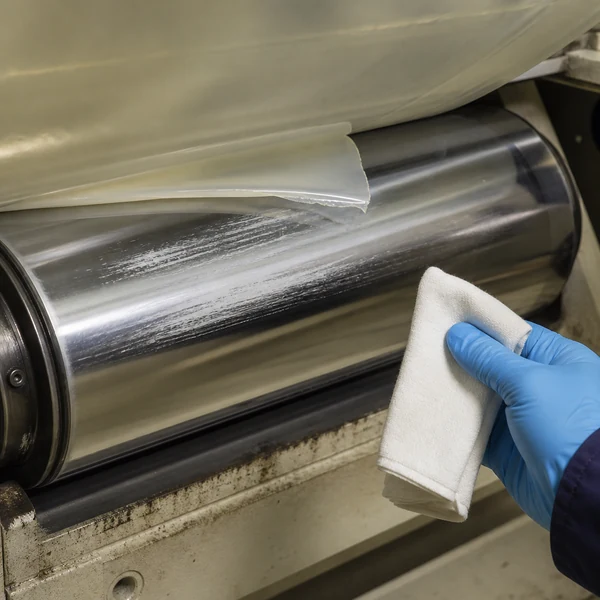
Clean sticking can occur on a roll that still looks polished: the film clings but leaves little transferable residue. Plate-out produces a layer of low-compatibility ingredients, degradation products, pigment, filler, or contamination on the metal. The deposit may look waxy, powdery, oily, streaked, or discolored. It often grows with run time and can print defects back onto the film.
Wipe a defined area only after lockout and according to plant safety procedures. Record the deposit color, feel, solubility behavior, mass if measurable, and the time required for it to return. Do not assume every white deposit is excess wax. Stabilizer components, calcium carbonate fines, pigments, processing residues, and degraded material can look similar.
For a broader deposit investigation, use the AIMSEA plate-out troubleshooting guide. Dow also describes hot-metal release and plate-out control as relevant performance functions for a PVC processing aid, which reinforces that release behavior depends on the whole melt and interface, not lubricant dosage alone.
Check roll temperature before changing additives
The controller setpoint is not proof of the actual metal temperature. Check the calibrated surface temperature across the working width and compare it with a stable production record. A blocked passage, uneven heating or cooling, sensor offset, or changed line speed can create a local hot zone. If the film releases on one side but sticks on the other, a temperature map is more useful than a single center reading.
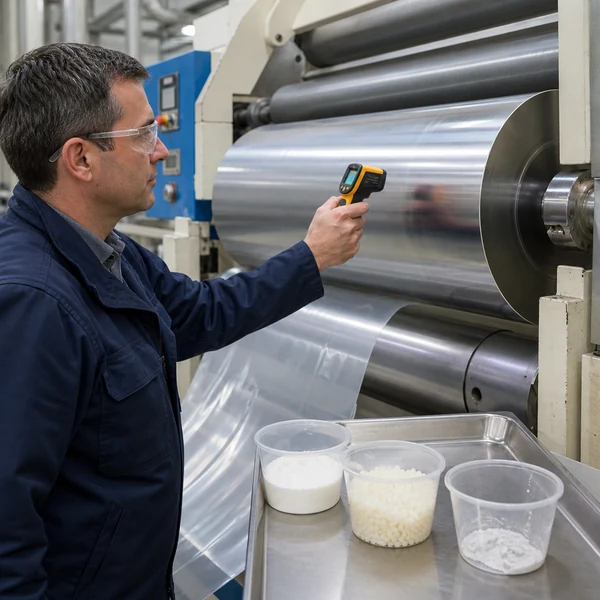
Change one temperature zone at a time and wait for the roll mass to reach equilibrium. A rapid sequence of setpoint changes makes cause and effect difficult to identify. Also confirm whether the new setting preserves gauge, gloss, embossing response, fusion, and downstream cooling.
Review the bank, nip, speed, tension, and take-off
A stable bank supplies a consistent thermal and mechanical history to the nip. A bank that is too large can increase residence time and heat exposure; a bank that is too small or unstable can create gauge and surface variation. Confirm feed rate, stock temperature, bank rotation, and material distribution across the roll.
Next review line speed, friction ratio, nip, and take-off tension as a connected system. Insufficient pull can allow a tacky film to remain on the roll. Excessive pull may distort gauge or orientation and is not a substitute for correct release. Verify cooling-roll temperature and contact because a film that remains too hot after the final nip can block, stretch, or mark even when it initially releases.
How the PVC calendering lubricant balance affects release
External lubricants reduce friction and adhesion at metal surfaces, while more internally acting lubricants change friction and flow within the compound. These labels describe dominant behavior, not perfectly separate categories. Their effect depends on chemistry, dosage, stabilizer package, resin, plasticizer, filler, temperature, and shear.
Too little effective external lubrication can increase roll adhesion and drive load. Too much can delay fusion, lower melt integrity, migrate, reduce printability, or form deposits. A high total lubricant level can therefore produce both slow fusion and plate-out while the operator still sees sticking. Review the complete package, including waxes, fatty acids, metallic stearates, ester lubricants, processing aids, and lubricating components already present in a one-pack stabilizer.
The practical signs and controlled adjustment sequence are explained further in Too Much or Too Little PVC Lubricant?.
Why the stabilizer-lubricant system must be checked together
A PVC calendering stabilizer must protect the compound through its actual heat and shear history while remaining compatible with the lubricant, plasticizer, pigment, filler, and processing aid system. If stability is marginal, early degradation can change color, viscosity, adhesion, and deposit formation. If components are poorly dispersed or incompatible, they may migrate toward the metal interface.
Do not replace only the stabilizer and assume the old lubricant package remains optimal. Compare fusion, torque, dynamic color hold, roll release, deposit rate, haze, gloss, odor, and long-run stability. AIMSEA's calendering PVC application page describes lubricant balance and lower plate-out as application-specific objectives, but the final package still has to be validated in the actual customer formula and equipment.
Other formulation factors that can cause calendered PVC film problems
Plasticizer compatibility and volatility
A change in plasticizer type, purity, or level can alter hot tack, gelation, migration, and cooling behavior. Compare incoming lots and check whether the defect changes after heat aging or storage.
Filler, pigment, and moisture
Particle size, surface treatment, moisture, and dispersion can change friction and create deposits. A small raw-material change can be amplified across a wide polished roll.
Processing aid and melt strength
Insufficient melt strength can make release unstable even if surface lubrication appears adequate. Conversely, an unsuitable processing-aid level may change fusion and hot-metal behavior. Evaluate it with the full formula.
Roll cleanliness and finish
Scratches, corrosion, cleaning residue, and uneven polishing can anchor the film or collect deposits. Use only approved cleaning methods; aggressive abrasion may permanently change the release surface.
A controlled troubleshooting sequence
- Freeze the current formulation and record the complete process state.
- Identify the exact roll, width position, film side, and onset time.
- Map actual roll temperatures and verify speed, bank, nip, tension, and cooling.
- Inspect and characterize any deposit after safe shutdown.
- Compare raw-material lots, mixing records, and dry-blend uniformity.
- Run a qualified control formula under the same conditions.
- Change one process or formulation variable at a time.
- Confirm release, gauge, gloss, haze, color, tensile properties, migration, and long-run plate-out before approval.
Frequently asked questions
Will more external lubricant always stop calender roll sticking?
No. It may improve release when external lubrication is genuinely insufficient, but an excessive level can delay fusion or increase migration and plate-out. Confirm the mechanism first.
Why does sticking appear only after several hours?
Time-dependent onset often indicates deposit accumulation, temperature drift, additive migration, or gradual contamination. Trend the line and collect the residue instead of evaluating only the final defect.
Can a stabilizer change cause roll sticking?
Yes. A different stabilizer package can change compatibility, fusion, lubrication contribution, and thermal behavior. Revalidate the entire stabilizer-lubricant system.
Conclusion
PVC film sticking to calender rolls is best treated as an interface and process-balance problem. Establish where the symptom begins, verify the real thermal and mechanical conditions, distinguish clean sticking from plate-out, and then evaluate the formulation as a complete system. Controlled trials protect film quality while avoiding the common cycle of adding lubricant, creating deposits, and narrowing the processing window.
Technical references: Dow PARALOID K-175 ER product information; US Patent 6,140,401 on PVC calendering stabilizer compositions.