
Posted by Grayson
in blog
Marketing
Updated 2026-08-19
Why Rigid PVC Extrusion Pressure Fluctuates and What to Check First
Read:26
Source:
Introduction
In rigid PVC extrusion, maintaining stable melt pressure is essential for producing consistent pipes, profiles, sheets, and other extrusion products. When pvc extrusion pressure fluctuation occurs, manufacturers may experience unstable output, surface defects, dimensional variation, or difficulty maintaining normal production conditions.
However, pressure instability is usually not caused by one single factor. The actual cause may come from several connected areas, including material feeding, PVC fusion behavior, lubricant balance, temperature settings, processing parameters, and die conditions.
A common mistake during troubleshooting is adjusting machine settings immediately after pressure changes appear. While temperature or screw speed adjustments may temporarily reduce the problem, they may not solve the real cause if the issue comes from the formulation or material condition.
A more effective approach is to check the extrusion process step by step, starting from material consistency and moving toward processing conditions and equipment factors.
This article explains the common causes behind rigid PVC extrusion pressure fluctuation and provides a practical way to identify what should be checked first.
Key Takeaways
- Stable PVC extrusion pressure depends on the interaction between material formulation, processing conditions, and equipment operation.
- Unstable feeding, poor fusion, and lubrication imbalance are common reasons for pressure variation.
- PVC processing parameters such as temperature and screw speed should be adjusted only after confirming material conditions.
- A suitable PVC processing window helps maintain consistent fusion, melt flow, and product quality.
- Formula-related issues and machine-related issues should be separated during troubleshooting.
What Does PVC Extrusion Pressure Fluctuation Mean?
During rigid PVC extrusion, the material passes through several stages, including feeding, conveying, melting, fusion, and shaping through the die. Under stable production conditions, the melt pressure should remain relatively consistent.
PVC extrusion pressure fluctuation refers to abnormal changes in melt pressure during this process. The variation may appear as continuous pressure changes, sudden pressure spikes, or unstable pressure readings during otherwise normal operation.
A small amount of pressure variation is expected because extrusion is a continuous process. The problem occurs when the fluctuation affects product quality or makes the process difficult to control.
For rigid PVC applications, unstable pressure can influence surface appearance, product dimensions, fusion quality, and production efficiency. Therefore, pressure should not be considered as an isolated machine parameter. It is usually a reflection of the overall balance between material behavior and extrusion conditions.
Common Causes of Rigid PVC Extrusion Pressure Fluctuation
Unstable Material Feeding
One of the most common rigid pvc extrusion problems is inconsistent material feeding.
The extrusion process relies on a continuous and uniform supply of PVC compound into the screw. If the feeding amount changes during production, the screw filling condition changes as well, which directly affects melt pressure.
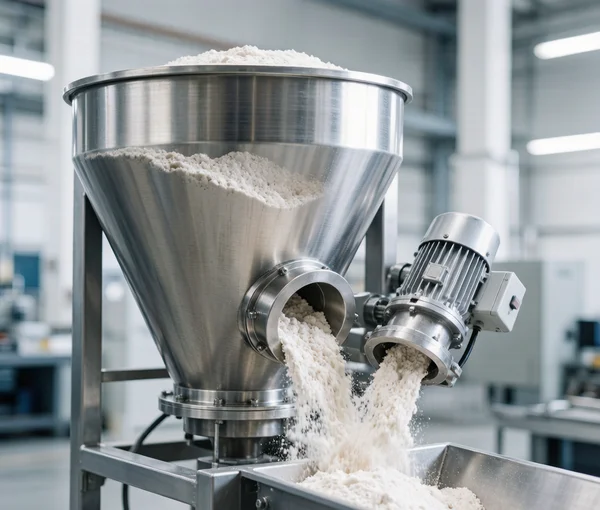
Material feeding instability can happen because of poor powder flow, inconsistent dry blend density, material bridging inside the hopper, or variation between different production batches.
When the material supply is uneven, the extruder may alternate between insufficient and excessive material loading. This creates pressure changes that cannot always be corrected by increasing temperature or adjusting screw speed.
Before changing extrusion settings, manufacturers should first confirm whether the material is being delivered consistently. Checking hopper conditions, dry blend flow behavior, and batch-to-batch material differences can often reveal the source of pressure instability.
A stable feeding condition provides the foundation for stable extrusion performance.
Poor PVC Fusion and Plasticization
Another important reason behind pressure instability is the condition of PVC fusion.
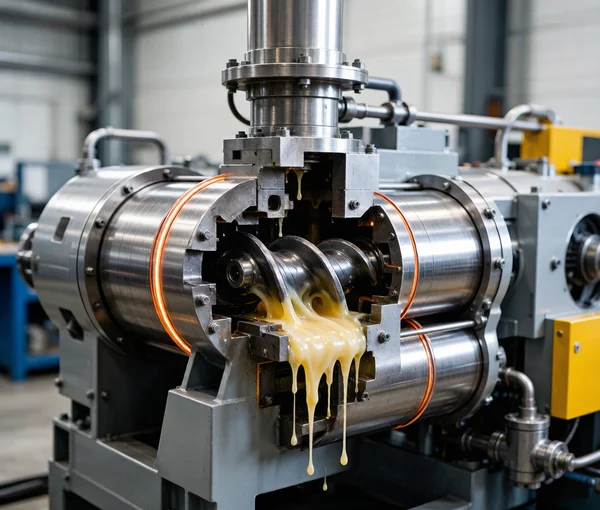
Unlike some thermoplastics that melt easily, PVC requires controlled heat, shear, and processing assistance to achieve proper fusion. During extrusion, PVC particles gradually combine into a uniform melt structure. If this fusion process falls outside the suitable range, melt flow behavior can become unstable.
Insufficient fusion may result in uneven melt flow and increased resistance inside the extrusion system, causing pressure to rise during processing. On the other hand, excessive fusion caused by excessive heat history or shear can change melt characteristics, increase degradation risk, and reduce processing stability.
These conditions are closely related to pvc fusion problems and should be evaluated together with temperature settings, screw speed, residence time, and additive balance.
A stable fusion condition does not simply mean applying more heat. The goal is to maintain the correct processing range where PVC achieves uniform plasticization without unnecessary thermal stress.
Incorrect Lubrication Balance
Lubrication plays a critical role in rigid PVC extrusion because it affects friction, fusion behavior, and melt movement inside the extruder.
PVC formulations typically require a balance between internal and external lubricants. Internal lubrication influences the interaction between PVC particles and affects fusion speed, while external lubrication mainly controls friction between the PVC melt and metal surfaces.
When the lubrication system is not properly balanced, extrusion pressure may become unstable.
Too little lubrication can increase friction and make processing more difficult, causing higher pressure and inconsistent melt movement. However, excessive external lubrication may delay fusion and reduce melt stability. If internal lubrication is insufficient, PVC may also experience poor plasticization behavior.
For this reason, lubricant adjustment should not be based only on pressure readings. The relationship between lubrication level, fusion condition, torque changes, and product quality should be considered together.
Maintaining the right lubricant balance is an important part of keeping a stable PVC processing window.
Temperature and PVC Extrusion Processing Parameters
Temperature control is one of the most important factors affecting extrusion stability. In rigid PVC extrusion, temperature settings determine how the material is conveyed, fused, and shaped through the die. Even small changes in temperature distribution can influence melt viscosity and lead to pressure variation.
When the processing temperature is too low, PVC may not achieve sufficient plasticization. The material remains less uniform, increasing flow resistance and requiring higher pressure to move through the extrusion system. This condition is often associated with unstable fusion and poor surface quality.
However, higher temperature does not always improve processing performance. Excessive heat exposure may accelerate PVC degradation and change melt characteristics. In some cases, the material becomes unstable because it stays within the barrel too long under high thermal stress.
Besides barrel temperature, other pvc extrusion processing parameters also affect pressure stability, including screw speed, output rate, residence time, and torque.
Increasing screw speed can improve production output, but it also increases shear and material throughput. If the formulation or temperature profile cannot support the higher processing speed, pressure fluctuation may occur.
For this reason, manufacturers should evaluate extrusion conditions as a complete system rather than adjusting individual parameters separately. A stable process requires a balance between temperature profile, screw operation, material formulation, and production speed.
Die Condition and Pressure Resistance
Although pressure fluctuation is often associated with the extruder itself, the die section can also create significant pressure instability.
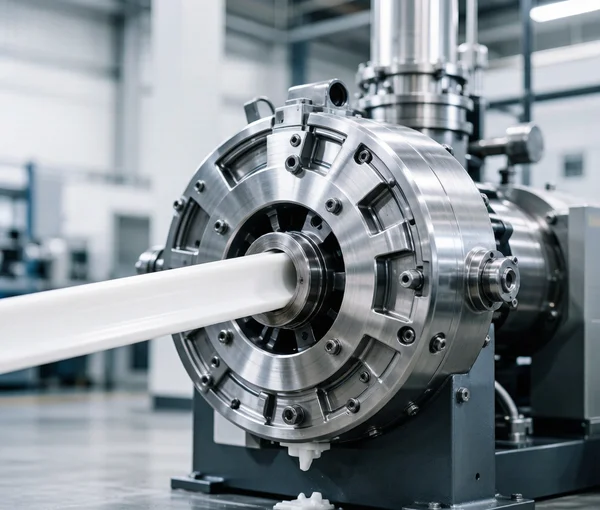
After PVC material is fully plasticized, it must pass through the die with consistent resistance. Any change in the flow path can affect pressure distribution and cause unstable extrusion.
Common die-related causes include material buildup, contamination inside the flow channel, uneven flow resistance, or changes in die condition after long-term operation.
When deposits accumulate inside the die, the available flow area may become smaller. The extruder then needs higher pressure to push the melt through the restricted area. This can create unstable pressure readings and uneven product output.
In some cases, the issue is not a complete blockage but an uneven flow condition. Different areas of the die may experience different resistance, causing variations in melt distribution and product appearance.
During pvc extrusion troubleshooting, die inspection should be considered when:
- Pressure changes continue after material and temperature conditions are confirmed stable.
- Product surface quality changes without obvious formulation changes.
- Pressure gradually increases during longer production runs.
Maintaining a clean and consistent die condition helps reduce unnecessary pressure variation and improves extrusion stability.
A Practical PVC Extrusion Troubleshooting Sequence
When pvc extrusion pressure fluctuation occurs, changing multiple parameters at the same time can make the problem more difficult to identify. A step-by-step troubleshooting process is usually more effective.
The first step is to confirm whether the material supply is stable. Check whether feeding is continuous, whether the dry blend flows properly, and whether different batches show different processing behavior.
If feeding is stable, the next step is to evaluate fusion behavior. Product appearance, melt condition, torque changes, and processing temperature can provide useful information about whether PVC is properly plasticized.
The following stage is reviewing extrusion settings. Temperature profile, screw speed, output rate, and residence time should be compared with previous stable production conditions. Sudden changes in these parameters may explain why pressure becomes unstable.
Finally, if material and processing conditions appear normal, equipment-related factors should be inspected. The die, screw condition, and other contact areas should be checked for contamination, wear, or flow restrictions.
A practical checking order can be summarized as:
| Checking Area | Main Questions |
|---|---|
| Material feeding | Is the compound supplied continuously and consistently? |
| Fusion condition | Is PVC properly plasticized without under-fusion or overheating? |
| Processing parameters | Are temperature, screw speed, and output within a suitable range? |
| Lubrication balance | Is friction and fusion behavior properly controlled? |
| Die condition | Is there buildup or uneven flow resistance? |
This approach helps avoid unnecessary adjustments and makes it easier to identify the actual cause.
How to Maintain a Stable PVC Processing Window
A stable PVC processing window means operating within a range where the material can achieve consistent fusion, flow behavior, and product quality.
Instead of searching for one fixed processing value, manufacturers usually need to maintain a suitable range of conditions that can tolerate normal production variation.
Several factors contribute to a stable processing window.
First, raw material consistency is essential. Changes in PVC resin characteristics, additives, fillers, or lubricant levels can affect extrusion behavior even when machine settings remain unchanged.
Second, formulation balance plays an important role. Stabilizers, lubricants, and other additives work together to control fusion speed, thermal stability, and melt flow. A formulation that performs well under one production condition may require adjustment when output speed or product requirements change.
Third, production parameters should be recorded and monitored. Keeping track of temperature, torque, pressure, and output conditions helps manufacturers identify changes before they become major production problems.
A stable process is not achieved by constantly correcting pressure changes. It comes from maintaining consistent material properties and operating conditions.
When to Adjust Formulation Instead of Machine Settings
When pressure fluctuation appears, many operators first adjust machine parameters such as temperature or screw speed. These changes may provide temporary improvement, but they are not always the right solution.
If the same equipment settings produce different results with different material batches, the issue may be related to formulation consistency rather than machine operation.
For example, changes in lubricant content, stabilizer level, filler ratio, or raw material characteristics can affect fusion behavior and melt pressure.
In this situation, continuously adjusting extrusion parameters may hide the problem rather than solve it.
A simple way to separate formulation issues from equipment issues is to compare production results:
- If the problem appears only with certain material batches, formulation or raw material variation should be reviewed.
- If the problem occurs consistently across different batches, equipment condition and processing parameters should be investigated.
Understanding this difference helps manufacturers improve long-term process stability instead of relying on repeated parameter adjustments.
Frequently Asked Questions
What causes PVC extrusion pressure fluctuation?
PVC extrusion pressure fluctuation is commonly caused by unstable feeding, inconsistent PVC fusion, improper lubrication balance, temperature variation, or die flow resistance. The actual cause should be identified through a systematic check of material, formulation, and processing conditions.
How can I reduce pressure fluctuation during rigid PVC extrusion?
Reducing pressure fluctuation usually starts with stabilizing material feeding, checking fusion conditions, reviewing extrusion parameters, and confirming lubrication balance. Adjusting machine settings without identifying the root cause may only provide temporary improvement.
Can lubricants affect PVC extrusion pressure?
Yes. Lubricants influence friction, fusion speed, and melt flow behavior. An incorrect balance between internal and external lubricants may change processing stability and contribute to pressure variation.
Which PVC extrusion parameters should be monitored?
Important parameters include barrel temperature, screw speed, torque, melt pressure, output rate, and material condition. Monitoring these factors together provides a clearer understanding of extrusion stability.
Improving PVC Extrusion Stability Through Proper Material Selection and Process Control
Stable rigid PVC extrusion depends on more than machine operation. The relationship between formulation design, additive balance, and processing conditions determines whether the production process can remain consistent over time.
For PVC manufacturers, selecting suitable stabilizers, lubricants, and processing additives is an important part of maintaining a reliable extrusion process. Proper additive systems help control fusion behavior, thermal stability, and melt processing performance.
By evaluating material characteristics together with extrusion parameters, manufacturers can reduce unexpected pressure changes and improve production consistency.
A systematic approach to pvc extrusion troubleshooting allows production teams to identify the real cause of instability, optimize the PVC processing window, and achieve more predictable extrusion performance. See our AIMSEA PVC application solutions for support across rigid, flexible, and cable applications.