
Posted by Grayson
in blog
Marketing
Updated 2026-08-21
Why PVC Dry Blend Behaves Differently Between Batches: Bulk Density, Cooling and Storage Checks
Read:8
Source:
Primary keyword: PVC dry blend consistency
Secondary keywords: PVC dry blend mixing; PVC bulk density; PVC dry blend flowability; PVC cooling mixer; PVC extrusion feeding problems; PVC compounding process; PVC dry blend storage
Quick Answer
When the same PVC formulation behaves differently between batches, the first suspect should not automatically be the extruder or the stabilizer. PVC dry blend consistency can change when ingredient weights, resin or filler condition, mixer loading, addition sequence, hot-mix endpoint, cooling performance, conveying, maturation time, or storage conditions vary. These changes alter the blend's bulk density, temperature, flowability, segregation tendency and feeding behavior. The most efficient investigation compares a problem batch with a retained stable batch under the same test and production conditions.
What Is PVC Dry Blend Consistency?
PVC dry blend consistency means that separately mixed batches enter downstream processing with sufficiently similar physical and processing characteristics. It does not mean that every laboratory number must be identical. It means that variation remains inside a validated operating range and does not force operators to repeatedly correct feeder speed, screw speed, barrel temperature or output.
A consistent dry blend should normally show repeatable:
- ingredient composition and dispersion;
- discharge temperature from the hot and cooling mixers;
- apparent or bulk density;
- powder flow and freedom from lumps;
- moisture condition and storage temperature;
- feeding rate at a fixed feeder setting;
- fusion response, motor load and output on the production line.
The important point is that dry blend is not merely a list of ingredients. It is a manufactured intermediate material with its own thermal and physical history. Two batches made from the same written recipe can therefore behave differently.
Why Can the Same PVC Formula Produce Different Batches?
PVC resin, filler, stabilizer, lubricant, processing aid, pigment and other additives differ in particle size, porosity, surface condition and bulk density. During PVC dry blend mixing, high-speed agitation generates frictional heat, distributes solids and helps low-melting ingredients coat or enter the porous resin structure. The hot blend is then cooled so that these interactions stabilize before conveying and storage.
If one stage changes, the downstream symptom may appear far away from the mixer. A lower-density blend may deliver less mass per feeder revolution. A warm blend may cake or bridge. Segregation may create short periods with a different additive balance. The extruder then shows changes in torque, fusion, pressure, output, color or surface quality even though its settings have not moved.
This is why troubleshooting should follow the material path:
weighing → hot mixing → cooling → conveying → storage → feeding → fusion.
Check 1: Confirm Weights, Lots and Rework Before Changing Settings
Start with traceability. Confirm the actual batch sheet rather than relying only on the target recipe. Review scale calibration, dosing tolerances, ingredient sequence, manual additions and the amount and source of rework. A small weighing or identification error in a low-dose lubricant, stabilizer or processing aid can have a larger processing effect than a modest change in a high-dose ingredient.
Record raw-material lot changes as well. Different resin lots can vary in particle morphology and porosity; fillers may arrive with different moisture, particle-size distribution or surface treatment; additives may differ in physical form. These differences do not automatically mean that a material is out of specification, but they can change mixing time, powder flow and fusion behavior.
For a clean comparison, isolate three samples when possible:
- retained material from a stable batch;
- material from the problem batch;
- a controlled repeat batch made after verifying weights and sequence.
Do not mix questionable rework into the controlled batch. Otherwise, the investigation begins with an uncontrolled variable.
Check 2: Verify Mixer Fill Level and Ingredient Addition Sequence
High-speed mixers depend on a stable material circulation pattern. An underfilled or overfilled vessel can change the vortex, residence time, heat generation and dispersion. Batch mass should therefore be controlled against the qualified working capacity of the specific mixer, not merely its nominal vessel volume.
The addition sequence also matters. PVC resin, stabilizer, internal and external lubricants, filler, pigment and liquid ingredients may need different addition points based on temperature, time or motor load. Changing the sequence can cause waxes to coat particles too early, liquids to form local wet zones, or fine additives to remain poorly dispersed.
Compare the actual sequence with the approved standard and check:
- whether automatic valves open at the correct step;
- whether operators add minor ingredients at a repeatable point;
- whether liquid addition is gradual and well distributed;
- whether vessel-wall deposits retain part of an ingredient;
- whether the mixer is completely discharged between batches.
A written recipe without a controlled addition procedure is not a complete PVC compounding process specification.
Check 3: Compare the Full Hot-Mix Profile, Not Only Drop Temperature
Drop temperature is useful, but it is not enough by itself. Two batches can reach the same indicated temperature through different combinations of mixer speed, blade condition, starting temperature, batch load and mixing time. Their dispersion and thermal history may therefore differ.
Plot or record at least:
- starting material temperature;
- time versus material temperature;
- motor current or torque versus time;
- ingredient addition points;
- hot-mix discharge temperature;
- total cycle time.
Look for changes in the rate of temperature rise, not just the endpoint. A slower cycle may indicate blade wear, a changed fill level, cold raw materials, thermocouple drift or a raw-material difference. An unusually fast cycle may indicate a lower load, hotter incoming material or excessive friction.
Use actual material temperature where possible. Jacket or vessel readings can lag behind the powder and may not represent the whole batch. Sensors should be kept clean and periodically checked against a reference.
Check 4: Measure PVC Bulk Density Correctly
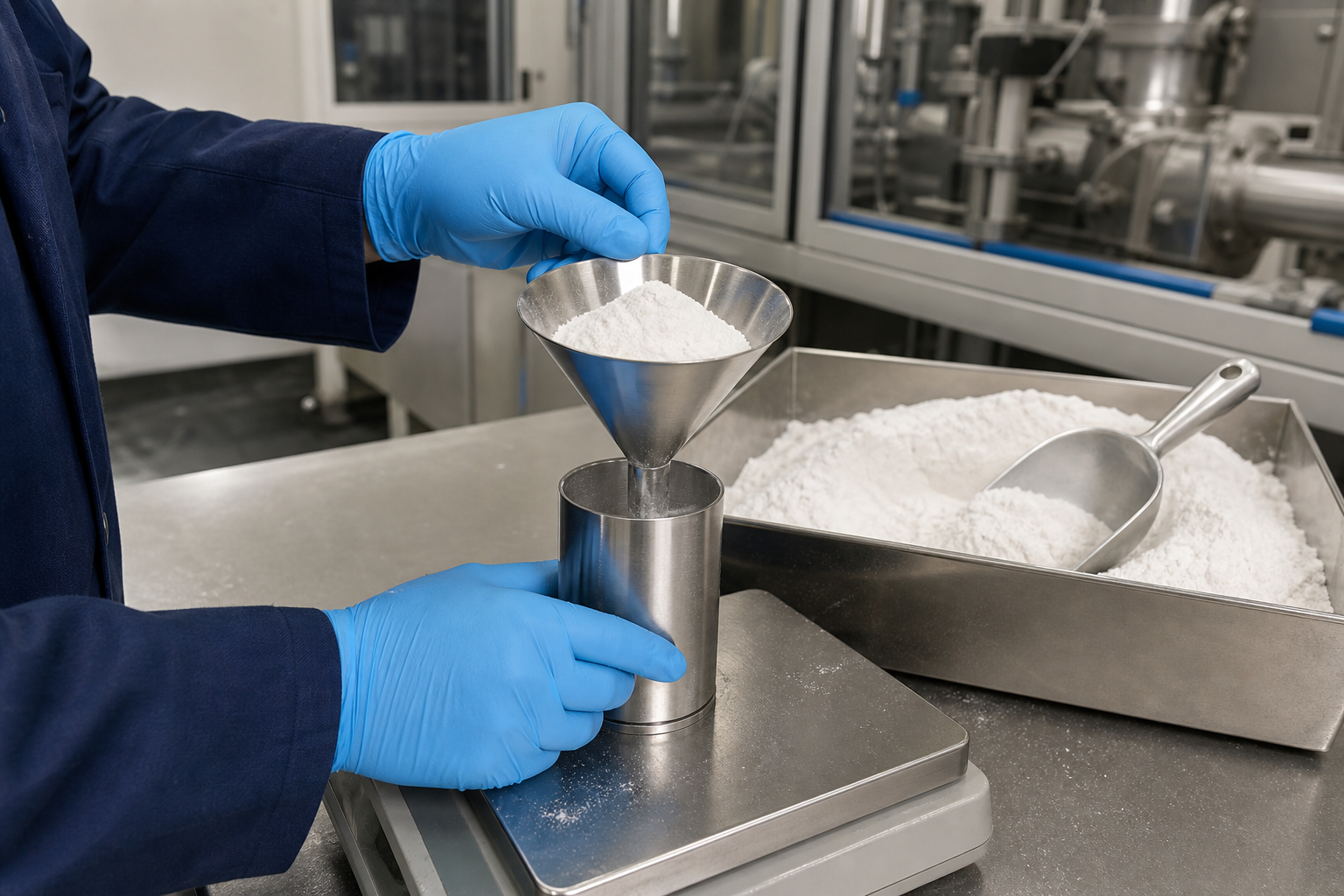
PVC bulk density is the mass of powder occupying a defined volume under a specified filling method. It is a practical indicator because volumetric feeders and screw channels respond to occupied volume, while production output is measured by mass.
If bulk density decreases, the same feeder volume may deliver less material. Operators may see reduced output, unstable hopper level, changed motor load or apparent underfeeding. If density increases, mass throughput can rise at the same feeder setting, potentially changing fusion and load.
Bulk density is not a complete quality verdict. It can be influenced by resin morphology, filler level, mixing history, cooling, compaction during conveying and sample handling. Use it as a comparative control:
- condition samples consistently;
- use the same container, funnel and filling method;
- avoid tapping one sample but not another;
- take samples from comparable locations;
- repeat the measurement and report the average and spread.
Compare stable and unstable batches against an internal control range developed for that formulation and line. A universal target copied from another factory may be misleading.
Check 5: Test PVC Dry Blend Flowability and Look for Segregation
PVC dry blend flowability describes how readily the powder moves through hoppers, pipes and feeders. It is related to bulk density but is not the same property. Two samples can have similar density while differing in cohesion, static tendency, lumping or funnel flow time.
Inspect the blend for:
- soft or hard agglomerates;
- warm, tacky zones;
- excessive dust;
- visible color or filler streaks;
- deposits on the mixer, conveyor or silo wall;
- rat-holing or bridging in the hopper;
- pulsating feeder refill cycles.
A controlled funnel-flow test, sieve check and visual examination can reveal differences that a density cup misses. For higher-risk investigations, particle-size distribution and samples from the top, middle and bottom of a container can help identify segregation.
Long or aggressive pneumatic conveying can separate components with different particle size or density. Repeated transfers, high conveying velocity and poorly designed silo filling can make a uniform mixer discharge less uniform by the time it reaches the extruder.
Check 6: Audit the PVC Cooling Mixer
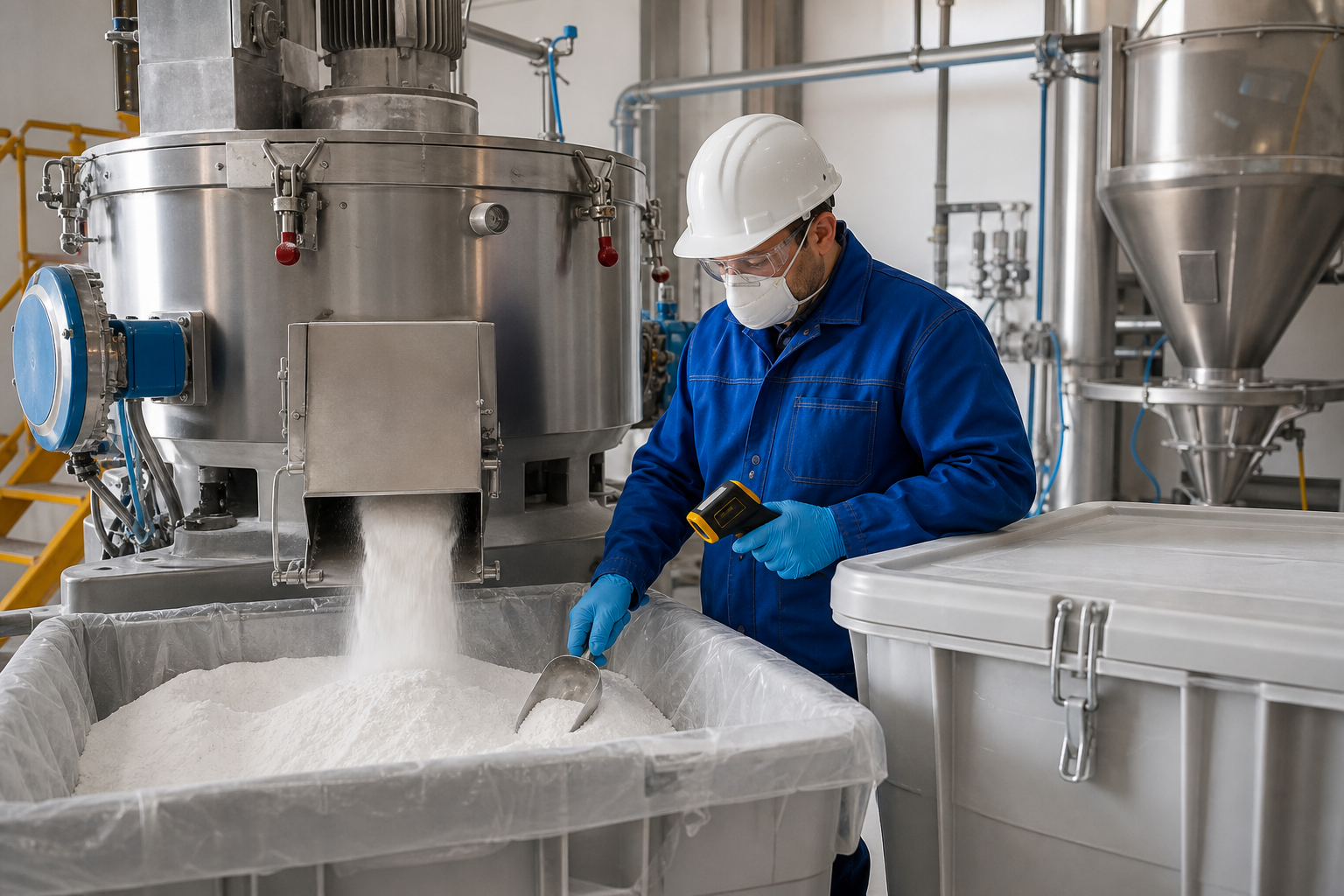
The PVC cooling mixer does more than make the powder safe to handle. It stops the hot blend from continuing to change, reduces caking risk and creates a predictable inlet condition for conveying and storage.
Compare cooling performance over the complete shift. Cooling water may be cold at startup but warm later as the system accumulates heat. Fouled jackets, reduced water flow, an overloaded cooler or worn agitation components can create temperature gradients. A single temperature reading near the wall may hide a warmer center or a hot pocket near the discharge.
Check:
- hot material transfer time into the cooler;
- batch load and cooler working capacity;
- cooling-water inlet and outlet temperatures;
- water flow, pressure and jacket cleanliness;
- agitation speed and paddle condition;
- temperature at multiple points when practical;
- cooling time and final discharge temperature;
- residual powder left after discharge.
Do not adopt one universal discharge temperature without validation. Rigid and plasticized formulations, equipment designs and plant climates differ. Establish the range that produces free-flowing material without premature additive loss or storage caking on the actual line.
Check 7: Control Maturation Time and PVC Dry Blend Storage
Material can continue to equilibrate after cooling. This is especially important when liquids or low-melting ingredients are involved. One batch processed immediately and another held overnight may show different apparent density, flow and feeding even if both were made correctly.
Define a minimum and maximum hold time for each formulation family. Record production time, cooling completion, silo or container number and extrusion time. A first-in, first-out system reduces unexplained age differences.
During PVC dry blend storage, control:
- material temperature before entering the silo or container;
- ambient humidity and condensation risk;
- storage duration;
- container closure and contamination control;
- vibration or compaction during transport;
- segregation during silo filling and discharge;
- cross-contamination from previous formulations.
Moisture problems are not always caused by wet raw materials. Warm powder entering a cooler environment can create condensation. Humid conveying air and poorly sealed containers can also change flowability.
Check 8: Separate Dry-Blend Problems from Extruder Problems
Batch-to-batch variation often appears as PVC extrusion feeding problems, but equipment must still be checked. Inspect hopper level control, refill timing, feeder calibration, screw condition, throat cooling and bridging. Confirm that screw speed, vacuum, temperatures and downstream restriction are stable.
A practical separation test is to run retained stable blend and problem blend under the same controlled line condition. Record mass output, feeder setting, motor load, head pressure, melt temperature, fusion indicators and product quality. If the symptom follows the material, the dry-blend path becomes the priority. If both materials behave similarly, inspect equipment and process control.
For a structured line-side sequence, see AIMSEA's guide, Why Rigid PVC Extrusion Pressure Fluctuates and What to Check First. Its first material check is to compare the PVC dry blend with a stable batch before changing multiple extrusion parameters.
A Practical Batch-Comparison Checklist
| Check | Stable Batch | Problem Batch | What a Difference May Mean |
|---|---|---|---|
| Raw-material lots | Recorded | Recorded | Resin, filler or additive physical-property shift |
| Actual weights and rework | Verified | Verified | Composition or dosing variation |
| Mixer load and sequence | Standard | Compare | Changed circulation or dispersion |
| Time-temperature profile | Reference curve | Overlay | Heat-generation or sensor difference |
| Motor current/torque profile | Reference curve | Overlay | Load, blade or material difference |
| Hot-mix endpoint | Within range | Compare | Different coating or absorption history |
| Cooling curve and discharge | Within range | Compare | Residual heat or cooling gradient |
| Bulk density | Internal range | Repeat test | Volumetric feeding difference |
| Flowability and sieve residue | Internal range | Repeat test | Caking, agglomeration or segregation |
| Moisture and storage age | Controlled | Compare | Condensation or maturation difference |
| Extruder mass output | Baseline | Same settings | Confirms feeding impact |
| Torque, pressure and product | Baseline | Same settings | Connects powder condition to processing |
How to Correct the Process Without Creating a New Problem
Freeze the last stable condition before making changes. Correct verified mechanical or procedural deviations first: calibration, mixer load, sequence, sensor condition, cooling-water performance, discharge completeness or storage rotation. Then produce a controlled batch and compare it with retained reference material.
Change formulation only after process variation has been reduced. Stabilizers and lubricants influence fusion, heat stability, release and plate-out, but changing their dosage cannot reliably compensate for uncontrolled weighing, cooling or segregation. It may hide one symptom while narrowing the processing window elsewhere.
When evaluating a new stabilizer or one-pack system, use the same resin, filler, mixer procedure, cooling condition, aging time and test method. AIMSEA recommends comparing the complete formulation under repeatable laboratory and production conditions rather than judging a stabilizer from one isolated torque or color result.
Frequently Asked Questions
Why does lower PVC dry blend bulk density reduce extrusion output?
At the same volumetric feeder setting, a lower-density powder can deliver less mass. This may reduce output and change screw filling, motor load and fusion. Confirm by measuring actual mass throughput rather than relying only on feeder speed.
Can two PVC dry blends have the same bulk density but different flowability?
Yes. Bulk density measures mass per defined volume, while flowability is affected by cohesion, particle-size distribution, static, moisture and agglomeration. Use both density and a repeatable flow or sieve test.
Why does warm PVC dry blend cause feeding problems?
Warm material can remain tacky, compact in storage, form lumps or bridge in the hopper. It can also enter the extruder at an inconsistent temperature. Check cooling uniformity and actual material temperature before storage and feeding.
How long should PVC dry blend rest before extrusion?
There is no universal time for every rigid and plasticized formulation. Establish a validated hold-time window by comparing density, flow, feeding and product results at controlled intervals. Process all comparison batches at the same age.
Does inconsistent torque always mean the PVC formulation is wrong?
No. Torque can change with dry-blend density, feed rate, temperature, equipment condition, test mass and sensor accuracy. Compare a retained stable batch and verify the process before reformulating.
What should be checked first when batches behave differently?
First verify actual weights, raw-material lots, rework, mixer load, addition sequence and the full hot- and cold-mix records. Then compare bulk density, flowability, moisture, storage age and mass feeding against a stable batch.
Build a Repeatable Dry-Blend Control Window
The best control plan links mixer data to downstream results. For each formulation family, retain the batch sheet, time-temperature and motor-load curves, cooling record, density, flow result, storage age and extruder response. Trends across several batches are more useful than one isolated limit.
If a PVC plant is experiencing unexplained batch differences after a stabilizer or lubricant change, AIMSEA can review the formulation context and proposed comparison plan. Share the PVC application, resin and filler system, additive package, mixer type, batch size, hot- and cold-mix records, storage time and line symptoms. A controlled comparison helps determine whether the next action belongs in the mixing process, the additive balance or the extrusion line.
CTA: Discuss Your PVC Dry-Blend Consistency Trial
Send AIMSEA a stable-batch record and a problem-batch record. We can help organize the stabilizer, lubrication, fusion and processing variables that should be compared before the next production trial.