
Too Much or Too Little PVC Lubricant? How to Fix Slow Fusion, Plate-Out and Rough Surfaces
Read:43
Source:
Too much or too little PVC lubricant can produce similar-looking extrusion defects, which is why random dosage changes often make the problem worse. Excessive external lubrication commonly delays fusion and weakens particle-to-particle interaction, while insufficient metal release can increase friction, sticking, torque, and die deposits. The correct fix is to identify where friction is occurring, verify the fusion state, and adjust one component at a time.
Key takeaways
- "Internal" and "external" describe dominant behavior, not perfectly separate categories; many PVC lubricants have both effects.
- Slow fusion, rough surfaces, plate-out, high torque, and die build-up must be interpreted with melt temperature, pressure, motor load, output, and torque-rheometer data.
- A stabilizer, filler, resin, processing aid, or mixing-sequence change can shift the apparent lubrication balance even when the wax dosage is unchanged.
- Use retained good material and small controlled trials. Do not change several lubricants and temperature zones at the same time.
What is PVC lubrication balance?
PVC lubrication balance is the relationship between friction inside the compound and friction at the PVC-metal interface. Internal lubricants are relatively compatible with PVC and mainly reduce friction within the polymer matrix or lower effective melt viscosity. External lubricants are less compatible and mainly reduce adhesion between hot PVC and the screw, barrel, die, calender roll, or calibration surfaces.
The distinction is practical rather than absolute. Baerlocher's technical lubricant guide describes a continuous transition between internal and external action and identifies "combined" lubricants that provide both. The guide also notes that external lubricants generally prolong fusion time, while internal lubricants reduce melt viscosity. This is why replacing one wax with the same phr of another product is not necessarily an equivalent change.
What happens when there is too much PVC lubricant?
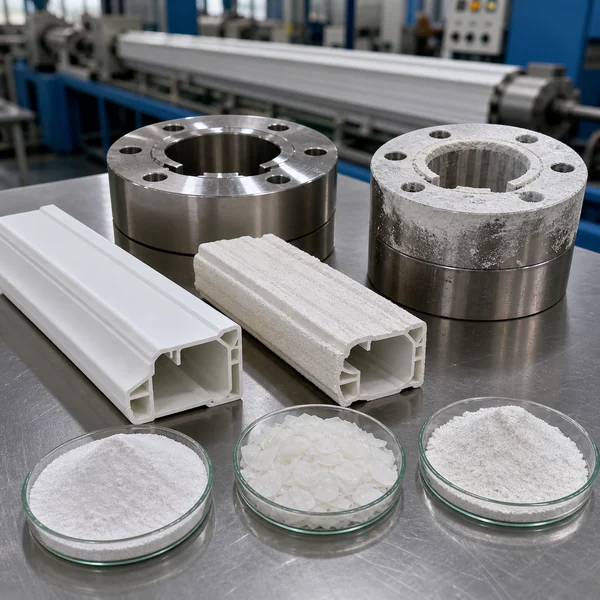
Excess lubricant can reduce the shear and particle interaction needed for reliable fusion, but the exact symptom depends on which lubricant dominates, the process, and the rest of the formulation. In rigid extrusion, excessive external action is a frequent cause of delayed fusion. The compound may convey without developing a sufficiently homogeneous melt within the available screw length.
Slow fusion and low energy transfer
When the PVC particles and metal surfaces slip too readily, less mechanical energy is converted into the heat and deformation required for gelation. A laboratory torque curve may show a later fusion peak. On the line, operators may see lower motor load, a need for higher temperature, sensitivity to line speed, weak weld lines, dull or rough surfaces, and inconsistent impact properties.
Do not diagnose over-lubrication from low torque alone. Low feed, a warmer melt, worn screws, a different resin, or an instrument-condition change can also reduce torque. Compare the current dry blend with a retained stable sample using the same mixer load, chamber temperature, rotor speed, and endpoint rules.
Plate-out and surface deposits
Poorly compatible lubricant, stabilizer, pigment, or other additive can separate from the compound and accumulate on tooling. Plate-out may appear on the die lip, screw, barrel, calibrator, or rolls. It can produce streaks, dull areas, spots, changing dimensions, more frequent cleaning, or particles that break free and mark the product.
More external lubricant does not always cure a deposit. It may improve release in one system but increase migration in another. The correct diagnosis should distinguish plate-out from PVC degradation, burned residue, filler agglomerates, contamination, and simple mechanical damage. AIMSEA's guide to PVC blooming versus plate-out explains why the location and timing of a deposit matter.
Reduced adhesion, printing, or welding performance
Exudated material at the surface can interfere with downstream bonding, printing, coating, or welding. This risk is application-specific and should be evaluated after conditioning, not only immediately after extrusion. A glossy part is not proof of a well-balanced formulation if its surface energy or weld strength has deteriorated.
What happens when PVC lubricant is too low?
Insufficient lubrication increases friction. If the shortage is mainly external, PVC can adhere more strongly to hot metal and release poorly. If the melt lacks adequate internal lubrication, viscosity, torque, shear heating, and pressure can rise. Both situations can narrow the processing window and accelerate thermal stress.
High torque, pressure, and melt temperature
A lubricant shortage may increase motor load and head pressure, but those signals are not unique. A colder compound, excessive feed, blocked screen, restricted die, high filler loading, or mechanical wear can produce the same trend. Check output and screw speed with pressure, load, and actual melt temperature on a common timeline.
If torque rises progressively during a run, inspect the die and vent area for build-up, confirm cooling and heater control, and check whether the feed or bulk density is drifting. A sudden step change after a raw-material lot change is stronger evidence for formulation or dry-blend variation than a slow deterioration over several production days.
Sticking, melt fracture, and rough surfaces
Insufficient PVC-metal release can produce drag at the die wall. The surface may show roughness, chatter, melt fracture, drag marks, or localized overheating. Raising the die temperature can sometimes improve appearance, but it may only mask the friction problem and reduce the thermal-stability reserve.
Before adding wax, inspect die cleanliness, land condition, temperature uniformity, alignment, output, and melt homogeneity. A rough surface caused by under-fusion requires a different correction from roughness caused by excessive wall adhesion.
Why symptoms overlap
PVC lubricant troubleshooting is difficult because slow fusion can leave a rough surface, while insufficient release can also leave a rough surface. Plate-out may come from excessive incompatible material, poor dispersion, thermal degradation, or a package interaction. High pressure can mean high viscosity, a restriction, unstable feeding, or deposits - not simply "too little lubricant."
The Society of Plastics Engineers' PVC gelation workshop shows that formulation functions interact: calcium stearate can help PVC particle breakdown, paraffin and PE/OPE waxes regulate extrusion and metal release, and acrylic processing aids promote fusion and melt strength. The same workshop also emphasizes that blending order matters because waxes can coat resin, fillers, or other additives and change dispersion.
This means a PVC lubrication balance cannot be optimized by an internal-to-external ratio alone. Resin morphology, stabilizer chemistry, filler surface treatment, processing aid, impact modifier, pigment, mixer temperature, addition sequence, discharge temperature, and storage time all affect the result.
A symptom-based PVC lubricant troubleshooting table
| Symptom | Possible lubrication-related cause | Check before changing dosage |
|---|---|---|
| Slow fusion | Excess external action or lubricant coating of particles | Resin lot, process aid, mixing order, actual melt temperature, screw wear |
| High torque or pressure | Insufficient internal lubrication or metal release | Feed rate, restriction, melt temperature, output, die cleanliness |
| Plate-out or die build-up | Incompatible/excess lubricant or package interaction | Deposit composition, degradation, dispersion, filler and stabilizer lots |
| Rough surface | Under-fusion or inadequate die-wall release | Fusion curve, die temperature uniformity, shear, mechanical damage |
How to correct slow fusion without causing plate-out
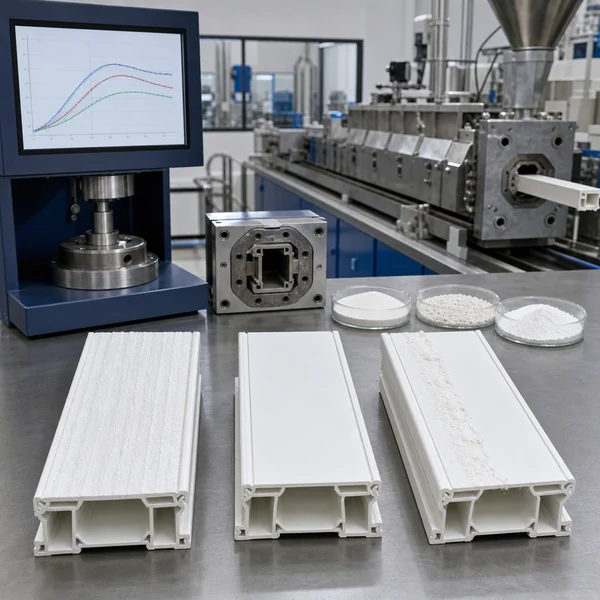
Start by confirming that slow fusion is real. Compare a repeatable torque curve, motor load, head pressure, melt temperature, output, and finished-part properties. If excessive external lubrication is supported by the evidence, reduce the suspected component in a small controlled step rather than cutting the entire package.
Keep the stabilizer and processing aid in view. A one-pack stabilizer may already contain lubricating components; adding the old separate wax dosage can over-lubricate the new system. Conversely, reducing a wax may expose insufficient thermal protection or metal release. AIMSEA's PVC stabilizer and one-pack additive solutions should be evaluated as complete packages in the customer's actual compound.
After each change, inspect both short-term fusion and long-run cleanliness. A formulation that fuses faster in a ten-minute trial may still build deposits after two hours. Validate impact or tensile performance, dimensional control, surface condition, color, weld or bond performance, and cleaning interval as appropriate.
How to correct sticking and high torque without delaying fusion
If the evidence points to insufficient metal release, evaluate a small increase or a more effective external lubricant rather than indiscriminately lowering viscosity. The lubricant's chemistry, molecular weight, polarity, melting behavior, and dosage all matter. A product with stronger external action may require a lower phr than the material it replaces.
If internal friction is excessive, confirm that the formulation has not lost a compatible internal lubricant or changed stabilizer chemistry. Also verify that filler loading, filler treatment, and processing aid have not shifted the melt demand. Adjustments must preserve the required gelation and physical properties.
Use AIMSEA's PVC torque rheometer curve guide to compare fusion time, fusion torque, and equilibrium behavior under repeatable laboratory conditions.
A controlled trial plan
- Preserve a reference. Keep retained material from the last stable production lot and document its complete recipe and process.
- Freeze equipment conditions. Confirm screw, barrel, die, heaters, thermocouples, cooling, venting, feeder, and calibrator condition.
- Compare dry blends. Check bulk density, flow, moisture, agglomeration, mixer addition order, discharge temperature, cooling, and aging time.
- Run one-variable laboratory trials. Change only the suspected lubricant or package component in small steps. Use identical mixer or rheometer conditions.
- Confirm on the line. Record output, pressure, motor load, melt temperature, dimensions, surface, color, and deposit growth for enough time to expose drift.
- Test finished properties. Verify the properties required by the product and application before approving the revised formulation.
Frequently asked questions
Does more external lubricant always reduce plate-out?
No. It may improve metal release, but excessive or incompatible material can also migrate and contribute to deposits. Identify the deposit and verify fusion before increasing dosage.
Can barrel temperature replace a lubricant adjustment?
Temperature can change viscosity and fusion, but it does not correct an unsuitable lubricant package. Using heat to compensate for slow fusion can reduce thermal stability and increase discoloration or degradation risk.
Why did fusion change after replacing the stabilizer?
Commercial stabilizers and one-pack systems can contribute internal or external lubrication. A replacement changes more than heat stability, so the separate lubricant dosage and mixing sequence may need re-optimization.
Should lubricant dosage be specified only in phr?
PHR is necessary but not sufficient. Chemical type, purity, molecular weight, melting range, polarity, physical form, dispersion, and interactions with the complete formulation determine performance.