
Calcium Stearate vs Zinc Stearate in Rigid PVC: Which One Affects Fusion and Release?
Read:30
Source:
Calcium stearate and zinc stearate are both metallic stearates used in rigid PVC, but they should not be treated as interchangeable powders. Zinc stearate can support initial color and contributes strong metal release, yet an unbalanced zinc level can accelerate the well-known sudden discoloration called zinc burning. Calcium stearate offers lubrication and acid-scavenging support and is commonly paired with zinc chemistry, but it cannot by itself provide every function required for a robust Ca-Zn stabilizer system.
Key takeaways
- Calcium stearate vs zinc stearate is not a simple internal-versus-external lubricant comparison; both also participate in stabilization chemistry.
- Zinc stearate generally gives stronger early color and release effects, but excessive or unsupported zinc can shorten long-term color stability.
- Calcium stearate helps build longer-term balance and lubrication, but the final result depends on co-stabilizers, waxes, processing aids, and the complete rigid PVC formula.
- Choose the ratio through torque, color-hold, plate-out, release, and finished-product testing rather than a universal phr rule.
What is the practical difference between calcium stearate and zinc stearate in rigid PVC?
The practical difference is the combination of their metal ion chemistry, compatibility, and interfacial behavior. Both contain long fatty-acid chains that can reduce friction and aid processing. Zinc chemistry is more active in replacing unstable chlorine sites in PVC and can improve early color, but zinc chloride formed during stabilization can catalyze rapid dehydrochlorination if it is not neutralized or complexed. Calcium compounds help capture acidic species and support longer-term balance, which is why commercial Ca-Zn systems use carefully designed combinations rather than either soap alone.
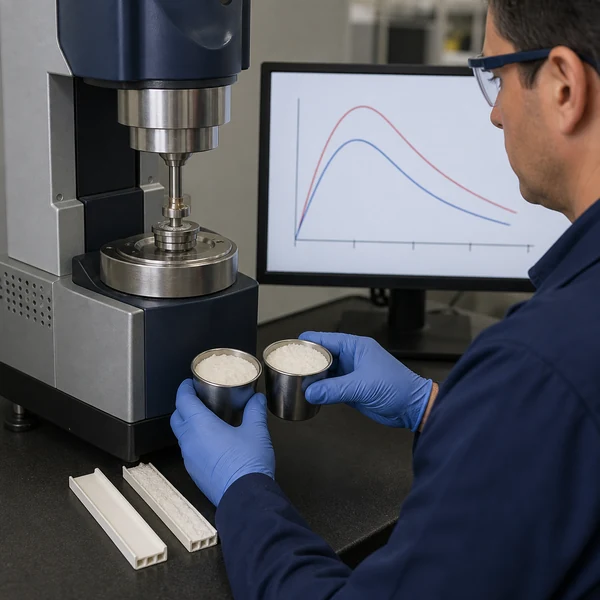
Published PVC studies repeatedly show that calcium/zinc stearate performance changes with ratio and auxiliary stabilizers. They also show why a result from one resin, filler level, temperature, or test method should not be copied directly into another production formula.
Which one affects PVC fusion more?
Both can affect fusion because both change friction, heat generation, and the way the compound interacts with metal. The direction and magnitude depend on dosage and the rest of the lubricant system. In a torque rheometer, increasing overall external lubrication often delays the fusion peak and lowers shear heating. A more compatible or internally acting component may reduce internal friction without producing the same release effect.
It is therefore misleading to state that calcium stearate is always internal and zinc stearate is always external. Metallic stearates show mixed behavior in real PVC compounds. Resin porosity, calcium carbonate, acrylic processing aid, impact modifier, paraffin wax, oxidized polyethylene wax, stabilizer carrier, and test temperature can change the observed fusion curve.
Compare fusion time, peak torque, equilibrium torque, stock temperature, and the appearance of the fused mass. A longer fusion time is not automatically bad if the production window remains stable, and a faster peak is not automatically good if it leads to high shear or early degradation.
Which metallic stearate gives better release?
Zinc stearate is widely valued for release and anti-stick behavior, but the best rigid PVC result rarely comes from maximizing zinc stearate. Strong release can be useful at a die, mold, or hot roll, yet excessive interfacial lubrication may weaken fusion, reduce weld-line strength, alter gloss, or increase deposits. Calcium stearate also contributes lubrication and can support a more balanced long-run system.
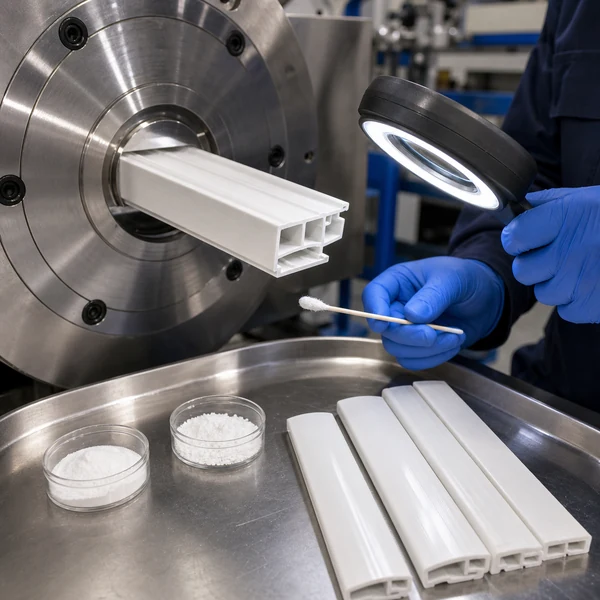
Evaluate release by recording die pressure, motor load, surface gloss, drag marks, plate-out rate, cleaning interval, and the force required to eject a molded part where relevant. A clean release at startup is not enough if deposits appear after two hours.
Why can too much zinc stearate cause sudden discoloration?
During PVC degradation, hydrogen chloride is released. Zinc-based stabilizing reactions can initially protect labile sites and support good early color, but zinc chloride may form. Zinc chloride is a Lewis acid and can accelerate further dehydrochlorination. When the supporting calcium soap and co-stabilizer system can no longer control this species, the compound may change quickly from acceptable color to severe yellow, brown, or black discoloration.
This phenomenon is commonly called zinc burning. Peer-reviewed work on PVC stabilizers reports that zinc stearate alone or an unbalanced Ca-Zn system can show poor long-term thermal stability, while polyols, beta-diketones, hydrotalcites, epoxidized oils, and other co-stabilizers can extend the stability window. These ingredients are not universally interchangeable; transparency, migration, odor, regulatory, and application requirements still govern selection.
What role does calcium stearate play?
Calcium stearate contributes lubrication and participates in the acid-control side of the stabilizer system. In combination with zinc chemistry and suitable co-stabilizers, it helps move the formulation away from a short initial-color window toward a more usable processing window. However, simply increasing calcium stearate can also change fusion, surface finish, deposit behavior, and compatibility.
Calcium stearate quality also matters. Fatty-acid composition, free fatty acid, moisture, particle size, bulk density, and metal content can influence dispersion and reproducibility. Compare supplier specifications and incoming-lot data before treating two products with the same generic name as identical.
Calcium stearate vs zinc stearate: a practical comparison
| Question | Calcium stearate direction | Zinc stearate direction |
|---|---|---|
| Lubrication | Contributes mixed internal/external lubrication depending on formula | Often provides strong release and anti-stick behavior |
| Initial color | Usually needs zinc and co-stabilizer support | Can support strong early color |
| Long-term stability | Supports balance and acid control in a package | Can trigger zinc burning when unsupported or excessive |
| Fusion effect | Formula-dependent; may delay or reshape fusion as dosage changes | Formula-dependent; strong release may reduce frictional heating |
| Release | Useful contribution but normally part of a larger lubricant system | Frequently selected when stronger metal release is needed |
| Main risk when increased alone | Slow fusion, deposits, or changed surface properties | Slow fusion, plate-out, or shortened color-hold through zinc burning |
How should you adjust a rigid PVC formulation?
1. Start from a qualified control
Keep resin, filler, processing aid, impact modifier, pigment, waxes, mixing cycle, and extrusion settings constant. Record the exact grade and lot of each metallic stearate.
2. Change the Ca/Zn balance in small controlled steps
Do not change total metallic stearate, wax level, and processing aid at the same time. A small matrix that holds total addition constant while changing the Ca/Zn contribution can reveal whether the main response is color, fusion, or release.
3. Measure more than one performance dimension
Use torque rheometry, static oven aging, dynamic color-hold, Congo red or conductivity where appropriate, extrusion pressure, die build-up, gloss, impact, tensile, and dimensional tests. The accepted formulation must survive both the laboratory screen and a representative continuous run.
4. Review the co-stabilizer package
If early color is good but long-term stability collapses, adding more calcium soap may not be the most efficient answer. The package may need a suitable acid scavenger, complexing agent, antioxidant, polyol, beta-diketone, hydrotalcite, or epoxidized co-stabilizer. Select only materials that meet the product's regulatory and performance requirements.
5. Recheck the complete lubricant balance
Metallic stearates are only part of the lubrication system. Review paraffin wax, polyethylene wax, oxidized wax, ester lubricant, fatty acid, processing aid, and lubricating ingredients already carried by a one-pack stabilizer. The symptoms of imbalance are covered in AIMSEA's PVC lubricant troubleshooting guide.
Troubleshooting by symptom
| Symptom | Check first | Controlled direction |
|---|---|---|
| Fusion too slow | Total external lubrication and processing temperature | Reduce one external contribution at a time; confirm stability |
| Poor die release | Metal surface, die temperature, zinc stearate and wax balance | Improve release without sacrificing fusion or weld strength |
| Good initial color, sudden darkening | Zinc level and co-stabilizer capacity | Rebalance Ca/Zn and zinc-control co-stabilizers |
| Plate-out during long runs | Compatibility, total soap/wax level, filler and temperature | Analyze deposit before changing dosage |
| Rough or dull surface | Fusion, dispersion, die deposit, and processing aid | Restore melt quality rather than adding release agent blindly |
Why one-pack systems often perform differently from simple blends
A commercial Ca-Zn one-pack may contain metallic soaps, co-stabilizers, antioxidants, lubricants, processing aids, carriers, and application-specific modifiers. Replacing it with equal nominal amounts of calcium stearate and zinc stearate does not reproduce the same chemistry. Conversely, adding separate stearates on top of a one-pack can unknowingly double-count lubrication or zinc contribution.
For rigid pipes and profiles, review the full formulation and processing window. The PVC pipe fusion stability guide explains how stabilizer, lubricant, filler, and processing aid changes interact during extrusion.
Frequently asked questions
Is zinc stearate only a PVC lubricant?
No. It contributes lubrication and release, but zinc chemistry also participates in thermal stabilization and initial color. That dual role is why dosage and co-stabilizers matter.
Is calcium stearate always an internal lubricant?
No. Its observed internal or external effect depends on the entire formula and process. Treat those labels as dominant tendencies, then verify with rheology and production data.
Can calcium stearate prevent zinc burning by itself?
A suitable calcium contribution helps, but robust Ca-Zn systems normally rely on a wider co-stabilizer package. Required performance and test conditions determine the design.
What ratio should rigid PVC use?
There is no universal ratio. Resin, filler, product geometry, equipment, temperature, regulatory needs, and other additives all change the optimum. Use a controlled trial matrix.
Conclusion
Calcium stearate and zinc stearate affect rigid PVC through both lubrication and stabilization. Zinc stearate can strengthen release and early color, while calcium stearate helps build a more durable balance, but neither should be optimized in isolation. The reliable choice comes from a complete Ca-Zn package evaluated with fusion, color-hold, plate-out, release, and finished-product tests.
Technical references: Thermal stabilization of PVC by calcium and zinc carboxylates; Research discussing zinc burning in PVC; Baerlocher metallic stearates brochure.