
Why PVC Pipe Formulations Lose Fusion Stability During Extrusion
Read:58
Source:
A PVC pipe formulation can lose fusion stability even when the extruder settings have not changed. The usual reason is that the dry blend, additive package, feed condition, and actual shear-temperature history have moved out of balance. The fastest correction is not to raise every barrel zone. It is to determine whether the compound is receiving too little fusion energy, too much lubrication, inconsistent feeding, or enough heat to begin degradation.
Key takeaways
- Fusion stability is a system result: resin, stabilizer, internal and external lubrication, processing aid, filler, mixing, feeding, screw condition, and temperature all interact.
- Slow fusion, unstable pressure, rough surfaces, and weak pipe walls can share a cause, but they should be confirmed with process trends and controlled trials rather than appearance alone.
- Change one variable at a time and compare fusion time, fusion torque, equilibrium torque, melt temperature, output, motor load, pressure, color, and mechanical results.
- A stabilizer change may require a new lubrication balance because commercial stabilizer packages can also influence lubrication and fusion.
What does fusion stability mean in PVC pipe extrusion?
Fusion stability means that a PVC dry blend repeatedly converts from compacted particles into a sufficiently homogeneous, workable melt within the available screw length and thermal window. Unlike many pellet-fed thermoplastics, suspension PVC does not simply become a uniform melt after reaching one temperature. Heat, compression, shear, particle breakdown, additive compatibility, and residence time work together.
A stable process therefore produces repeatable melt temperature, head pressure, motor load, output, surface appearance, dimensions, and physical properties. A formulation can show acceptable color yet remain under-fused. It can also produce a smooth surface while running too close to degradation. Fusion should be judged from several signals, not from one pressure reading or one pipe sample.
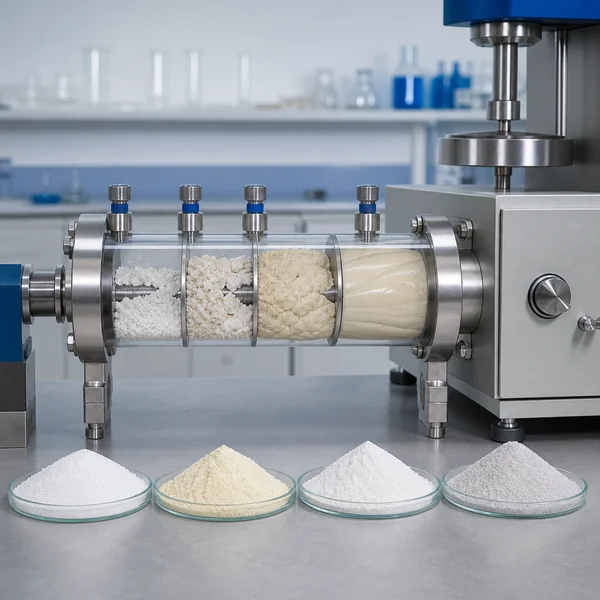
Laboratory mixer and torque-rheometer tests are useful because a controlled torque curve can show loading, compaction, fusion, and the later equilibrium region. Thermo Fisher Scientific notes that PVC dry-blend behavior is sensitive both to formulation changes and to test conditions, so repeatable sample mass, chamber temperature, rotor speed, and handling are essential when comparing results.
Why does a PVC pipe formulation suddenly fuse too slowly?
Slow fusion means that the compound requires more time or energy to reach the required degree of gelation. Typical symptoms include a delayed fusion peak in a laboratory test, lower or unstable motor load, rough or grainy surfaces, weak impact performance, poor knit strength around the spider lines, and sensitivity to small changes in line speed.
External lubrication is too strong for the current process
External lubricants reduce friction between PVC and metal. That function is necessary for release and clean processing, but an excessive external-lubrication effect can delay particle-to-particle interaction and reduce the shear energy available for fusion. The same dosage may behave differently after a change in wax grade, stabilizer package, filler surface treatment, mixing sequence, or screw condition.
Do not respond by cutting all lubricants together. Internal and external lubricants do different jobs, and commercial ingredients rarely behave as perfectly isolated categories. Run a small controlled matrix around the suspected external lubricant or one-pack dosage while keeping resin, filler, processing aid, mixing procedure, and extruder conditions fixed.
The formulation no longer develops enough melt strength
Processing aids promote fusion and help build melt elasticity. Too little processing aid, an unsuitable molecular-weight range, or a poorly dispersed additive can leave the compound sensitive to output and temperature. A pipe may look acceptable at a low rate but lose surface quality or dimensional stability as throughput rises.
Before increasing dosage, confirm that the dry blend is uniform and that the selected processing aid matches the resin, filler loading, pipe type, and output target. More is not automatically better: excessive melt elasticity can increase torque, make sizing more difficult, or narrow the practical window.
Filler or resin variability changed the energy demand
Changes in PVC resin porosity, apparent bulk density, particle-size distribution, K-value, or residual moisture can affect additive absorption, feeding, and fusion. Calcium carbonate also changes the system through particle size, surface treatment, moisture, agglomeration, and loading. A nominally identical phr value does not guarantee identical behavior when the incoming material changes.
Compare incoming quality-control data and retained samples. Check bulk density, moisture, sieve residue or agglomerates, hot-mix discharge behavior, and dry-blend flow. If a problem began with a new raw-material lot, reproduce the old and new materials under the same laboratory procedure before retuning the production line.
Why can fusion become too fast or unstable?
Fast fusion is not automatically good fusion. If friction, shear, or internal lubrication pushes fusion too early, the compound may generate excessive torque and heat before it reaches the die. The result can be a narrow operating window, rising melt temperature, discoloration, pressure drift, die build-up, or degraded mechanical consistency.
Lubrication balance shifted toward excessive internal action
Internal lubricants can reduce melt viscosity and influence particle fusion. Their effect depends on compatibility, dosage, and the other components in the package. A stabilizer replacement can therefore change the apparent lubrication balance even when the separately added waxes remain unchanged.
When a new calcium-zinc or one-pack system is introduced, treat it as a formulation change rather than a drop-in color-protection ingredient. AIMSEA's PVC stabilizer and one-pack additive overview describes one-pack systems as integrated combinations of stabilizing, lubricating, and functional components. Production trials should verify the complete balance.
Temperature, screw speed, or residence time moved together
Operators sometimes change several zones, screw speed, and feed rate at once. That may restore appearance temporarily, but it hides the cause. A higher screw speed can increase shear heating while reducing residence time; a higher feed rate can change fill and pressure; a hotter adapter or die can reduce viscosity while increasing degradation risk.
Record actual melt temperature rather than relying only on heater setpoints. Compare motor load, screw speed, feed rate, head pressure, output per hour, and cooling conditions on the same time axis. If the instability follows a repeating cycle, investigate feeding, bridging, bulk-density variation, cooling control, heater cycling, and screen or die build-up before reformulating.
How stabilizers and lubricants interact with fusion
A heat stabilizer protects PVC against dehydrochlorination during processing, but the commercial stabilizer system may also influence friction, compatibility, plate-out, color, and fusion. The European Council of Vinyl Manufacturers explains that stabilizers are essential to protect PVC during hot processing and that calcium-based systems are widely used in pipe applications. Selection still has to match the complete compound and its processing window.
Too little thermal protection may appear as early yellowing, odor, black specks, unstable torque, or a falling stability reserve after the fusion point. Too much or poorly matched lubricating character may delay fusion or encourage deposits. This is why a stabilizer should be evaluated with the actual resin, filler, pigments, impact modifier, processing aid, and lubricant package rather than in isolation.
For application-specific context, review AIMSEA's PVC pipe and fittings stabilizer application page. Any supplier recommendation should still be confirmed on the target extruder and against the required pipe standard.
A practical troubleshooting sequence for unstable fusion
Start with evidence that separates formulation drift from equipment or operating drift. The sequence below reduces the risk of correcting the wrong variable.
- Freeze the reference condition. Record the last stable formulation, raw-material lots, hot- and cold-mix conditions, aging time, feed rate, screw speed, temperature profile, vacuum, output, pressure, motor load, and cooling settings.
- Confirm the symptom. Separate slow fusion from thermal degradation, feed surging, die restriction, poor dispersion, or mechanical wear. Note whether pressure, torque, melt temperature, color, output, and dimensions move together.
- Check dry-blend consistency. Compare bulk density, moisture, flow, agglomerates, discharge temperature, cooling, storage time, and segregation. Inspect feeder refill cycles and hopper bridging.
- Check equipment before changing the recipe. Inspect screw and barrel wear, heater and thermocouple performance, cooling channels, vacuum, screen or breaker components, die deposits, and calibration stability.
- Run a repeatable laboratory comparison. Test retained good material, current material, and controlled formulation variants using identical sample mass and test conditions. Compare the full torque curve, not only fusion time.
- Change one formulation variable at a time. Use small, documented steps for external lubricant, internal lubricant, processing aid, stabilizer package, or filler. Recheck both processing and finished-pipe properties.
- Validate at production scale. A laboratory improvement is a screening result. Confirm line stability over sufficient time to reveal heat build-up, plate-out, feeding cycles, and property variation.
A useful companion is AIMSEA's guide to reading a PVC torque rheometer curve, which helps connect fusion time and torque with a consistent test procedure.
Which process signals should be compared?
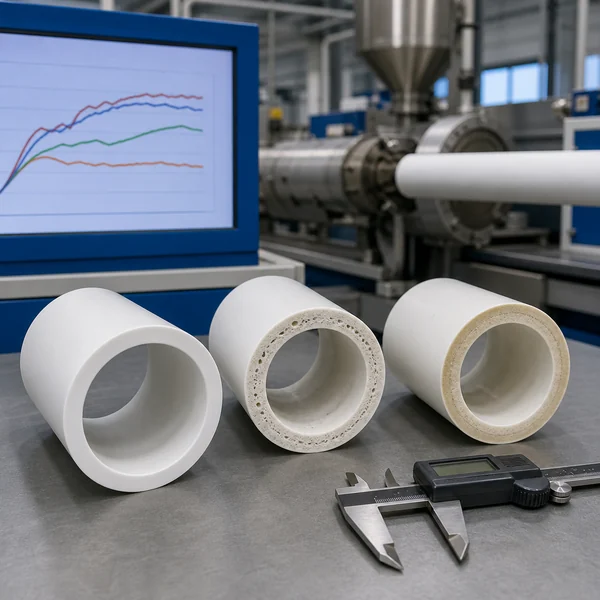
No single measurement proves that a formulation is correct. Use a small set of synchronized indicators.
| Signal | What a change may indicate | What to confirm |
|---|---|---|
| Fusion time | Lubrication, processing-aid, resin, filler, or test-condition shift | Repeatability and full curve shape |
| Fusion and equilibrium torque | Energy demand or melt-viscosity change | Actual mass temperature and sample handling |
| Head pressure and motor load | Feeding, viscosity, restriction, wear, or deposit change | Output and screw speed at the same time |
| Color and surface | Under-fusion, degradation, dispersion, or plate-out | Mechanical tests and equipment cleanliness |
How to qualify a revised PVC pipe formulation
A revised formulation is ready only when it remains stable across an agreed operating range and the finished pipe meets its applicable requirements. Compare start-up, steady-state production, short interruptions, and restart behavior. Include impact, tensile or ring-stiffness tests as appropriate, dimensional checks, appearance, color, and any application-specific compliance testing.
For a supplier trial, provide the application, resin grade, filler type and loading, current additive package, mixing procedure, line configuration, target output, observed defect, process trend, and required test standard. AIMSEA can then evaluate the stabilizer-additive balance against the real operating problem rather than recommending a component from the pipe name alone.
Frequently asked questions
Can higher barrel temperature fix slow PVC fusion?
It can mask slow fusion temporarily, but it may also reduce the thermal-stability margin. Confirm dry-blend consistency, shear, lubrication, processing aid, feeding, and actual melt temperature before making a permanent temperature increase.
Does high extrusion pressure mean the PVC is over-fused?
No. High pressure can also result from low melt temperature, high viscosity, excessive feed, a restricted die, deposits, screen resistance, or mechanical condition. Interpret pressure together with motor load, melt temperature, output, screw speed, and product quality.
Should the stabilizer dosage be changed first?
Not automatically. First determine whether the instability is thermal, rheological, feeding-related, or mechanical. If a stabilizer or one-pack lot is implicated, compare retained and current samples under controlled conditions and adjust the complete lubrication-stabilization balance.
Why does the laboratory fusion result differ from the production line?
Laboratory tests use controlled geometry and conditions, while an extruder adds feeding behavior, screw design, wear, venting, residence-time distribution, die resistance, and scale effects. Use laboratory testing to screen changes, then validate them on the actual line.