

Posted by Ms.Yan
in blog
Technical Engineer
Updated 2026-11-18
How to Improve Thermal Stability in PVC Wood-Plastic Composite Extrusion?
Read:24
Source:
Introduction
PVC wood-plastic composites (PVC WPC) combine polyvinyl chloride (PVC) with wood flour or wood fibers to produce boards, wall panels, ceiling panels and other building materials. Compared with conventional rigid PVC products, these composites require additional attention to raw material preparation, moisture control and extrusion conditions.
One of the main challenges is maintaining thermal stability throughout processing. Excessive heat exposure, uneven material distribution or unsuitable additive combinations can contribute to discoloration, surface defects and inconsistent product quality.
For PVC WPC manufacturers, improving thermal stability requires more than selecting a heat stabilizer. Wood flour characteristics, formulation balance, lubrication and extrusion conditions must also be considered.
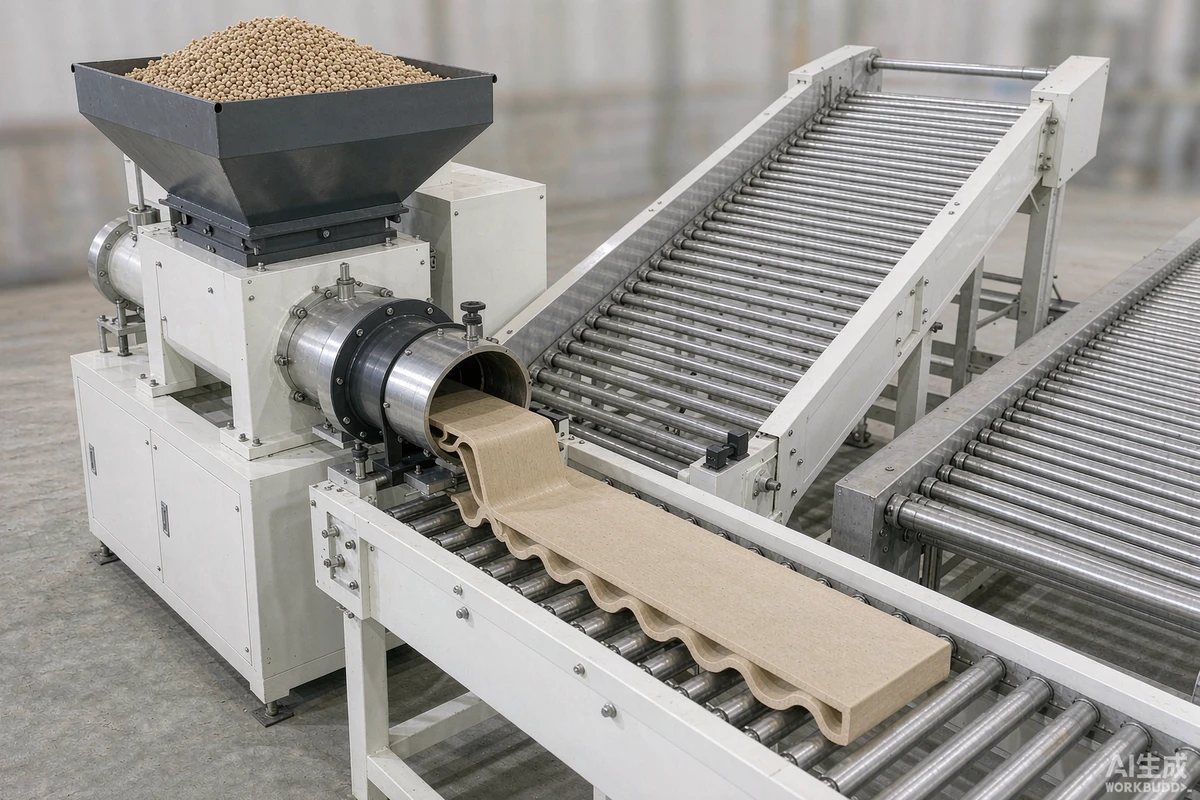
Figure 1. PVC wood-plastic composite wall panel extrusion line, die and formed profile.
1. Why Is Thermal Stability Important in PVC WPC Extrusion?
PVC is sensitive to excessive heat exposure during processing. When thermal degradation occurs, dehydrochlorination can release hydrogen chloride (HCl), followed by the formation of conjugated structures that contribute to discoloration.
In PVC WPC formulations, wood flour introduces additional processing considerations because it has different thermal and moisture characteristics from the PVC matrix.
Several factors make thermal stability particularly important.
1.1 Different Thermal Characteristics of PVC and Wood Flour
PVC and wood flour respond differently to processing temperatures.
PVC requires sufficient heat and mechanical energy to achieve proper fusion, while wood components are sensitive to excessive thermal exposure. Prolonged exposure to unsuitable temperatures can cause wood discoloration, volatile release and deterioration of the composite.
Manufacturers therefore need to balance PVC fusion requirements with the thermal limitations of wood flour.
1.2 Moisture in Wood Flour
Wood flour can absorb moisture from the surrounding environment. If moisture is not adequately controlled before processing, it may contribute to:
- Surface bubbles and voids.
- Uneven material density.
- Poor surface appearance.
- Inconsistent extrusion quality.
Moisture management should therefore be considered before adjusting the stabilizer formulation.
1.3 Processing Temperature and Residence Time
Extrusion temperature, screw speed and material residence time all influence the thermal history of PVC WPC.
Excessive temperature or prolonged residence time may increase the risk of material degradation. However, reducing the temperature too much can also affect PVC fusion and processing stability.
The objective is to establish a suitable processing window rather than simply lowering the temperature.
2. How Do Wood Flour Content and Dispersion Affect PVC WPC Processing?
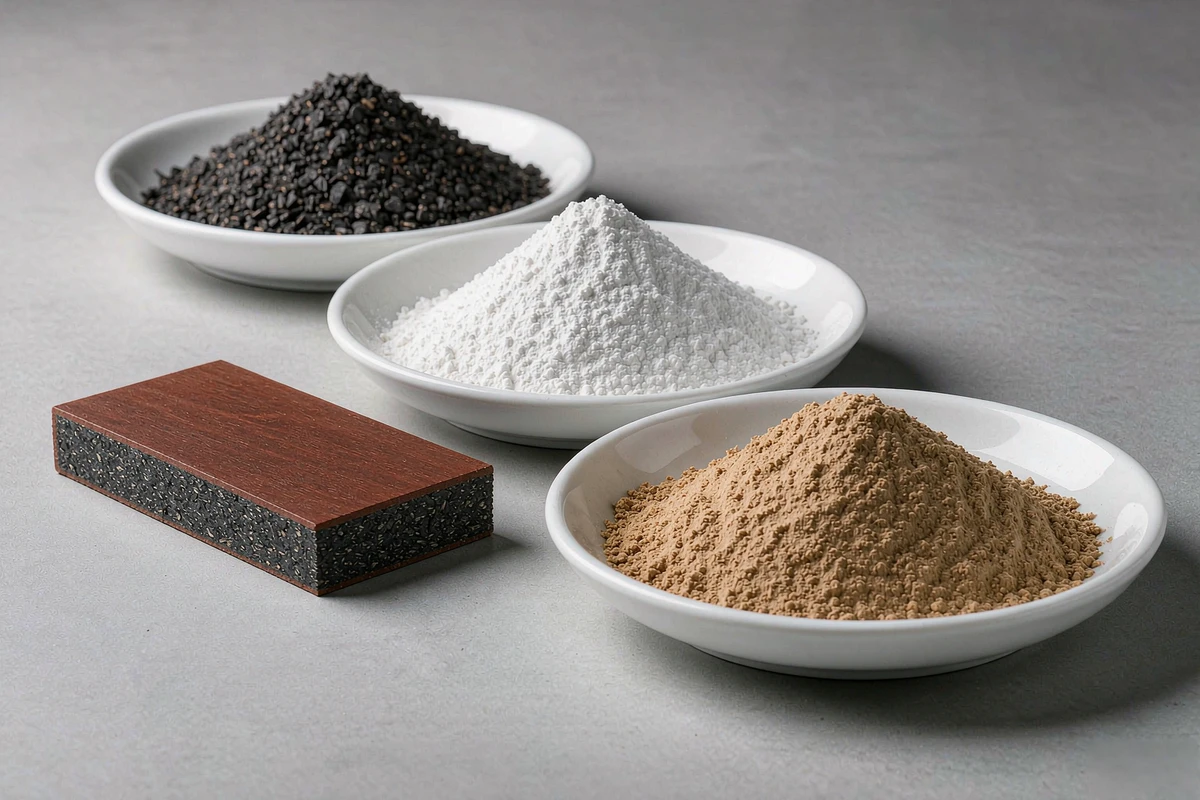
Figure 2. Wood flour, PVC resin and composite granules in WPC formulations.
Wood flour content is an important formulation variable because it affects the proportion of the polymer matrix and the overall processing behavior of the composite.
Increasing wood flour content can change melt viscosity, material flow and the interaction between the wood and PVC phases.
2.1 Wood Flour Content and Melt Flow
A higher wood flour loading generally increases the solid filler content and can make the composite more difficult to process.
Manufacturers may encounter:
- Increased extrusion torque.
- Changes in melt flow.
- Greater difficulty achieving uniform material distribution.
- Changes in surface quality.
The actual effects depend on wood flour characteristics, particle size, moisture content, PVC grade and the additive system.
There is no single wood flour percentage suitable for every PVC WPC application. Formulations should be evaluated according to the target product and extrusion equipment.
2.2 Wood Flour Dispersion
Uniform dispersion is important for achieving consistent material properties.
Poor dispersion may create localized differences in material composition, which can affect surface appearance and product consistency.
A suitable additive system, together with appropriate mixing and processing conditions, helps manufacturers manage these challenges.
2.3 Moisture and Raw Material Preparation
Before extrusion, manufacturers should evaluate the moisture condition, particle size and consistency of the wood flour.
Drying and material preparation requirements should be determined according to the raw material and production process.
These steps are important because a heat stabilizer cannot independently resolve moisture-related defects or poor filler dispersion.
3. Common Thermal Stability Problems in PVC WPC Extrusion
Understanding the symptoms and their possible causes helps manufacturers identify the appropriate corrective actions.
3.1 Yellowing and Discoloration
Yellowing may occur when PVC undergoes thermal degradation or when wood components experience excessive heat exposure.
Possible contributing factors include:
- Excessive processing temperature.
- Long material residence time.
- Inadequate heat stabilization.
- Poorly balanced additive formulations.
Manufacturers should examine the complete processing history rather than assuming that the stabilizer is the only cause.
3.2 Uneven Surface and Material Defects
Bubbles, voids and uneven surfaces may be associated with moisture, insufficient dispersion or unstable extrusion conditions.
Before changing the stabilizer dosage, manufacturers should check wood flour moisture, feeding consistency and material mixing.
3.3 Unstable Extrusion Performance
Changes in extrusion torque, pressure and material flow may indicate formulation or processing imbalances.
Lubrication, PVC fusion behavior, filler loading and equipment conditions should be evaluated together.
A stabilizer adjustment alone may not resolve every extrusion problem.
4. How to Select a Heat Stabilizer for PVC WPC?
Selecting a suitable heat stabilizer requires consideration of the complete formulation and production process.
4.1 Evaluate the PVC WPC Application
Different products may require different processing characteristics.
For example:
- PVC WPC wall panels may require consistent color and surface appearance.
- WPC ceiling panels may require stable extrusion and uniform product dimensions.
- Foamed WPC wallboards require additional attention to foaming behavior and cell uniformity.
The stabilizer should be selected according to the actual product structure and manufacturing requirements.
4.2 Consider Thermal Stability and Processing Performance
A suitable stabilizer should support the required thermal stability during processing.
Other considerations may include:
- Initial color and color retention.
- Processing consistency.
- Compatibility with the lubricant system.
- Interaction with foaming agents and other additives, where applicable.
For foamed WPC products, cell uniformity and foaming performance should also be evaluated.
4.3 Confirm Dosage Through Formulation Trials
Stabilizer dosage should not be determined independently of the complete formulation.
PVC resin grade, wood flour loading, filler content, lubricant balance and processing conditions can all influence the required dosage.
Manufacturers should follow the supplier's recommended dosage as a starting point and confirm the final formulation through production trials.
5. AIMSEA PVC Stabilizer Solutions for WPC Applications
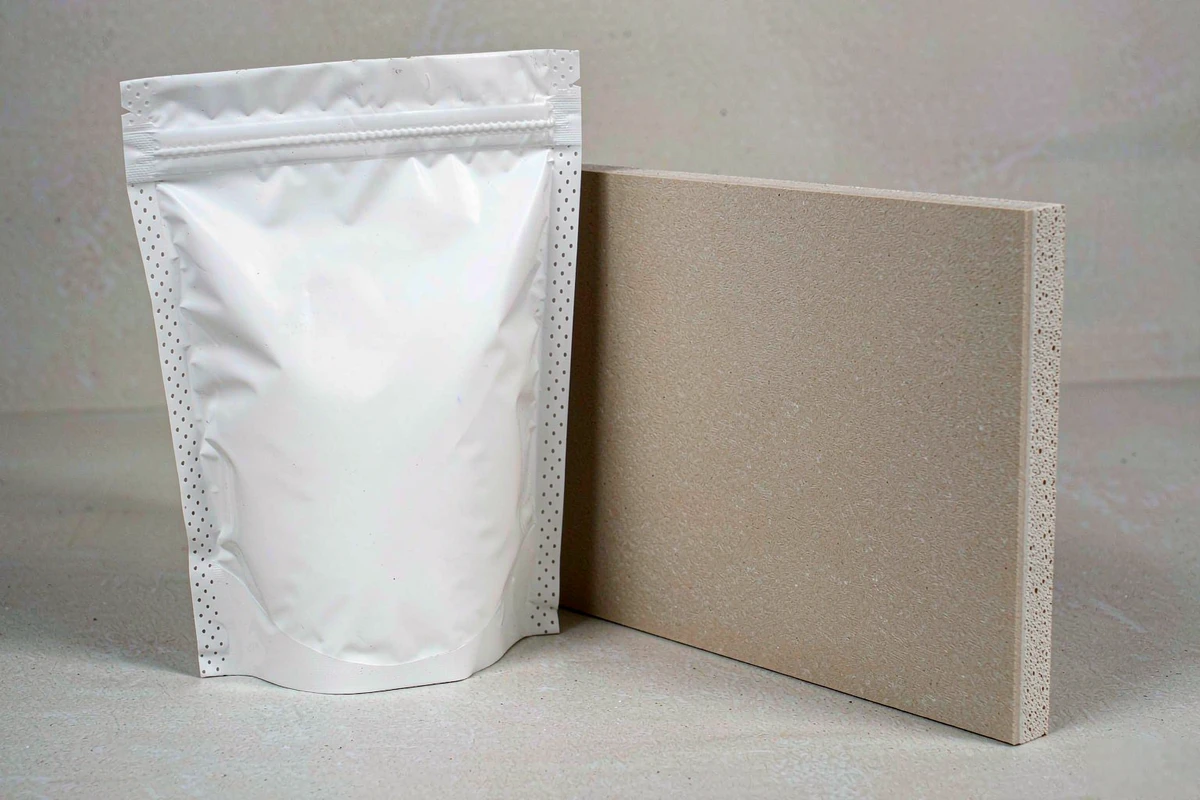
Figure 3. PVC heat stabilizer powder sample and a foamed WPC wallboard.
AIMSEA develops and manufactures non-toxic PVC stabilizers for different processing and application requirements, including building materials, profiles, pipes, cables and other PVC products.
For wood-plastic composite applications, AIMSEA provides stabilizer options designed for relevant wallboard and building material formulations.
AIMSTA-5141 for WPC and Foaming Wallboards
AIMSTA-5141 is a powder-form PVC stabilizer listed for WPC and foaming wallboard applications.
Its product specifications highlight:
- Good thermal stability.
- Excellent foaming properties.
- Good uniformity of foam cells.
- Environmentally friendly formulation.
- Heavy-metal-free characteristics.
Recommended dosage: 4–6 PHR.
The dosage should be evaluated against the actual formulation, raw materials and production conditions before commercial production.
Matching Stabilizers to Different PVC Applications
AIMSEA also offers other application-specific stabilizer grades.
For example, AIMSTA-8161 is listed for wood-plastic wall panels and ceiling panels, with good thermal stability.
Different product grades should be evaluated according to their intended application rather than treated as interchangeable.
Manufacturers can discuss their PVC resin, wood flour content, product structure and extrusion requirements with AIMSEA to identify a suitable stabilizer option.
6. How to Evaluate Thermal Stability During Production?
Selecting a stabilizer is only one part of the formulation process. Manufacturers should also establish a consistent evaluation procedure.
The following checks can help assess PVC WPC processing performance.
Thermal stability testing
Evaluate the material's resistance to thermal degradation under defined test conditions. Static thermal stability testing can help compare discoloration behavior over time.
Extrusion performance
Monitor extrusion torque, pressure, material flow and production consistency under controlled conditions.
Product appearance
Check color uniformity, surface quality, bubbles, voids and other visible defects.
Formulation comparison
When changing stabilizer grades or dosages, compare samples under consistent raw material and processing conditions.
These evaluations help manufacturers distinguish between formulation-related problems and issues caused by moisture, equipment or processing conditions.
Conclusion
Improving thermal stability in PVC wood-plastic composite extrusion requires a balanced approach to raw material preparation, formulation design and processing control.
Wood flour content, moisture, dispersion, lubrication and extrusion conditions all influence the final processing performance. A suitable PVC heat stabilizer helps support thermal stability, but it must work as part of the complete additive system.
For manufacturers producing PVC WPC wall panels, ceiling panels and foaming wallboards, AIMSEA provides application-specific stabilizer options, including AIMSTA-5141 and AIMSTA-8161.
Looking for a suitable PVC stabilizer for your WPC production?
Share your PVC formulation, wood flour content, target product and extrusion requirements with AIMSEA. Our team can help evaluate a suitable stabilizer solution for your application.