

Posted by Ms.Yan
in blog
Technical Engineer
Updated 2026-10-29
What Causes Fish Eyes in Clear PVC Film and Sheet?
Read:11
Source:
Small cloudy spots, raised particles, or circular distortions can make an otherwise transparent PVC film or sheet unacceptable. These defects are often described as fish eyes, although not every visible spot has the same origin.
Some fish eyes are PVC resin particles that have failed to fuse properly. Others may be associated with contamination, poorly dispersed ingredients, degraded material, or inconsistent processing. The distinction matters because increasing extrusion temperature or changing stabilizer dosage will not solve every type of defect.
For manufacturers of clear PVC film and sheet, effective troubleshooting begins with identifying the particles, reviewing material changes, and separating fusion problems from formulation or equipment issues.
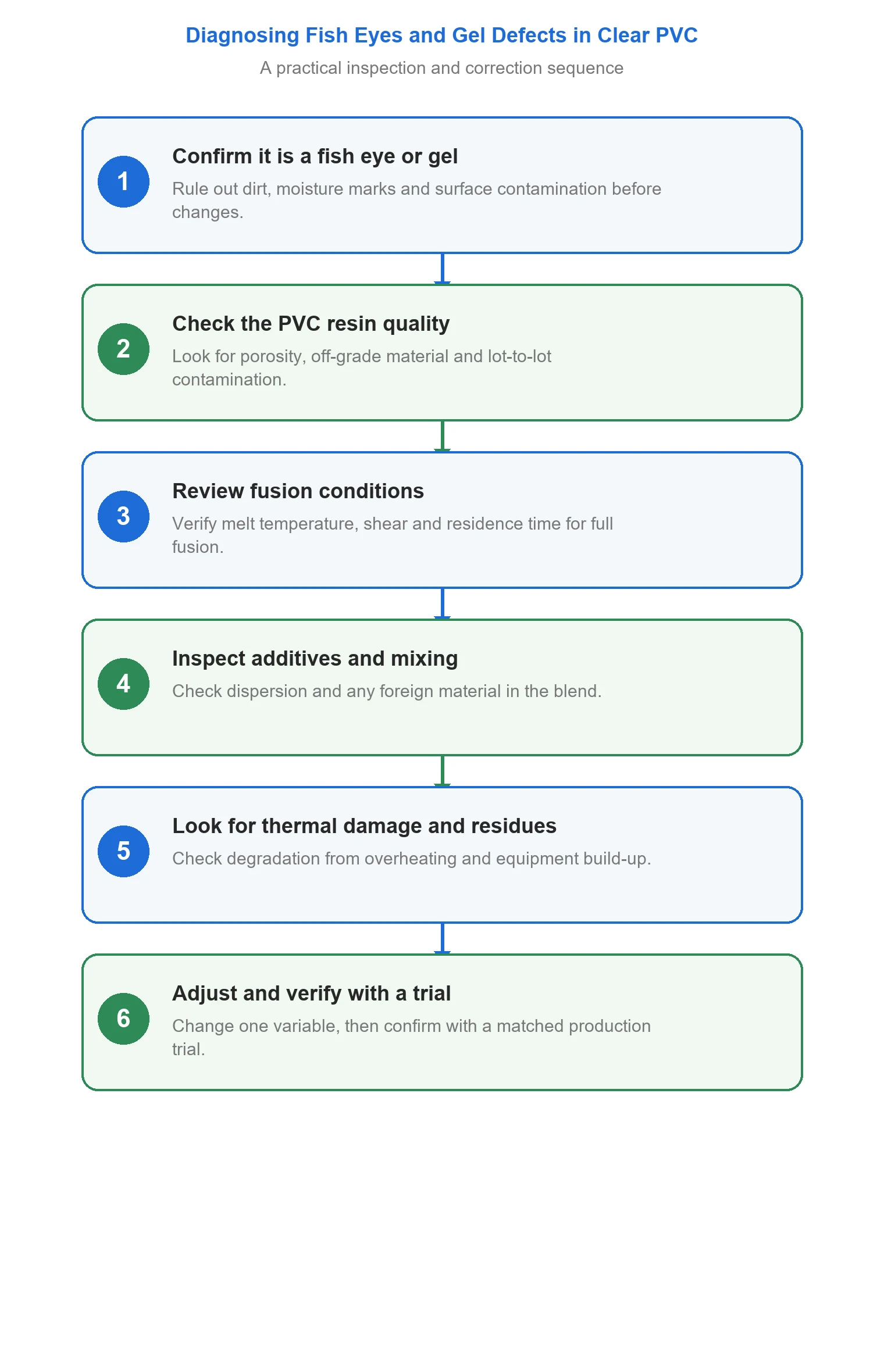
Figure 1. A practical inspection and correction sequence for fish eyes and gel defects in clear PVC film and sheet.
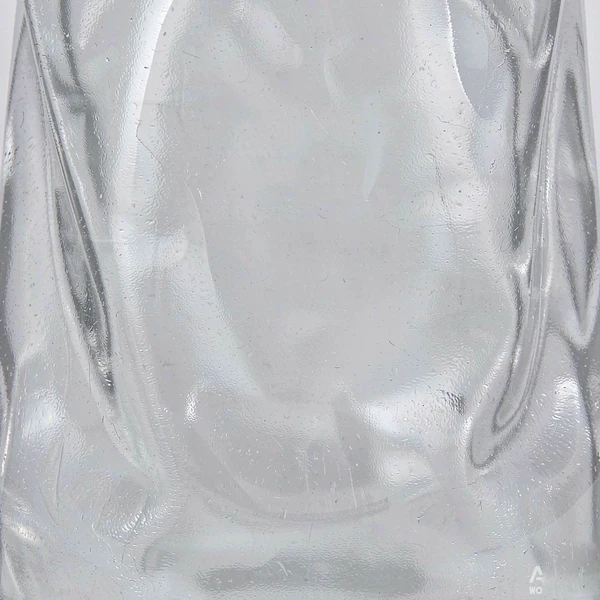
Figure 2. Macro view of a smooth transparent clear PVC film surface under studio lighting.
Quick Answer
Fish eyes in PVC are commonly associated with resin particles that do not fully fuse under processing conditions. Similar-looking defects may also result from contamination, additive agglomerates, or degradation. To reduce them, manufacturers should identify the defect source, check resin and mixing quality, and verify processing changes through controlled trials.
Key Takeaways
- Not every visible spot is a PVC resin fish eye. Contamination, additive agglomerates, and degradation can produce similar defects.
- Resin characteristics matter. Particle structure, porosity, grade consistency, and cross-contamination can influence fish-eye formation.
- Processing conditions must be evaluated together. Temperature, shear, residence time, and lubrication affect PVC fusion.
- A stabilizer change is not always the solution. Heat stabilizers help protect PVC against degradation but cannot correct every unfused particle or contaminant.
- Controlled testing is essential. Compare the defect type and frequency before and after formulation or process changes.
What Are Fish Eyes in Clear PVC Film and Sheet?
In PVC processing, a fish eye commonly refers to a resin particle that remains incompletely fused within the surrounding material. In a transparent film or sheet, the particle may appear as a pale spot, small bump, translucent inclusion, or localized optical distortion.
The defect can be more noticeable in transparent products because the surrounding material does not conceal small variations in structure or appearance.
The term is sometimes used more broadly on production lines to describe different spots, gels, or particles. However, an unfused PVC resin grain is not necessarily the same as a filler agglomerate, degraded residue, or foreign contaminant.
This distinction is supported by ASTM D3596-26, a standard practice for determining gels or fish eyes in general-purpose PVC resins. The standard describes PVC resin fish eyes in terms of hard particles that do not fuse under specified hot-processing conditions [1].
A film may therefore contain defects arising from the resin itself, while another film with a similar appearance may have a mixing or equipment-related problem.
Correct identification is the starting point for an effective solution.
What Causes Fish Eyes and Gel Defects in PVC?
Several factors can cause or resemble fish-eye defects in clear PVC products. The most relevant are resin fusion behavior, material contamination, additive distribution, and processing conditions.
Incomplete PVC Fusion
PVC particles require sufficient heat and mechanical action to develop into a fused material during processing.
When the processing conditions do not provide adequate fusion, some resin grains can remain visible in the finished product.
Potential contributing factors include unsuitable temperature settings, insufficient shear, limited residence time, excessive external lubrication, or an inappropriate resin grade for the process.
However, increasing barrel or roll temperatures is not always the correct response. Higher temperatures can also increase the risk of PVC degradation if the stabilizer system and residence time are not suitable.
The appropriate adjustment depends on where fusion is occurring and how the compound responds under actual operating conditions.
Resin Porosity and Grade Contamination
Some fish-eye problems originate in PVC resin characteristics rather than the extrusion equipment.
Suspension PVC resin particles have a structure that affects their ability to absorb plasticizers and other formulation ingredients. Poorly absorbing or unusually dense resin particles may resist fusion under conditions suitable for the surrounding material.
Cross-contamination between resin grades can also create problems.
For example, particles of a higher-molecular-weight PVC grade may fail to fuse properly when processed under conditions selected for a lower-molecular-weight resin.
Specialist PVC resin technical literature identifies differences in particle porosity and cross-contamination as possible causes of persistent fish eyes [2].
When defects appear after a resin supplier or batch change, manufacturers should compare the new material with retained samples from a previously successful production run before changing the stabilizer formulation.
Poor Additive Dispersion and Contamination
Not every spot in a transparent PVC film is an unfused resin particle.
Poorly dispersed pigments, filler agglomerates, foreign particles, or incompatible formulation components may produce similar visible defects.
Contaminated recycled material or residues remaining in mixing and conveying equipment can introduce additional variation.
In flexible PVC formulations, incomplete plasticizer absorption or inconsistent mixing may also contribute to uneven fusion and localized defects.
The relevant investigation should consider the raw materials, mixing sequence, ingredient distribution, and processing equipment.
A visible defect should not automatically be classified as a stabilizer problem without examining these other possibilities.
Thermal Degradation and Equipment Residues
PVC exposed to unsuitable thermal conditions can undergo degradation, producing discoloration and changes in material properties.
Material retained in poorly swept sections of processing equipment may also experience prolonged thermal exposure.
When degraded residues detach and enter the main material flow, they may appear as dark specks or inclusions in the finished product.
These should be distinguished from pale, incompletely fused resin particles.
A rising number of dark defects during extended production can justify investigating residence time, equipment cleanliness, temperature control, and the stabilizer system.
How Can You Identify the Source of a PVC Fish-Eye Defect?
Visual appearance alone cannot always identify a defect, but it provides a useful starting point.
A systematic investigation should document defect size, color, shape, hardness, distribution, and frequency before making formulation changes.
| Observed Defect | Possible Explanation | Initial Investigation |
|---|---|---|
| Pale or translucent raised grain | Incompletely fused PVC particle | Resin grade, fusion behavior, processing conditions |
| Hard white speck | Resin particle or filler agglomerate | Particle examination, raw-material comparison |
| Dark brown or black inclusion | Degraded residue or foreign contamination | Equipment cleanliness, thermal exposure |
| Localized cloudy spot | Uneven fusion or ingredient distribution | Mixing quality, plasticizer absorption, formulation |
| Defects appearing after a resin change | Resin variation or cross-contamination | Retained resin samples, batch records |
| Defects increasing during continuous production | Material retention, degradation, or deposit accumulation | Time-based defect records, equipment inspection |
These observations indicate possible causes rather than definitive diagnoses. Microscopic examination and comparative testing may be needed.
A particularly useful question is whether the defect occurs consistently from the beginning of production or develops after the line has operated for some time.
If the spots appear immediately after changing resin batches, material characteristics deserve attention. If the defect frequency increases during continuous operation, equipment-related degradation or deposit formation may be more relevant.
Defect distribution can also help. Consistent defects across the full film width may suggest a different investigation from marks concentrated in one repeatable location.
The objective is to narrow the likely source before changing several processing variables.
Can PVC Stabilizers Help Prevent Fish Eyes?
PVC stabilizers play an important role in processing clear PVC, but their effect on fish-eye defects must be understood correctly.
A transparent PVC stabilizer helps protect the compound against thermal degradation and supports the required color and appearance performance under suitable processing conditions.
However, heat stabilization is not the same as resin fusion.
A stabilizer cannot automatically eliminate defective PVC resin grains, foreign particles, or poorly dispersed fillers.
In some formulations, changing a stabilizer package can indirectly influence fusion or surface quality because the package may also contain lubricating or other functional components.
For example, a calcium-zinc one-pack system may contribute both thermal protection and selected lubrication functions. Changing that package could therefore alter the overall lubrication balance and processing behavior.
If the lubricant balance changes, the fusion response may also change.
This is why manufacturers should compare the complete additive packages rather than assuming that a new heat stabilizer will directly remove fish eyes.
For clear PVC film and sheet, stabilizer selection should consider thermal stability, color retention, compatibility, dispersion, and the specific manufacturing process.
How to Reduce Fish Eyes During PVC Film and Sheet Production
The most effective troubleshooting method is to change only those variables that are supported by the initial diagnosis.
If the defect is associated with resin variation, changing extrusion temperature or stabilizer dosage may not address the cause. If the defect is related to inadequate fusion, reviewing temperature, shear, lubrication, and residence time may be appropriate.
A practical investigation begins with a stable reference batch and a record of when the defect first appeared.
Manufacturers should compare the current resin, formulation, and processing conditions against the reference. Where possible, defect samples should be examined to distinguish unfused resin from contamination or agglomerates.
Candidate changes can then be tested under comparable operating conditions.
Control Material and Mixing Consistency
Raw-material selection is an important first stage.
For transparent PVC, consistency in resin grade, relevant particle characteristics, and ingredient quality can help reduce variability.
In flexible compounds, plasticizer incorporation and additive distribution also require attention.
When changing suppliers or additive grades, manufacturers should retain samples from both the previous and replacement materials for comparison.
Adjust Processing Conditions Carefully
Temperature, shear, residence time, and lubrication affect PVC fusion, but changing several parameters simultaneously can make the result difficult to interpret.
If incomplete fusion is suspected, evaluate the existing processing window before increasing temperature.
For calendering, relevant variables may include compound preparation, roll conditions, material temperature, and the behavior of the formulation through the process.
For extrusion, screw mixing, temperature profile, residence time, and material flow may require review.
Processing adjustments should improve the target defect without causing unacceptable yellowing, degradation, or surface deposits.
Verify the Improvement Through Testing
Defect reduction should be confirmed quantitatively where practical.
Useful observations include defect count per defined film area, particle size distribution, defect appearance, fusion behavior, heat stability, and finished-product transparency.
A consistent inspection method is particularly important when comparing results across production trials.
For resin-related fish eyes, ASTM D3596-26 provides a relevant standardized testing reference under specified processing conditions [1]. Its use and applicability should be determined according to the resin and evaluation objective.
A laboratory test may identify a promising change, but representative production trials are still needed to confirm the effect under normal manufacturing conditions.
How AIMSEA Supports Clear PVC Formulation Evaluation
For manufacturers producing transparent PVC products, the stabilizer system should be evaluated as part of the complete formulation rather than treated as a universal remedy for every visible defect.
AIMSEA develops calcium-zinc PVC stabilizers and application-specific additive solutions for transparent PVC manufacturing, including clear hoses, transparent molded components, and specialty products requiring clarity and stable processing.
Its product range includes powder and paste-form stabilizers intended for different formulations and production requirements.
Application-Specific Clear PVC Stabilizer Options
For transparent PVC applications, AIMSEA offers products such as AIMSTA-6809T, a powder-form calcium-zinc stabilizer positioned for transparent flexible hose extrusion, where clarity, formulation compatibility, and processing consistency are important.
AIMSTA-6122 is a paste-form option for selected transparent hoses, molded products, and related formulations where dispersibility and surface appearance matter.
AIMSEA also supplies application-specific stabilizers for other transparent PVC products, including specialty light-strip materials.
These product directions do not mean that a particular stabilizer will eliminate fish eyes in every clear PVC film or sheet.
Instead, they provide candidates for formulation evaluation when the defect investigation indicates that additive compatibility, stabilization, or processing balance requires attention.
For PVC film and sheet manufacturers, the appropriate grade must be confirmed against the actual resin, plasticizer or lubricant system, manufacturing method, and finished-product requirements.
What to Share for a Technical Review
A manufacturer experiencing fish-eye defects should provide more than a description of the visible spots.
Useful information includes the product type, resin grade and batch, existing stabilizer package, plasticizer and lubricant levels, mixing process, production conditions, and the point at which the defects appear.
Photographs or retained samples of defective and acceptable material can help establish whether the problem is more likely related to resin fusion, dispersion, contamination, or thermal processing.
AIMSEA can then discuss relevant stabilizer options and sample evaluation requirements where the technical findings indicate a formulation-related concern.
The goal is to select an additive system that supports the required heat stability and appearance performance without overlooking the actual cause of the defect.
Frequently Asked Questions About PVC Fish Eyes
Are fish eyes and gels the same thing in PVC?
The terms are often used together, but they should be defined carefully. In PVC resin testing, fish eyes commonly refer to particles that do not fuse under specified processing conditions. Other gel-like or visible inclusions may have different origins.
Can changing the PVC resin eliminate fish eyes?
It may help when the problem is associated with resin characteristics, poorly fusing particles, or cross-contamination. A controlled comparison is needed before attributing the problem to the resin.
Will increasing PVC processing temperature remove fish eyes?
Not necessarily. Higher temperature may improve fusion in some cases, but it can also increase thermal degradation. Temperature changes should follow a diagnosis of the defect and the processing conditions.
Can excess lubricant cause fish eyes in PVC?
Excessive external lubrication may delay PVC fusion under certain conditions, potentially contributing to incompletely fused particles. The effect depends on the formulation, lubricant chemistry, and equipment.
Can a transparent PVC stabilizer eliminate fish-eye defects?
Not automatically. A suitable stabilizer supports heat stability and appearance, but it cannot reliably remove contamination, defective resin particles, or filler agglomerates. Its effects should be assessed in the complete formulation.
How should fish-eye defects be measured in PVC?
Manufacturers can use consistent visual inspection, defect counts over a defined area, microscopy where appropriate, and controlled processing tests. ASTM D3596-26 is a specific standard practice relevant to gels or fish eyes in general-purpose PVC resins.
Conclusion
Fish eyes in PVC film and sheet can result from incomplete resin fusion, resin variability, contamination, poor dispersion, or unsuitable processing conditions.
Although these defects may appear similar, they do not always have the same cause. Effective troubleshooting begins by identifying the particle type, reviewing material and process changes, and comparing controlled trials.
PVC stabilizers can support thermal stability, color retention, and formulation compatibility, but should not be treated as a substitute for proper fusion, material quality, or equipment control.
AIMSEA offers application-specific calcium-zinc stabilizers and technical support for transparent PVC formulations, helping manufacturers evaluate suitable stabilization options when additive performance is relevant to the observed problem.
Experiencing visible defects in clear PVC products?
>Contact AIMSEA with your product type, formulation details, processing conditions, and defect observations to discuss appropriate stabilizer evaluation and sample testing.
References
[1] ASTM International — ASTM D3596-26, Standard Practice for Determination of Gels (Fisheyes) in General-Purpose Poly(Vinyl Chloride) (PVC) Resins
Updated March 10, 2026. Defines a method for evaluating unfused resin particles under specified PVC processing conditions.
https://store.astm.org/d3596-26.html
[2] Chemical Associates — Elimination of Fish-Eyes During the Production of Suspension PVC
Technical discussion of resin particle structure, porosity, PVC grade cross-contamination, and the formation of incompletely fused resin particles.
https://chemical-associates.co.uk/the-elimination-of-fish-eyes-in-suspension-pvc.php