
PVC Profile Stabilizer Selection: Initial Whiteness, Weld Strength and Weatherability
Read:290
Source:
Abstract
For PVC profile manufacturers, stabilizer selection should not stop at heat stability or dosage. A suitable PVC profile stabilizer should support initial whiteness, extrusion stability, weld strength, surface quality and long-term weatherability. These performance indicators are closely connected with the stabilizer system, lubricant balance, TiO₂ interaction, processing window and outdoor durability requirements.
This guide explains how a PVC heat stabilizer affects key PVC profile performance indicators. It also provides an “indicator–influencing factor–selection advice–test method” structure to help buyers evaluate stabilizer options more clearly before sample testing or bulk approval.
Why PVC Profile Stabilizer Selection Should Start from Performance Indicators?
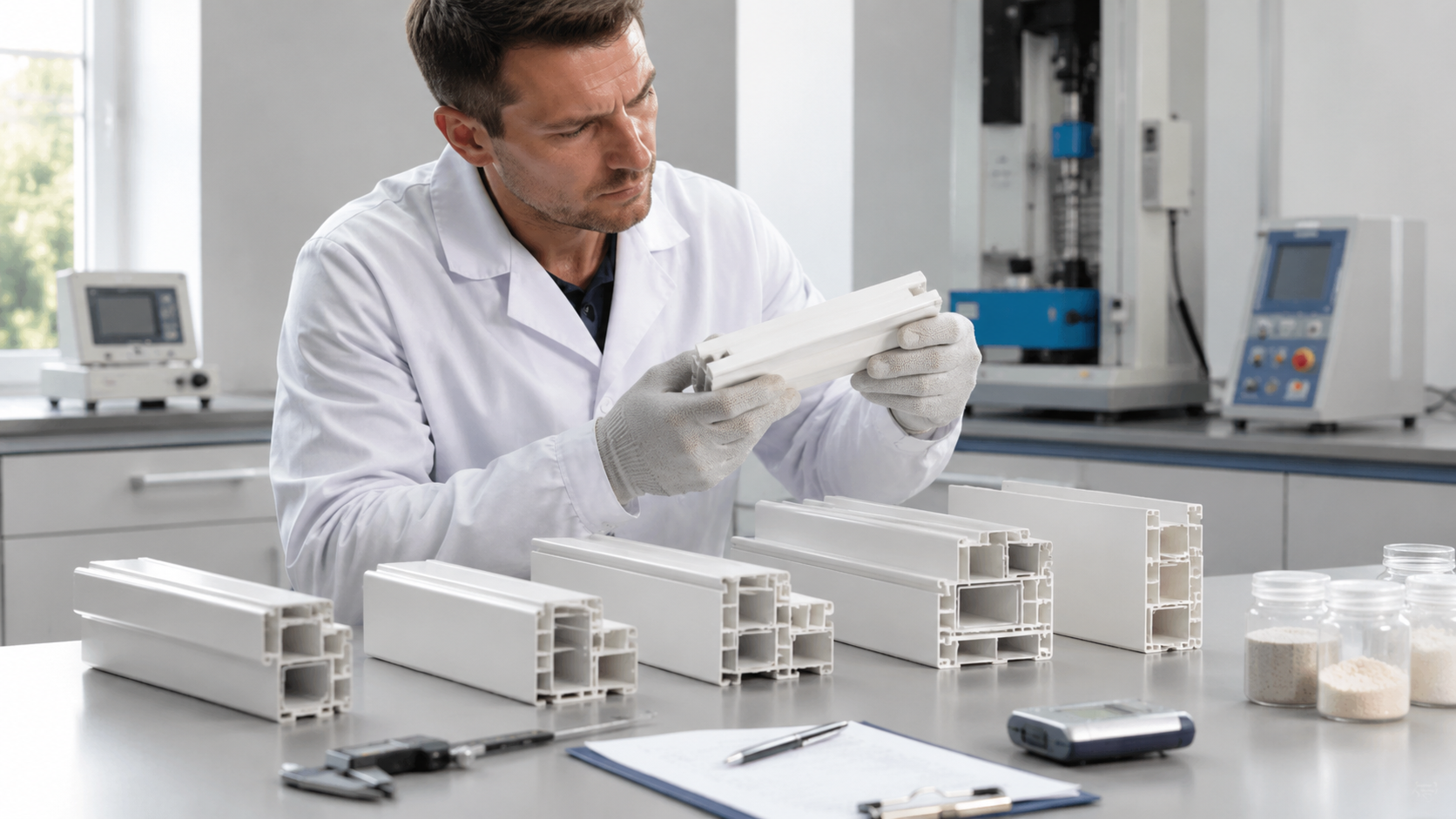
A PVC profile stabilizer should be selected according to the final performance targets of the profile, not only according to stabilizer type or unit price. For PVC window and door profiles, buyers usually care about initial whiteness, long-run color stability, weld strength, impact performance, extrusion surface, dimensional stability and outdoor weatherability.
A stabilizer that performs well in a simple heat stability test may still fail if the profile shows weak weld corners, yellowing after extrusion, rough surface, poor weather resistance or unstable production. This is why profile stabilizer selection should begin with measurable indicators.
How PVC profile stabilizer affects extrusion and final profile quality?
During PVC profile extrusion, the stabilizer protects PVC from heat degradation. However, it also interacts with lubricants, fillers, TiO₂, processing aids and impact modifiers.
If the stabilizer package is not balanced, the profile may show:
Poor initial whiteness
Yellowing during long production runs
Rough or dull surface
Plate-out or die build-up
Poor fusion
Weak weld strength
Lower outdoor durability
For this reason, the stabilizer package should be evaluated together with the full formula and real processing conditions.
Why profiles need balanced whiteness, weld strength and weatherability?
A formula that gives excellent initial whiteness may still fail if weld strength is low. A formula with strong fusion may still have poor weatherability if the UV package is weak. A formula with high weatherability may still be rejected if extrusion is unstable or the surface turns yellow during long runs.
For PVC profiles, the best stabilizer choice is usually a balance between color, processing, mechanical strength and outdoor durability.
Indicator 1: Initial Whiteness and Color Stability in PVC Profiles
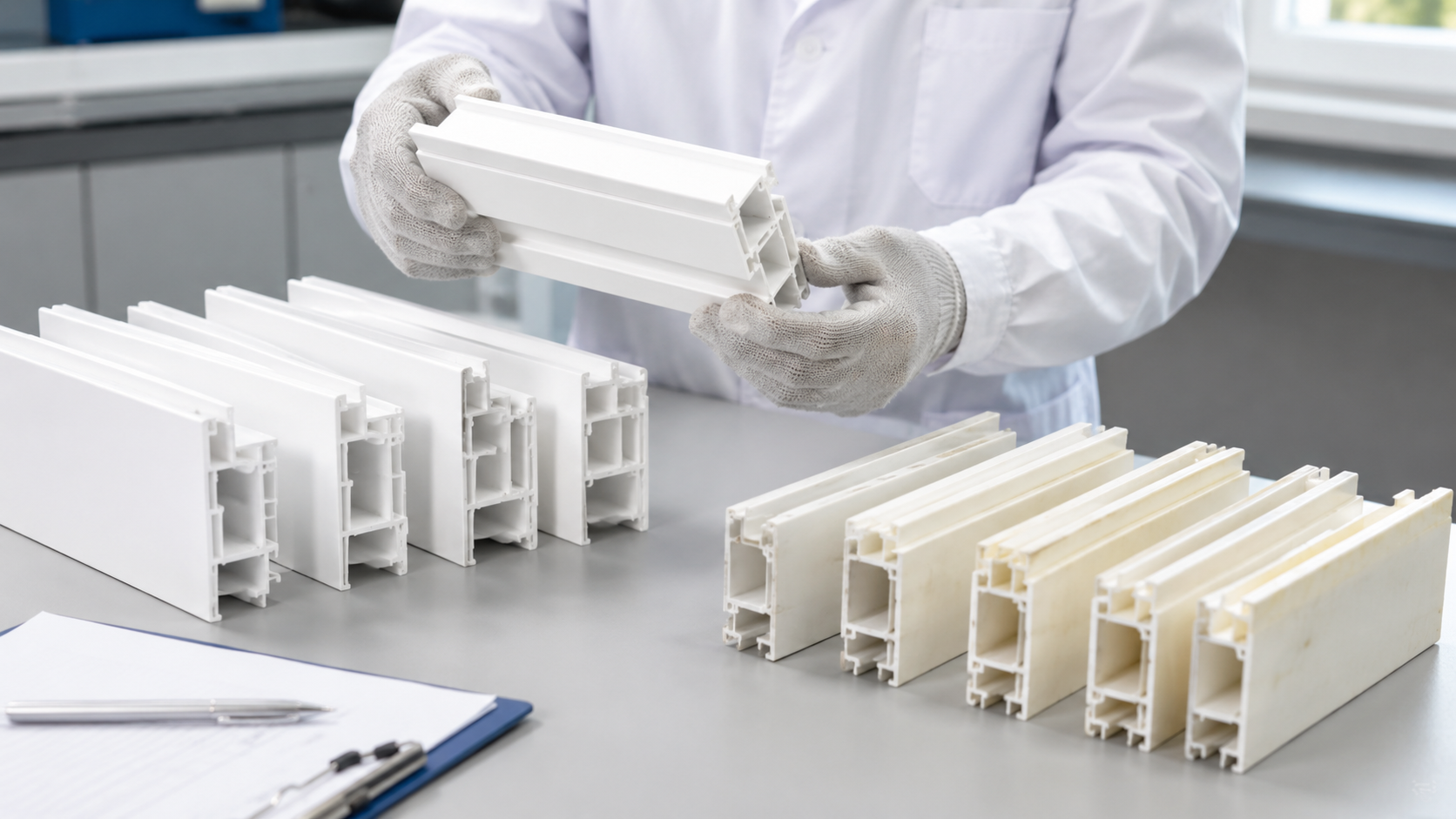
PVC profile whiteness is one of the first quality indicators customers notice. A white profile should maintain clean initial color after extrusion and avoid visible yellowing during production, welding, storage or outdoor use.
What affects PVC profile whiteness during extrusion?
Initial whiteness is affected by several factors:
Stabilizer system
TiO₂ type and dosage
Lubricant balance
Processing temperature
Residence time
PVC resin grade
Filler quality
Screw speed and output rate
If the stabilizer does not control early color well, the profile may shift from bright white to cream or yellow. If the processing temperature is too high or the residence time is too long, even a good stabilizer may not fully prevent color change.
How to choose a PVC heat stabilizer for better initial color?
A suitable PVC heat stabilizer for profiles should provide good early color and stable long-run performance. Buyers should not only compare the first extrusion sample. They should also record color after continuous production, welding, heat aging and storage.
Suggested evaluation points include:
Initial whiteness value
Yellowing index
Heat aging performance
Color change after long extrusion
Surface gloss and uniformity
Color change after welding
Batch-to-batch consistency
For white profiles, a calcium zinc stabilizer should be tested with the actual TiO₂, filler and lubricant system because these materials strongly influence final whiteness.
Indicator 2: Weld Strength and Fusion Balance
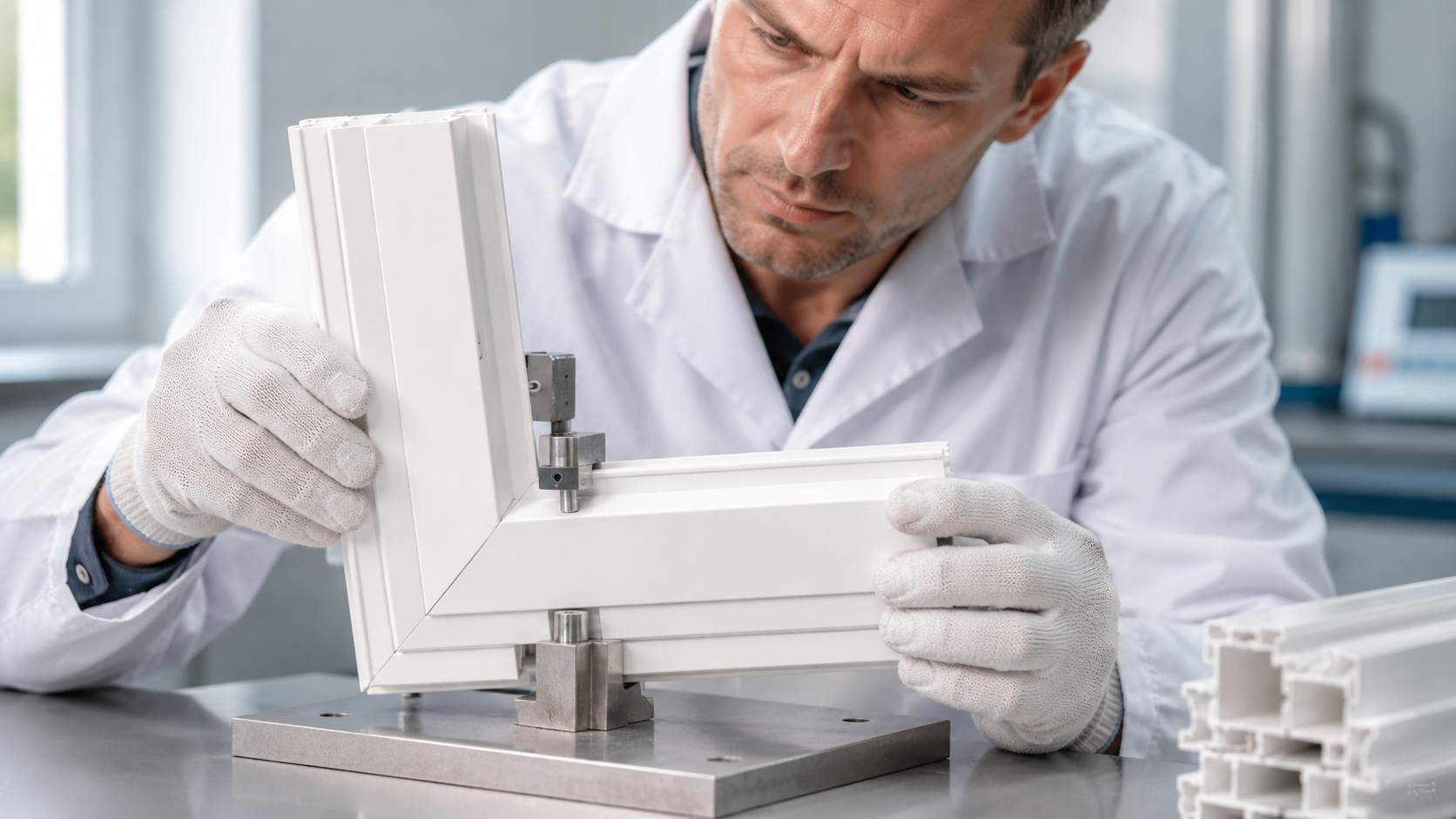
PVC weld strength is critical for window and door profiles because welded corners must maintain mechanical strength after fabrication. If the extrusion formula has poor fusion or excessive lubrication, the profile may weld poorly even if the stabilizer shows good heat stability.
Why PVC weld strength depends on more than welding temperature?
Weld strength is affected by welding temperature, welding time, welding pressure, profile geometry, fusion level, formulation and surface condition. From a stabilizer perspective, the key issue is fusion balance.
If the formula is under-fused, the material may not form a strong weld. If the formula is over-lubricated, the welding interface may be weakened. If the extrusion temperature is too high, local degradation may reduce mechanical strength.
This means weak weld strength should not be solved only by changing welding parameters. The stabilizer, lubricant system and extrusion condition should also be reviewed.
How stabilizer and lubricant balance influence profile weldability?
A PVC stabilizer package for profiles usually includes heat stabilization and lubrication support. Internal and external lubricants must be balanced so that the profile extrudes smoothly but still reaches proper gelation.
Too much external lubrication may improve die release but delay fusion. Too little lubrication may increase torque, surface roughness and heat build-up. A well-designed Ca-Zn stabilizer should support stable fusion, clean surface and enough weldability for downstream fabrication.
When evaluating weldability, profile manufacturers should check:
Fusion level
Surface condition before welding
Weld corner strength
Break position after testing
Welding temperature and pressure
Effect of stabilizer and lubricant adjustment
Indicator 3: Weatherability and UV Resistance for Outdoor Profiles
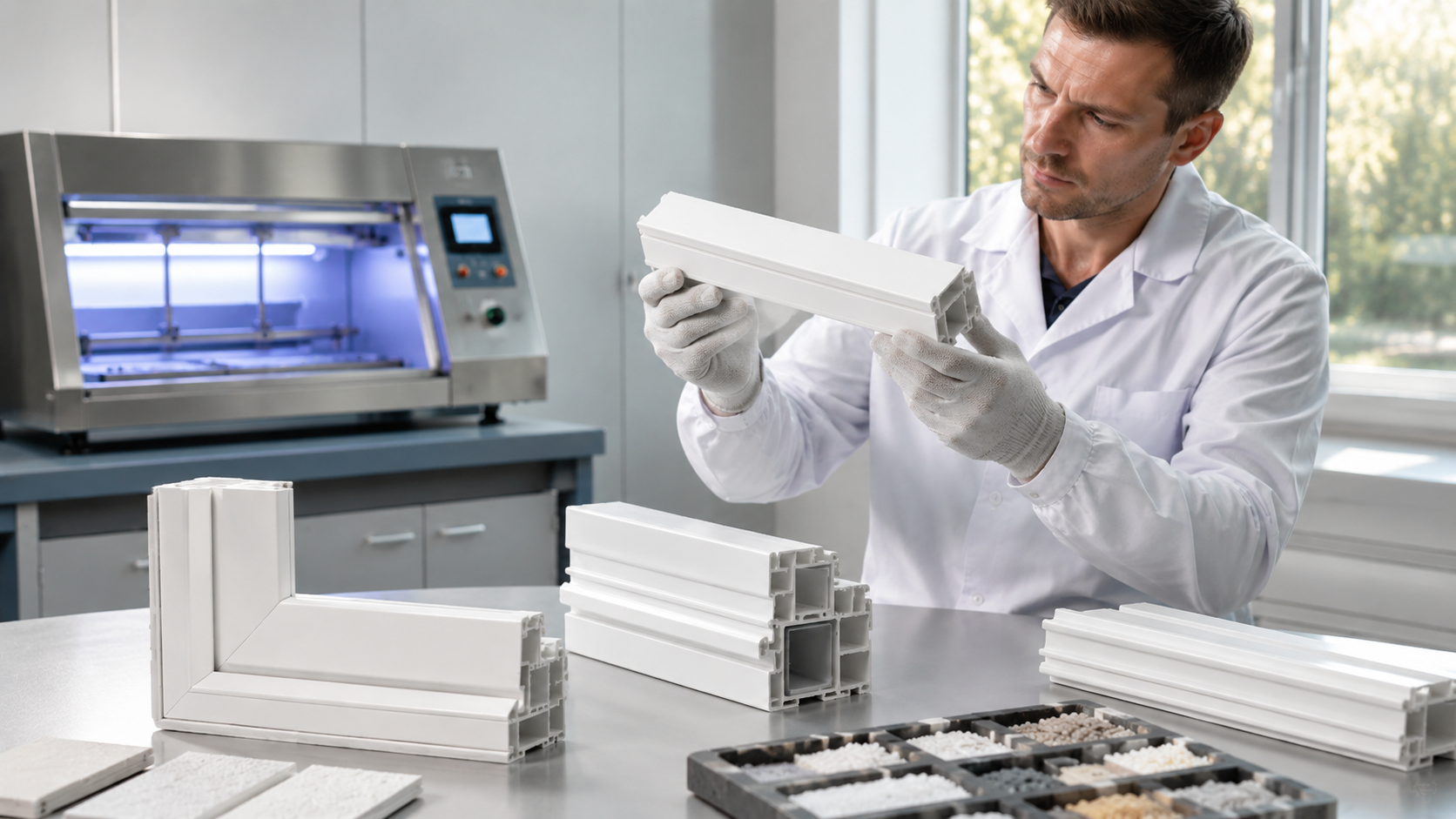
Outdoor profiles face sunlight, heat, rain, humidity and temperature cycles. PVC profile weatherability depends on the full formulation, including stabilizer, TiO₂, UV additives, impact modifier, filler and pigment system.
How PVC profile weatherability depends on stabilizer, TiO₂ and UV package?
The stabilizer helps protect PVC during processing, while TiO₂ and UV additives help protect the finished profile during outdoor exposure. If the profile is under-stabilized during extrusion, early degradation may reduce long-term weatherability. If TiO₂ dispersion or UV protection is weak, the surface may chalk, fade or lose impact strength faster.
A good outdoor profile formula should consider:
Heat stability during extrusion
Initial whiteness
TiO₂ quality and dispersion
UV protection system
Impact modifier compatibility
Surface gloss retention
Color change after exposure
Mechanical property retention
For export markets, a lead-free PVC stabilizer direction is also important when customers request safer additives, REACH/RoHS support or heavy metal control.
How to test weather resistance for PVC window profiles
Weatherability should not be judged only by visual appearance. Profile manufacturers should use structured tests to evaluate color retention, surface change and mechanical performance after exposure.
Common weatherability evaluation items include:
Artificial weathering
UV exposure
Xenon lamp exposure
Color difference before and after exposure
Gloss retention
Surface chalking
Impact strength retention
Weld strength after aging
The test method should match the final market and customer requirement. Outdoor profiles need stronger weatherability evaluation than indoor decorative profiles.
Indicator-Based Selection Table for PVC Profile Stabilizer
The following structure helps buyers evaluate a PVC window profile stabilizer more clearly.
Performance Indicator | Main Influencing Factors | Selection Advice | Suggested Test Method |
Initial whiteness | Stabilizer early color, TiO₂, temperature, residence time | Choose a stabilizer with good early color and low yellowing tendency | Whiteness value, yellowing index, visual comparison |
Long-run color stability | Heat stability, die residence time, screw speed, lubricant balance | Test after continuous extrusion, not only the first sample | Oven aging, heat exposure, production run observation |
Weld strength | Fusion level, lubricant balance, welding parameters, surface condition | Avoid over-lubrication and poor gelation | Weld corner strength test, failure load test |
Weatherability | Stabilizer, TiO₂, UV package, impact modifier, pigment | Match stabilizer with outdoor durability requirement | Artificial weathering, UV exposure, color difference test |
Surface finish | Lubricant balance, filler dispersion, die cleanliness | Check plate-out, gloss and roughness | Long-run extrusion, die deposit observation |
Dimensional stability | Fusion, cooling, filler level, heat reversion | Match stabilizer and lubricant with extrusion window | Heat reversion, dimension check |
Compliance direction | Lead, heavy metals, RoHS/REACH request | Use lead-free PVC stabilizer where required | REACH/RoHS report, heavy metal test |
Performance indicator, influencing factor, selection advice and test method
This table should be used as a trial planning tool, not only as a document checklist. If the main customer complaint is poor weld strength, the trial should include fusion and weld tests, not only color comparison. If the issue is outdoor fading, the trial should include weatherability and UV-related testing, not only heat stability.
Why test methods should match the profile application?
A profile used indoors may focus more on color and surface finish. A window profile used outdoors needs stronger weatherability. A profile for export may need both technical test data and compliance documents.
Therefore, test design should follow the final application, target market and customer acceptance criteria.
Customer Information Checklist for Stabilizer Recommendation
A PVC stabilizer supplier can make a more accurate recommendation when the buyer provides detailed formula and production data.
Information to Provide | Why It Matters |
Profile application | Defines weatherability, weld strength and color target |
Current stabilizer type and dosage | Helps compare Ca-Zn, lead-free and one-pack options |
PVC resin grade | Affects fusion and extrusion behavior |
TiO₂ type and dosage | Strongly affects whiteness and weatherability |
Filler type and dosage | Affects surface, strength and processing window |
Impact modifier and processing aid | Affects weld strength and impact performance |
Lubricant system | Affects fusion, die release and plate-out |
Extrusion temperature | Defines heat stability demand |
Screw speed and output | Shows dynamic processing stress |
Existing problem | Yellowing, weak weld, plate-out, poor weathering or rough surface |
Test data | Whiteness, weld strength, aging, weathering and heat reversion |
Target market | Determines REACH, RoHS or lead-free documentation need |
The more complete the information, the easier it is to adjust the stabilizer package and reduce unnecessary trial rounds.
How AIMSEA Supports PVC Profile Stabilizer Selection?

AIMSEA supports PVC profile manufacturers with lead-free Ca-Zn stabilizer, one-pack stabilizer and customized PVC heat stabilizer solutions. For profiles, the recommendation should be based on performance indicators such as initial whiteness, extrusion stability, weldability and weather resistance.
Lead-free calcium zinc stabilizer for PVC profiles
A lead-free PVC stabilizer direction is important for manufacturers serving export markets or customers with strict compliance requirements. AIMSEA’s calcium-zinc stabilizer solutions can support PVC profile manufacturers who need reliable heat stability, color control and safer additive direction.
For profile extrusion, the stabilizer should be tested together with TiO₂, filler, lubricant, impact modifier and processing aid to confirm actual performance.
One-pack PVC stabilizer for production consistency
A one-pack system can combine stabilizing, lubricating and processing support. For PVC profile extrusion, this can help reduce weighing errors, improve batch consistency and make production control easier.
However, the final formulation should still be tested by profile performance indicators, not only by dosage. Initial whiteness, weld strength, surface finish and weatherability should all be verified before bulk approval.
FAQ About PVC Profile Stabilizer Selection
What is the most important indicator when choosing a PVC profile stabilizer?
There is no single indicator for every profile. White window profiles usually need a balance of initial whiteness, weld strength, surface quality, dimensional stability and weatherability.
Can a calcium zinc stabilizer improve PVC profile whiteness?
A calcium zinc stabilizer can support good early color and lead-free formulation direction, but final whiteness also depends on TiO₂, resin, filler, lubricant balance and processing temperature.
Why does weld strength decrease after changing stabilizer?
Weld strength may decrease if the new stabilizer package changes fusion behavior, lubricant balance or surface condition. The profile should be tested for gelation, welding parameters and actual corner strength.
How is PVC profile weatherability tested?
PVC profile weatherability can be tested through artificial weathering, UV exposure, xenon lamp exposure, color difference measurement, gloss retention and mechanical property retention after aging.
What should buyers send before requesting a PVC profile stabilizer sample?
Buyers should send the current formula, TiO₂ dosage, stabilizer dosage, lubricant system, extrusion temperature, output rate, weld strength data, whiteness data and weatherability requirements.
Conclusion
A suitable PVC profile stabilizer should be selected by performance indicators, not only by stabilizer type or price. For PVC window and door profiles, the most important indicators are initial whiteness, long-run color stability, weld strength, surface finish and outdoor weatherability.
The practical selection structure is simple: define the indicator, identify the influencing factors, choose the stabilizer direction and confirm performance through proper testing. For profile manufacturers, this approach reduces trial errors and makes communication with the stabilizer supplier more efficient.
AIMSEA’s lead-free PVC stabilizer, calcium zinc stabilizer and customized PVC heat stabilizer solutions can support profile extrusion projects when buyers provide complete formula, processing and test data before sample trials.