
PVC Wire & Cable Stabilizer Testing Checklist: How to Update Your Application Page for Better Sample Requests
Read:290
Source:
Key Takeaways
·PVC wire and cable stabilizer is the best core keyword for this application-page update.
·The page should add a clear testing checklist, not repeat the full blog content.
·Buyers care about heat aging, Congo red time, electrical performance, moisture resistance and extrusion stability.
·A sample request module should ask for cable type, temperature grade, formula, standard and current problem.Abstract
Cable manufacturers do not choose a PVC cable stabilizer only by product name. They usually need to know whether the stabilizer can support the target temperature grade, maintain electrical performance, reduce moisture-related risk, improve extrusion stability and meet export compliance requirements.This article explains how to update a Wire & Cable application page with a concise testing checklist, FAQ module and sample request path.
Why the Wire & Cable Application Page Needs a Testing Checklist?
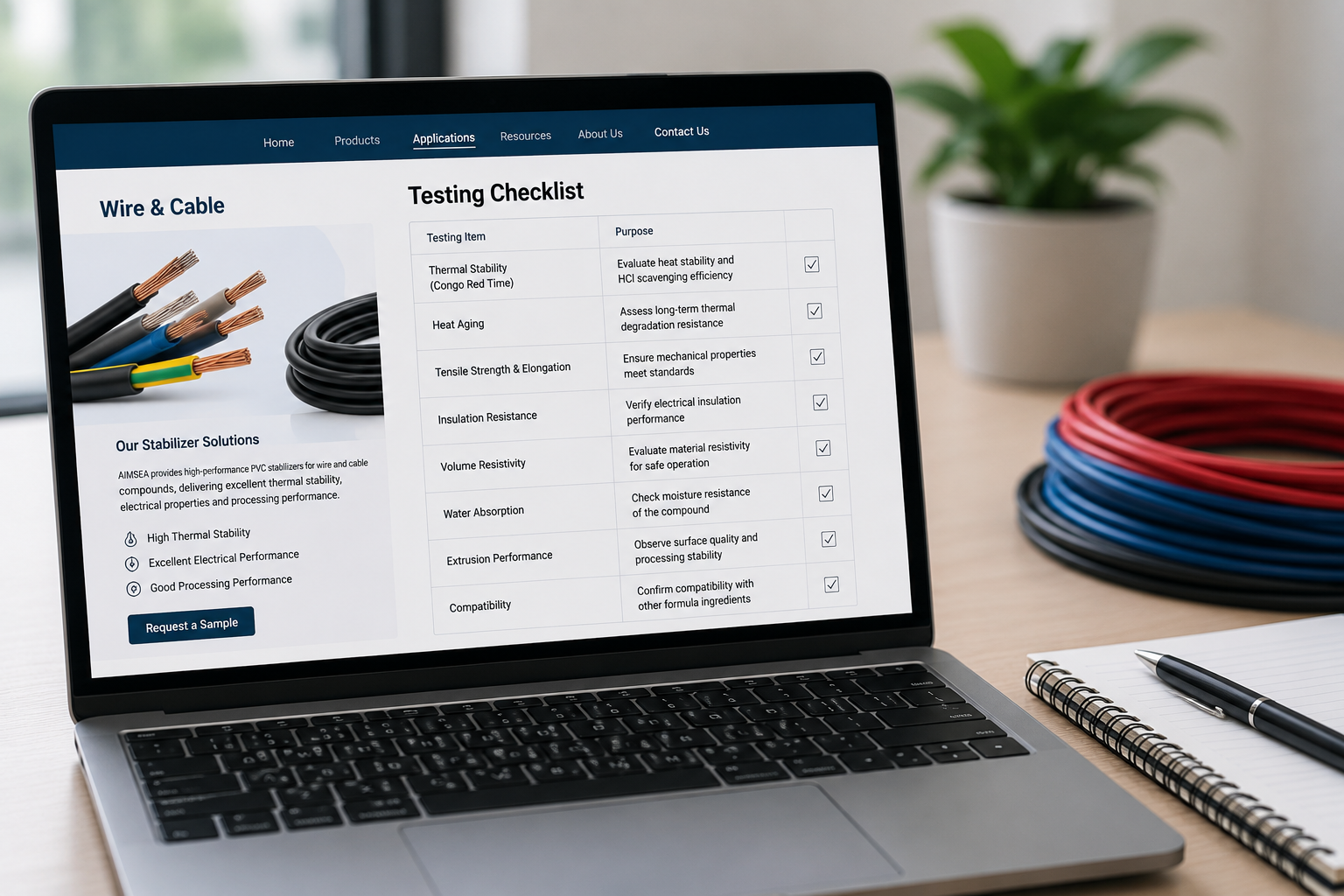
A Wire & Cable application page should do more than introduce products. For B2B buyers, it should answer one practical question: “Can this stabilizer work in my cable compound and production line?”
That is why the page should add a new section called Testing Checklist for PVC Cable Stabilizer. This section can help buyers quickly understand what to test before approving a PVC wire and cable stabilizer sample.
Search intent behind PVC wire and cable stabilizer
The keyword PVC wire and cable stabilizer has both technical and commercial intent. Buyers using this search term may be cable compounders, wire manufacturers, purchasing managers or technical engineers. They are often comparing stabilizer options for insulation, sheathing, automotive cable, low-smoke cable or export cable projects.
Their common questions include:
Buyer Question | Page Content Needed | Conversion Purpose |
Which stabilizer fits my cable grade? | Product fit by temperature grade | Helps buyers select faster |
What tests should I check? | Testing checklist table | Builds technical trust |
Can it support lead-free requirements? | Compliance and formulation note | Reduces purchase risk |
How can I request a sample? | Sample request module | Converts visitors into inquiries |
Testing Checklist for PVC Cable Stabilizer
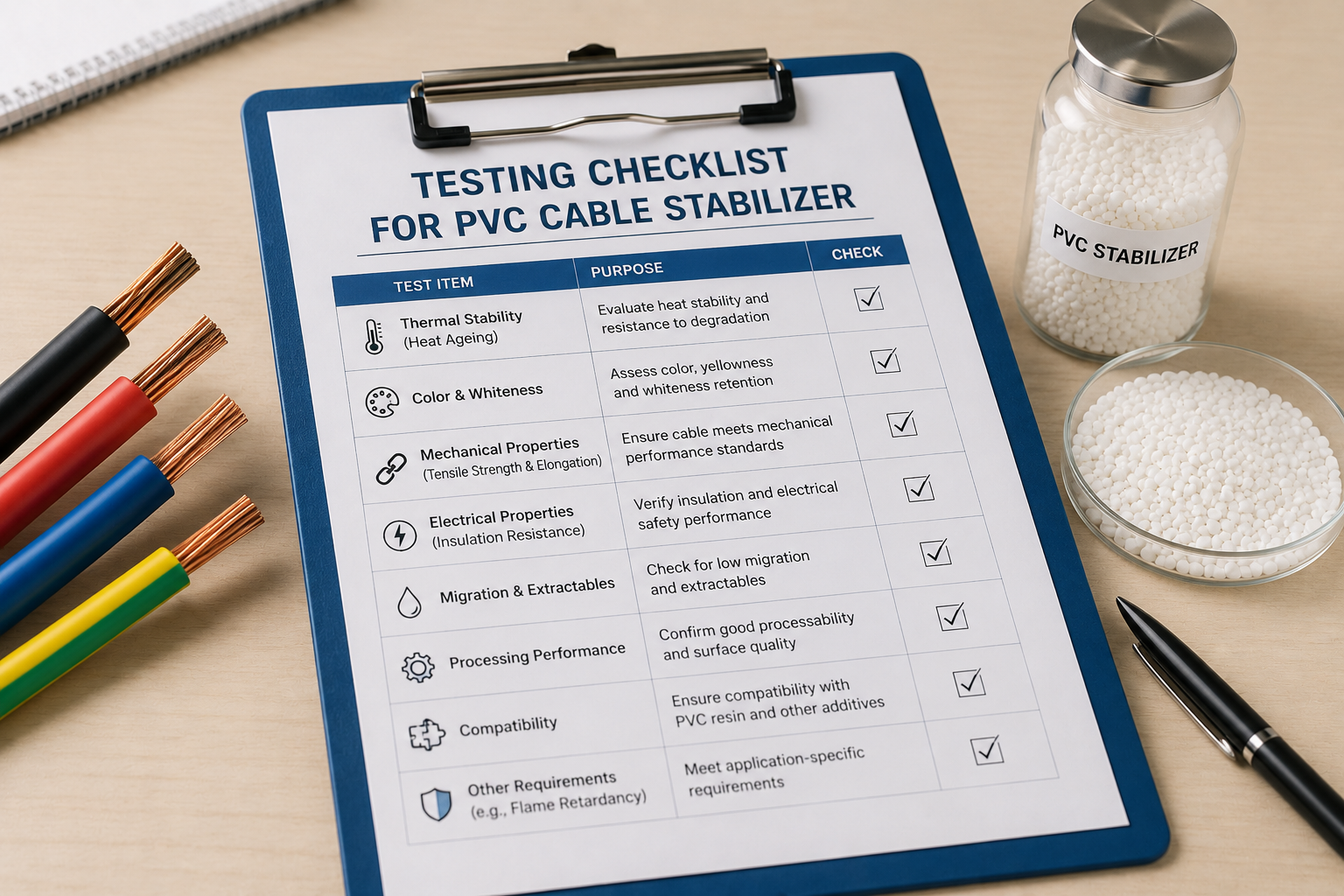
When buyers evaluate a PVC cable stabilizer, they should not rely on one single number. Cable performance depends on thermal stability, electrical properties, formula compatibility and production behavior.
International cable material testing often refers to the IEC 60811 series, which covers mechanical, physical, electrical, thermal and environmental tests for non-metallic insulation and sheathing materials. IEC 60811-401 also specifies air-oven aging procedures for insulating and sheathing materials.
Heat aging and thermal stability
A pvc heat stabilizer for cable compounds should be tested under the real temperature grade and processing condition. A 70°C general cable compound does not need the same stabilization window as a 105°C or 125°C automotive cable compound.
Key checks include:
Test Item | What It Shows | Why It Matters |
Heat aging | Tensile and elongation retention after aging | Confirms long-term flexibility |
Thermal stability | Resistance to heat degradation | Reduces yellowing and breakdown risk |
Loss of mass | Volatile loss under heat | Important for high-temperature PVC cable |
Heat shock | Cracking after heat exposure | Checks insulation reliability |
AIMSEA’s technical materials also show that PVC degradation can cause color change and HCl release during heating, which is why thermal-stability testing should be paired with physical performance checks.
Congo red time and HCl release risk
Congo red time is often used to evaluate the thermal stability of PVC compounds. A longer Congo red time usually means the compound has a better resistance window before obvious degradation begins.
However, Congo red time should not be used alone. A cable compound may show acceptable thermal stability but still fail in electrical performance, surface quality or long-term aging.
Congo red time is an important thermal-stability indicator, but final approval should also include heat aging, electrical performance, moisture resistance and extrusion testing.
Electrical performance and moisture resistance
Electrical performance is one of the most important requirements for PVC cable insulation. AIMSEA’s existing Wire & Cable application page already highlights low moisture absorption, high insulation resistance and volume resistivity.
Electrical Check | Buyer Concern | Page Message |
Insulation resistance | Power or signal loss risk | Stabilizer should support stable insulation performance |
Volume resistivity | Long-term cable reliability | Formula compatibility is critical |
Dielectric strength | Breakdown resistance | Test in the finished compound |
Moisture absorption | Electrical drop after exposure | Low-moisture formulation helps protect performance |
For export cable projects, this section should encourage buyers to share target standards and test data before sample recommendation.
Extrusion stability and surface quality
Production stability is just as important as lab data. A CaZn stabilizer for PVC cable should support stable extrusion, smooth cable surface and consistent color over long production runs.
Buyers usually care about:
·die deposit
·plate-out
·yellowing
·black spots
·surface roughness
·unstable outer diameter
·excessive cleaning downtime
AIMSEA recommends testing the stabilizer in the buyer’s actual extrusion conditions, including screw temperature, line speed, plasticizer system and filler level.
Flame-retardant cable formula compatibility
For flame retardant PVC cable, the stabilizer should be tested together with the full formulation. Flame-retardant additives, plasticizers, fillers and lubricants can all influence processing stability, electrical performance and cable appearance.
For flame-retardant PVC cable compounds, the stabilizer should be evaluated together with the flame-retardant package, plasticizer, filler and lubricant system.
How to Build the Wire & Cable Application Page for Conversion?
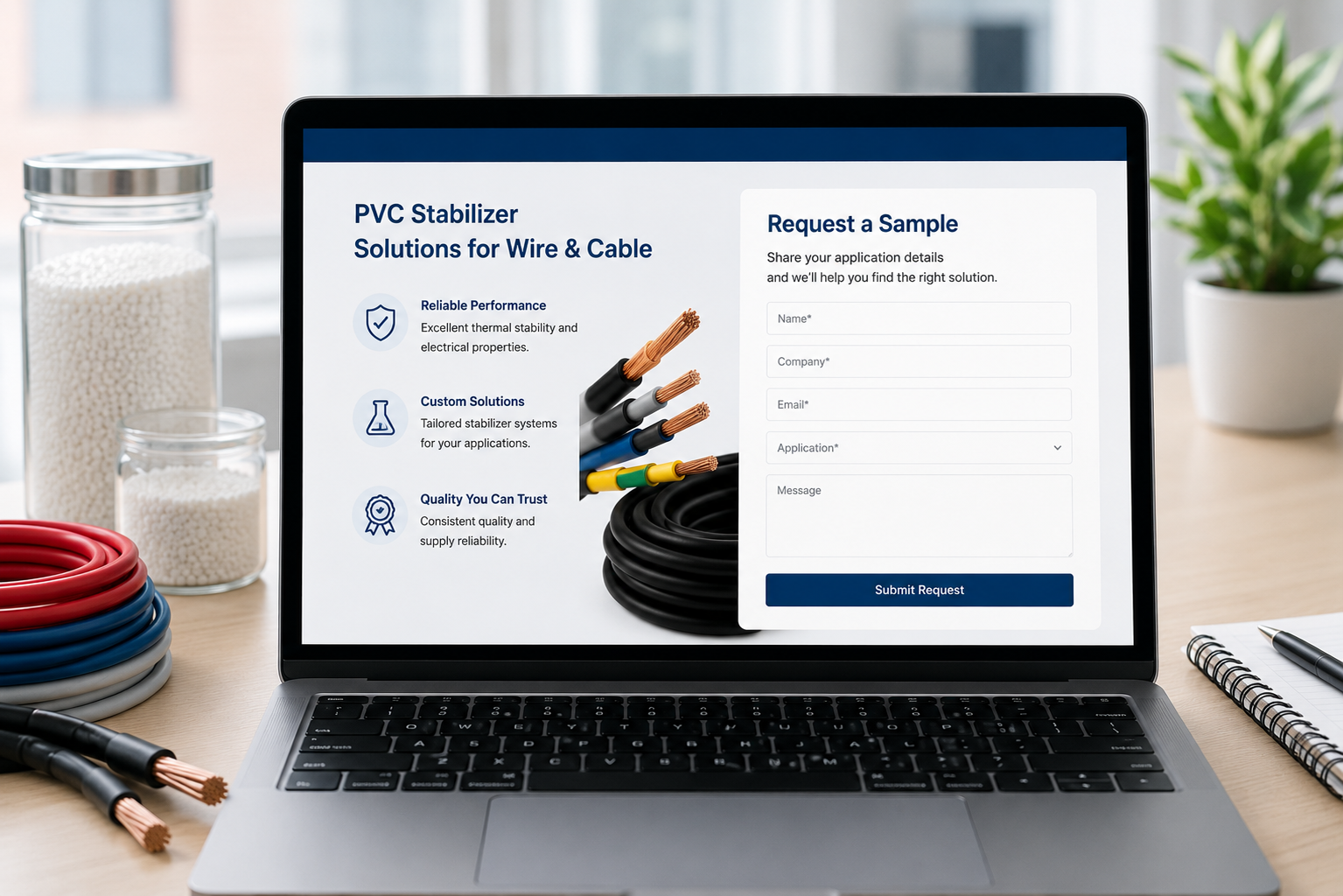
A good Wire & Cable application page should be easy to scan. Buyers should quickly understand the product direction, testing logic and next step.
Product fit by cable grade
Cable Grade | Common Buyer Need | Stabilizer Focus |
70°C PVC cable | General processing and cost balance | Basic heat stability and surface quality |
90°C PVC cable | Better aging performance | Improved thermal stability and electrical retention |
105°C PVC cable | Higher temperature resistance | Aging retention, Congo red time and extrusion stability |
125°C automotive cable | Severe heat and oil exposure | Long-term heat resistance and formula compatibility |
Flame-retardant PVC cable | Fire performance and processing balance | Compatibility with flame-retardant package |
Technical comparison table for buyers
Testing Area | Recommended Check | Buyer Should Provide |
Thermal stability | Congo red time, heat aging, color change | Target temperature grade |
Electrical performance | Insulation resistance, volume resistivity | Cable type and test standard |
Processing | Extrusion stability, plate-out, surface quality | Processing temperature and line speed |
Formula compatibility | Plasticizer, filler, lubricant interaction | Current formula |
Compliance | Lead-free, RoHS/REACH direction | Export market and document needs |
FAQ for PVC Cable Stabilizer Buyers
What tests should be checked first?
Buyers should first check heat aging, Congo red time, insulation resistance, moisture resistance, surface quality and continuous extrusion performance. For higher-temperature cable grades, loss of mass, heat shock and long-term aging retention should also be reviewed.
Is Congo red time enough for approval?
No. Congo red time is useful, but it is not enough for full approval. A PVC wire and cable stabilizer should also be tested for heat aging, electrical properties, moisture resistance, extrusion behavior and final cable appearance.
Can Ca-Zn stabilizers replace lead-based stabilizers?
In many PVC cable applications, calcium zinc stabilizer systems are used as lead-free alternatives. The final choice depends on cable grade, formulation, processing method and target standard.
This topic has become more important because the EU restriction on lead in PVC articles applies from November 29, 2024, limiting lead to no more than 0.1% by weight of the PVC material, with certain derogations. For export-focused buyers, lead-free stabilizer selection should be linked with documentation review.
What information is needed before recommending a sample?
The buyer should provide the cable type, temperature grade, standard, current formula, processing conditions and current production problem. This helps the supplier recommend a more accurate CaZn stabilizer for PVC cable instead of a generic grade.
Sample Request Checklist for Cable Manufacturers
What information should buyers submit?
Required Information | Example |
Cable application | Insulation, sheath, flexible cord, automotive cable |
Temperature grade | 70°C, 90°C, 105°C, 125°C |
Target standard | IEC, UL, VDE, GB, SAE, OEM requirement |
Current formula | PVC resin, plasticizer, filler, flame retardant, lubricant, stabilizer |
Processing condition | Extruder temperature, screw speed, line speed |
Current issue | Yellowing, plate-out, low Congo red, odor, poor insulation resistance |
Test data | Aging retention, Congo red time, electrical test value, surface result |
Send your cable type, temperature grade, current formula and testing issue. AIMSEA will recommend a suitable PVC cable stabilizer or CaZn stabilizer for PVC cable based on your processing and compliance needs.
Need support for 90°C, 105°C or 125°C PVC cable compounds? Contact AIMSEA for sample testing and formulation guidance.
Conclusion
A Wire & Cable application page should help buyers move from technical interest to clear action. While detailed blogs can explain testing methods and product selection in depth, the application page should focus on what cable manufacturers need most: key performance checks, practical answers and an easy way to request a suitable sample.
By adding a Testing Checklist for PVC Cable Stabilizer, a focused FAQ section and a clear sample request module, AIMSEA can make the page more useful for buyers evaluating cable insulation or sheathing compounds. The page should clearly explain which tests matter, what application details should be submitted and how AIMSEA can support the next trial.
The best update is simple: show the main testing items, guide buyers to provide cable type, temperature grade, formulation and current issues, then make the sample request process easy. This helps buyers make faster decisions and allows AIMSEA to recommend a more accurate stabilizer solution for real production needs.