
PVC Foam Board Stabilizer Troubleshooting: Yellowing, Cell Collapse and Plate-Out
Read:318
Source:
Quick Answer
A reliable PVC foam board stabilizer should balance thermal stability, foaming-agent decomposition, lubricant control and filler compatibility to reduce yellowing, cell collapse and plate-out.
Key Takeaways
·PVC foam board stabilizer selection should start from the actual production defect.
·PVC heat stabilizer for foam board performance directly affects yellowing, whiteness and long-run stability.
·Cell collapse is usually linked to melt strength, foaming-agent timing, lubrication balance and temperature control.
·Plate-out often comes from excessive external lubrication, poor compatibility, filler fluctuation or low die temperature.
·Buyers should provide equipment temperature zones, formula, foaming agent, filler ratio and defect photos before requesting a sample.
·A calcium zinc stabilizer or ca zn stabilizer system should be tested in the real foam-board formula, not selected by product name alone.
Abstract
PVC foam board production is sensitive to heat, foaming, lubrication and filler stability. When yellowing, cell collapse, density variation, pitting or plate-out appears, the PVC foam board stabilizer system is often one of the first areas to review. A stable formula needs the right balance of pvc heat stabilizer for foam board, foaming agent, foaming regulator, pvc lubricant additives, filler and processing temperature.
This guide provides a defect-based troubleshooting method for PVC foam board and foam profile manufacturers. Each problem is organized by symptom, possible cause, stabilizer or lubricant adjustment direction and trial verification indicators. It also explains how AIMSEA’s foam stabilizer solutions can support better whiteness, low precipitation, fine-cell structure and cleaner dies for PVC foam products. AIMSEA’s PVC Foam page highlights stabilizer and processing solutions for foam boards and profiles, including low precipitation, good whiteness, cell-wall stability and cleaner foam-board dies.
Why PVC Foam Board Stabilizer Troubleshooting Should Start from Defects
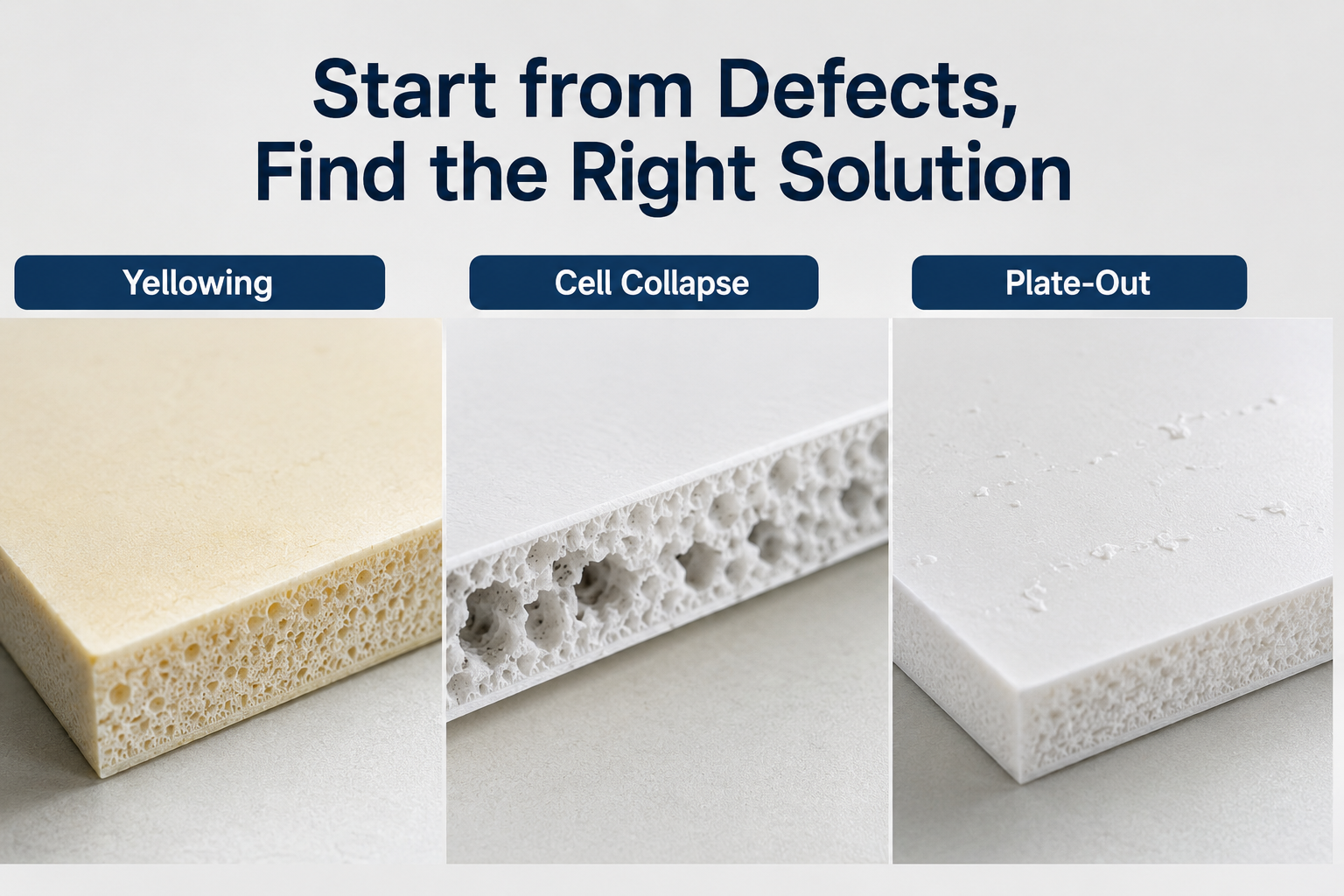
A PVC foam board stabilizer is not only used to protect PVC from heat degradation. In foam board production, it also influences whiteness, foam expansion, density control, melt flow, lubricant balance and die cleanliness. That is why troubleshooting should begin with the visible defect instead of only asking for a stronger stabilizer.
For example, yellowing may require better heat stability, but it may also come from excessive residence time or die build-up. Cell collapse may look like a foaming-agent problem, but the root cause may be weak melt strength or too much external lubricant. Plate-out may be related to pvc lubricant additives, filler quality or poor compatibility in the pvc compound stabilizer system.
AIMSEA’s main product page positions its PVC stabilizers as lead-free calcium-zinc systems and customized heat stabilizer solutions for multiple PVC applications, with formulation adjustment and sample testing support.
How pvc compound additives affect foaming quality
PVC foam board quality depends on the complete formulation. The stabilizer, foaming agent, foaming regulator, lubricant, filler and pigment must work within the same processing window.
Formula Factor | Role in PVC Foam Board | Possible Defect When Unbalanced |
PVC foam board stabilizer | Protects PVC during heating and extrusion | Yellowing, poor long-run stability |
Additives foaming agent for PVC | Releases gas to form foam cells | Large bubbles, hollow core, collapse |
Foaming regulator | Improves melt strength | Weak cross-section, poor cell wall |
PVC lubricant additives | Control fusion, metal release and flow | Plate-out, rough surface, unstable density |
Filler | Controls cost, rigidity and density | Pitting, density variation, die build-up |
TiO₂ | Improves whiteness and opacity | Poor whiteness if dispersion is weak |
Why the best pvc foam stabilizer depends on formula balance
The best pvc foam stabilizer is not always the one with the highest heat-stability number. For foam board, the better stabilizer is the one that matches the customer’s formula, temperature profile, foaming-agent decomposition window and lubrication system.
A good trial should compare:
Trial Indicator | What It Confirms |
Whiteness / L* value | Yellowing resistance |
Foam cell size | Foaming balance |
Density fluctuation | Process stability |
Die deposit | Plate-out control |
Torque and pressure | Lubrication and fusion balance |
Cross-section strength | Melt strength and foam curing |
Yellowing: Check the PVC Heat Stabilizer for Foam Board System
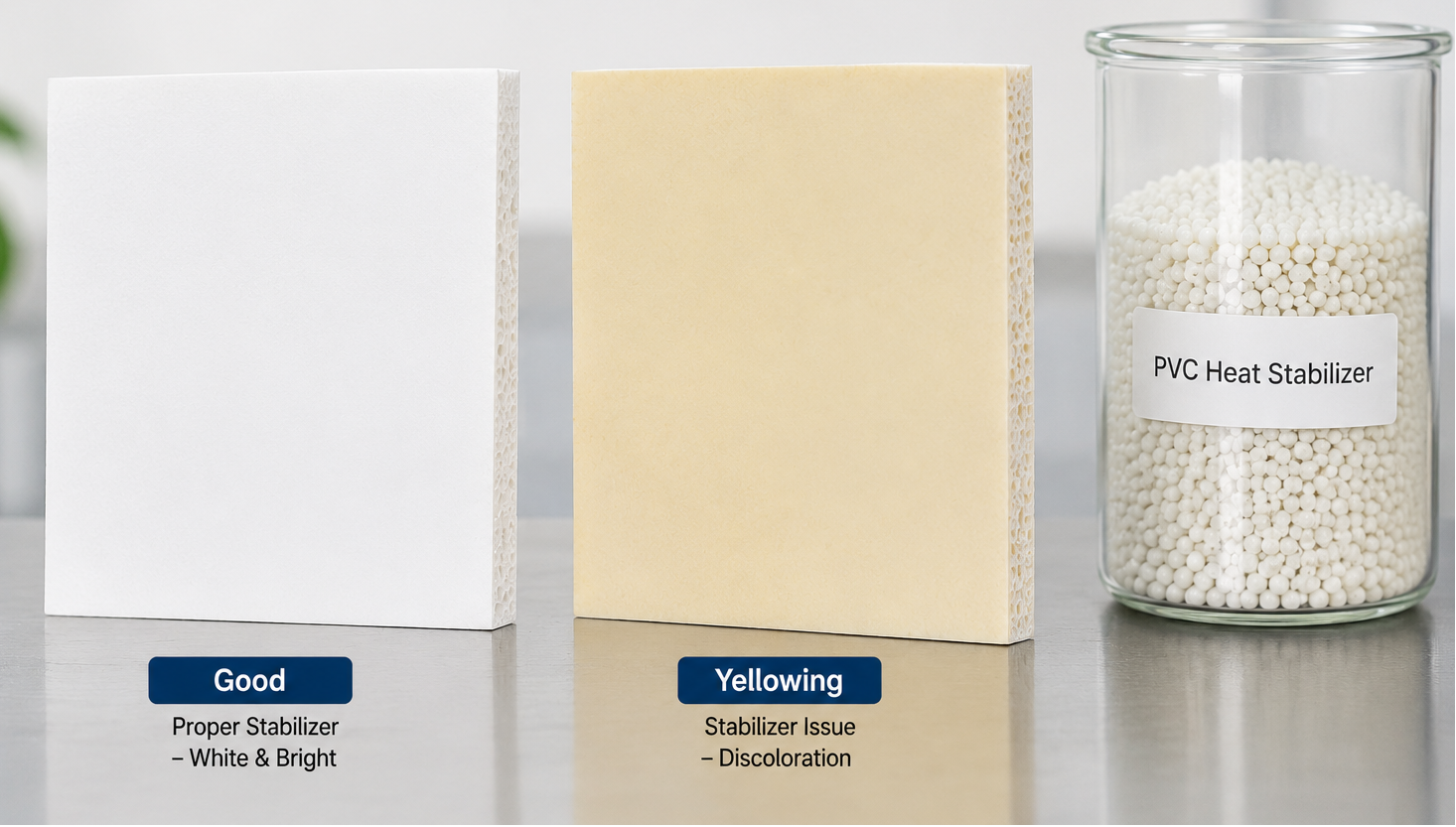
Yellowing is one of the most common reasons customers look for a new pvc heat stabilizer for foam board. It may appear on the board surface, in the inner core, near the die direction or after several hours of continuous production.
Symptom: surface yellowing, core yellowing or yellow streaks
Common symptoms include:
·surface color changes from white to cream or yellow
·board core is darker than the skin
·yellow lines appear in the extrusion direction
·whiteness decreases during long production runs
·thicker boards show stronger yellowing
AIMSEA’s PVC Foam page highlights good whiteness and TiO₂ synergy for foam cores and skins, and also notes high whiteness retention through Ca-Zn/TiO₂ synergy.
Stabilizer and temperature adjustment direction
Symptom | Possible Cause | Adjustment Direction | Trial Verification |
Surface yellowing | Die or barrel temperature too high | Improve pvc heat stabilizer for foam board and lower hot zones | Check surface L* value |
Core yellowing | Thick board retains heat longer | Improve long-term stability and cooling | Cut board and inspect core color |
Yellow streaks | Local overheating or die build-up | Adjust lubricant balance and die temperature | Track streak position |
Yellowing after long run | HCl accumulation or precipitation | Use low-precipitation calcium zinc stabilizer | Compare color after 2–4 hours |
The adjustment should not simply be “increase stabilizer dosage.” A better method is to review heat stability, residence time, lubricant level, TiO₂ quality and cooling conditions together.
Cell Collapse: Balance Additives Foaming Agent for PVC and Melt Strength
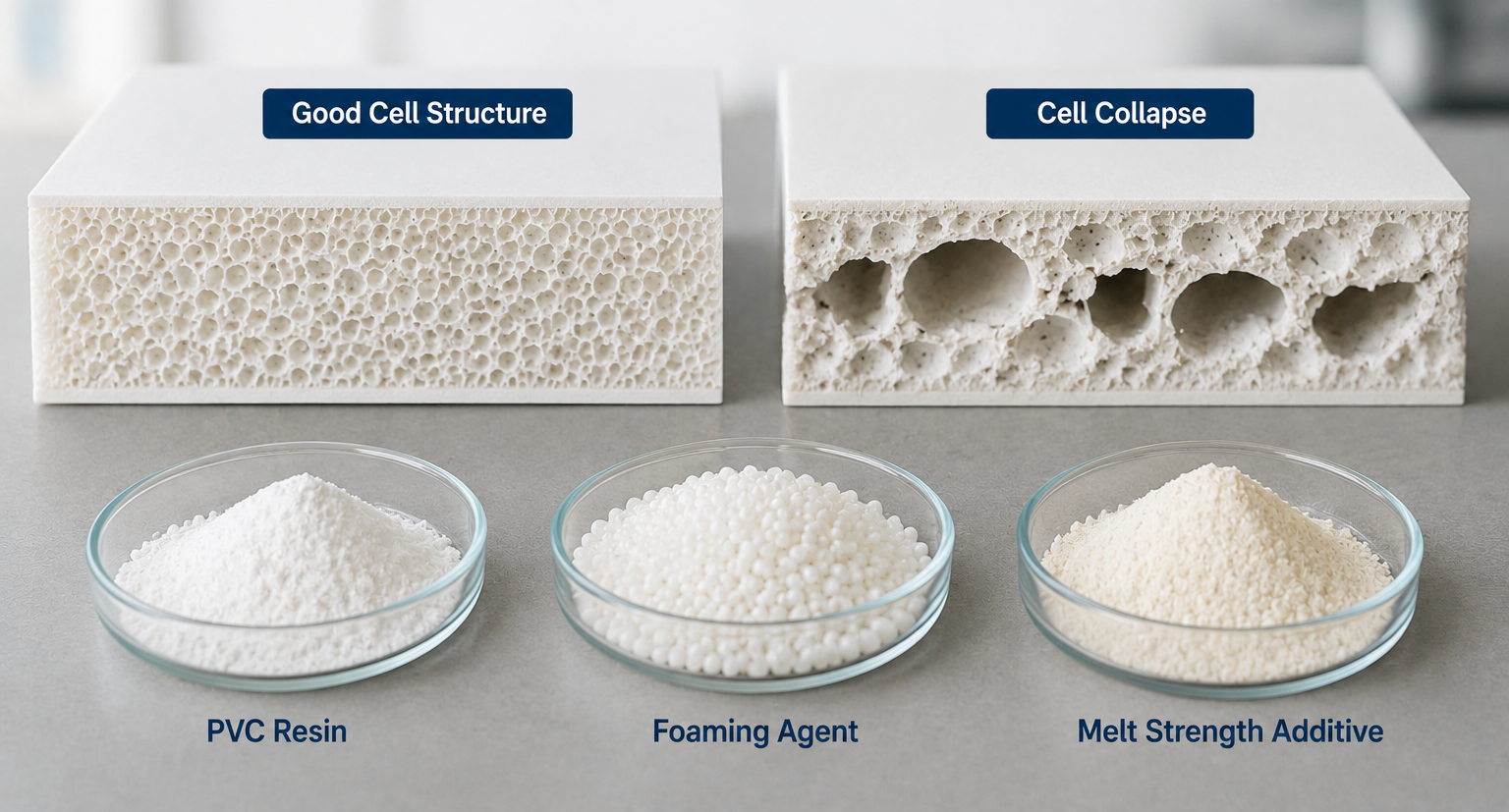
Cell collapse means the foam structure cannot hold its shape during expansion and cooling. This issue is often connected with additives foaming agent for PVC, melt strength, lubricant dosage and processing temperature.
Symptom: large cells, hollow core or weak cross-section
Typical signs include:
·large or uneven foam cells
·hollow core in the board center
·weak cross-section after cutting
·surface swelling or local bubbles
·density drops too quickly but strength becomes poor
Trial indicators for foam structure validation
Symptom | Possible Cause | Adjustment Direction | Trial Indicator |
Large cells | Foaming agent decomposes too early or too fast | Adjust foaming-agent system and temperature | Cell size and uniformity |
Cell collapse | Melt strength is insufficient | Improve foaming regulator and fusion | Cross-section strength |
Hollow core | Gas release exceeds melt support | Reduce foaming intensity or improve melt strength | Core integrity |
Rough cross-section | Poor plasticization | Adjust internal/external lubrication | Cut surface quality |
For this section, the phrase additives foaming agent of PVC can also be used once in the body or image alt text, because it appears in the keyword table as a close variant. However, in the main article, additives foaming agent for PVC reads more natural.
Density Variation: Review Stabilizer for PVC Compound and Filler Control
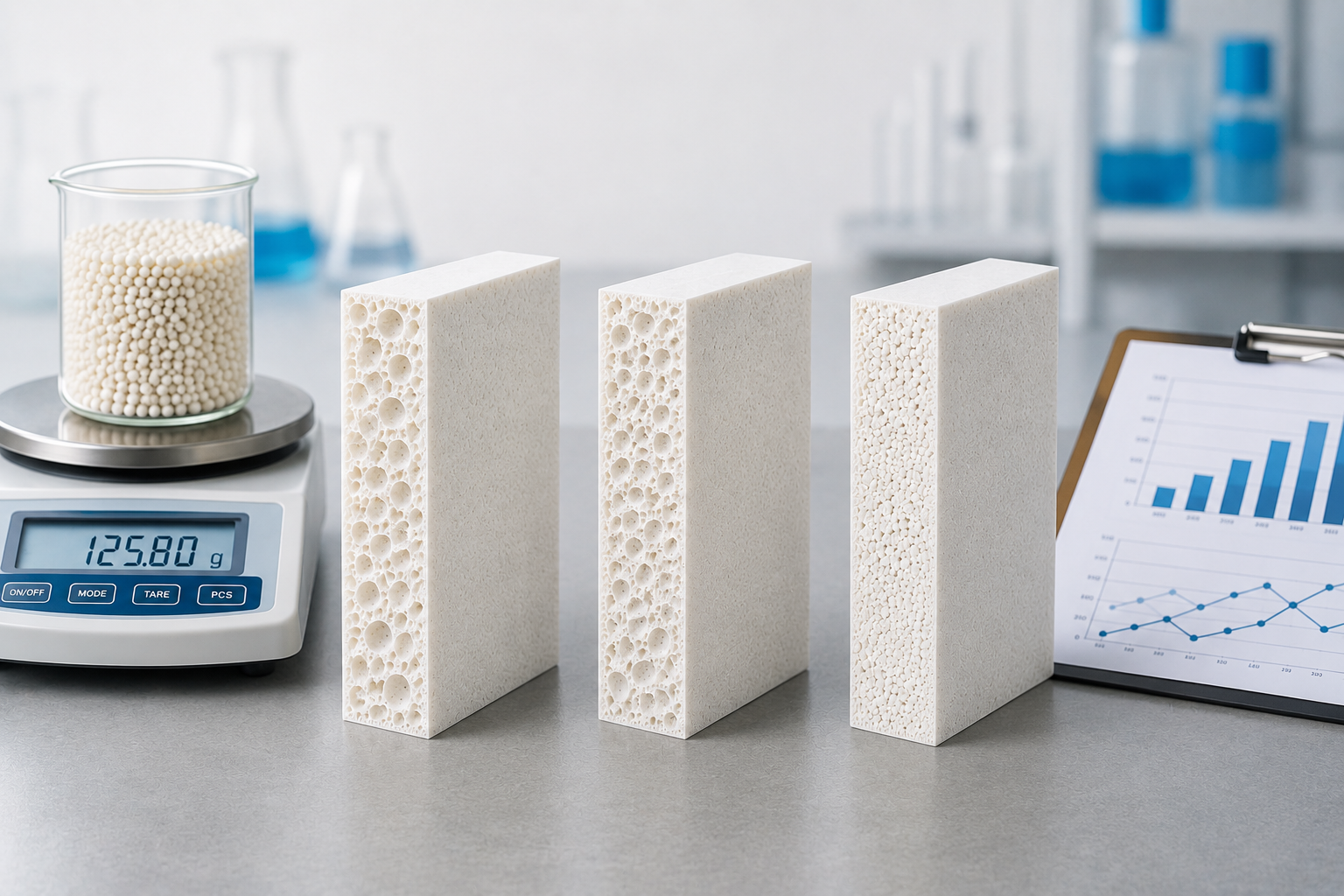
(图片alt:Review Stabilizer for PVC Compound and Filler Control)
Density variation is a serious issue for PVC foam board manufacturers because it affects cost, thickness, mechanical strength and customer acceptance. It may be caused by formula fluctuation, equipment instability or mismatch in the stabilizer for PVC compound system.
(h3) Symptom: unstable board weight, thickness or hardness
Common signs include:
·board weight changes between production shifts
·thickness is unstable across the width
·center density differs from edge density
·hardness changes after raw material batch change
·same formula gives different output on different days
Formula and process checks before changing dosage
Possible Cause | What to Check | Adjustment Direction |
Filler moisture | CaCO₃ moisture and particle size | Improve drying and batch control |
Lubricant imbalance | Torque, fusion and surface condition | Adjust pvc lubricant additives |
Foaming agent variation | Dosage accuracy and decomposition timing | Stabilize weighing and mixing |
Temperature drift | Barrel, die and melt temperature | Record actual temperature profile |
Stabilizer mismatch | Compatibility with filler and lubricant | Test foam-grade pvc compound stabilizer |
This is where pvc compound additives, pvc compounding additives and dry blend pvc additive can be used naturally. For example, in a dry blend system, the dispersion of stabilizer, lubricant, filler and foaming agent directly affects production consistency.
Pitting and Poor Surface Finish: Check PVC Compounding Additives
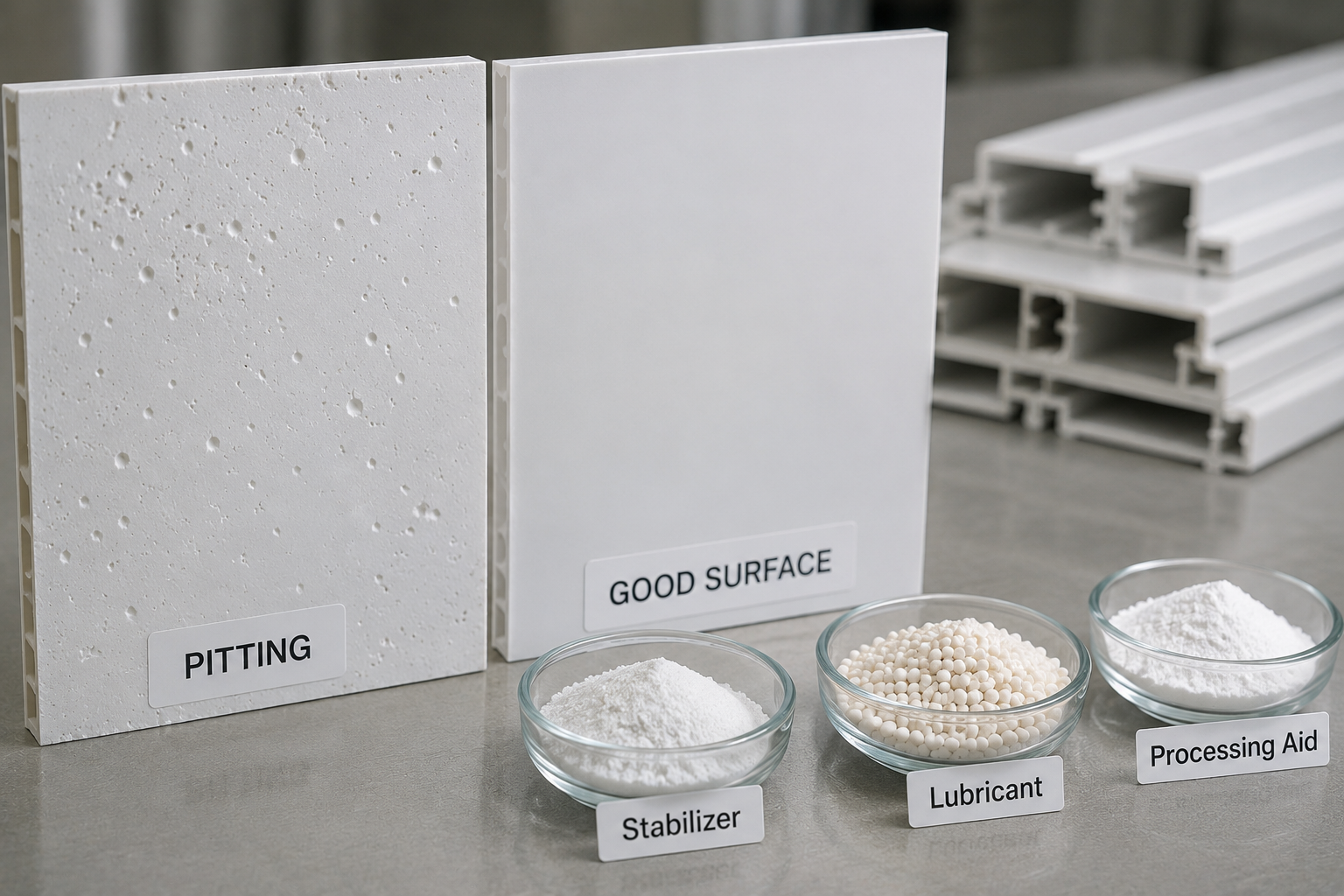
Pitting and poor surface finish are not always caused by the stabilizer alone. They often come from the interaction between pvc compounding additives, filler, moisture, pigment dispersion, mixing temperature and lubricant migration.
Symptom: pinholes, specks, rough skin or flow marks
Typical defects include:
·small pinholes on the surface
·black or brown specks
·rough skin after extrusion
·flow marks or surface lines
·poor lamination or printing performance
Mixing, dispersion and raw material checks
Check Item | Why It Matters |
Stabilizer dispersion | Poor dispersion can cause local instability |
Filler quality | Coarse particles may cause pitting |
TiO₂ dispersion | Affects whiteness and surface smoothness |
Mixing temperature | Overheating may trigger early decomposition |
Lubricant compatibility | Excess migration can reduce surface quality |
In PVC foam board production, specialty pvc additives should be tested as a complete package because stabilizer, lubricant, foaming agent and filler all influence the final surface.
Plate-Out: Adjust PVC Lubricant Additives and Stabilizer Compatibility
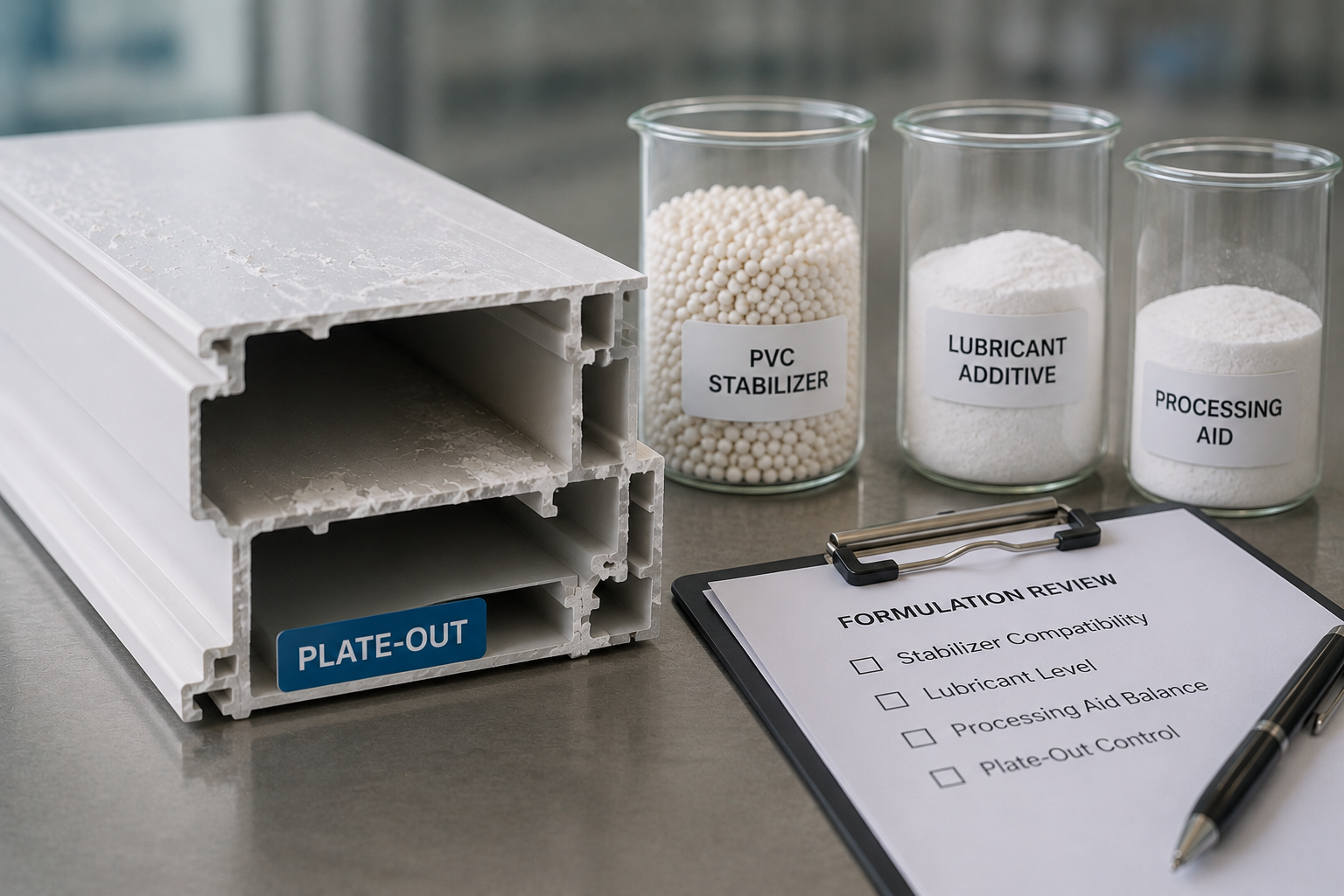
Plate-out is one of the most direct signs that the formula and process are not balanced. It can shorten continuous running time, create surface lines and increase die cleaning frequency.
Symptom: die deposit, surface lines and frequent cleaning
Common symptoms include:
·white or yellow deposit near the die lip
·black specks after long production
·surface lines in the extrusion direction
·pressure fluctuation after several hours
·shorter cleaning cycle
AIMSEA’s PVC Foam page directly mentions low precipitation, cleaner foam-board dies and longer run times, which makes this topic suitable for internal linking to the PVC Foam application page.
Low-precipitation calcium zinc stabilizer direction
Possible Cause | Adjustment Direction | Trial Verification |
Excessive external lubricant | Reduce migration tendency | Check die lip after 2 hours |
Poor stabilizer compatibility | Use low-precipitation calcium zinc stabilizer | Compare die deposit |
High filler fluctuation | Check CaCO₃ surface treatment | Monitor pressure curve |
Die temperature too low | Improve melt flow | Observe surface lines |
Local overheating | Improve heat stability | Compare odor and color |
Use calcium zinc stabilizer for PVC and ca zn stabilizer mainly in FAQ, CTA and product recommendation sections. This avoids repeating the same phrase too many times in the technical body.
FAQ: Lead Based PVC Stabilizer for Foam Board and Ca-Zn Alternatives
Can calcium zinc stabilizer replace lead based pvc stabilizer for foam board?
Yes, in many PVC foam board applications, calcium zinc stabilizer systems are used as lead-free alternatives. However, replacement should not be done by equal dosage only. The trial should compare whiteness, density stability, foam cell structure, thermal stability, plate-out and production cost.
For keyword coverage, the variant lead base stabilizer for pvc foam board can be used once in FAQ or image alt text, but the article should mainly use the grammatically correct form lead based pvc stabilizer for foam board.
What is the best pvc foam stabilizer for foam board production?
The best pvc foam stabilizer is the one that matches the customer’s PVC resin, filler ratio, foaming agent, lubricant package, board thickness and temperature profile. A stabilizer that works well in one foam board formula may not perform the same way in another formula.
What information should buyers provide for sample testing?
Buyers should provide:
Information Needed | Example |
Product type | PVC foam board, foam sheet, foam profile |
Board size | Thickness, width, target density |
Equipment | Single-screw or twin-screw extruder |
Temperature zones | Barrel, die and cooling settings |
Formula | PVC resin, CaCO₃, TiO₂, lubricant, foaming agent |
Current defect | Yellowing, cell collapse, pitting, plate-out |
Photos | Surface, cross-section, die deposit |
Trial goal | Whiter board, lower density, cleaner die, longer run time |
Is a pvc additive ca-zn compound heat stabilizer suitable for foam boards?
A pvc additive ca-zn compound heat stabilizer may be suitable when the formula requires lead-free heat stability, better whiteness and improved processing balance. However, it should be tested with the actual foam-board formula, especially the foaming agent, filler and lubricant system.
Conclusion: Request a PVC Foam Board Stabilizer Recommendation
PVC foam board troubleshooting should follow a defect-based method. Yellowing, cell collapse, density variation, pitting and plate-out may look like separate problems, but they are often connected through the same system: heat stability, foaming-agent timing, lubrication balance, filler control and equipment temperature.
For customers searching for PVC foam board stabilizer, pvc heat stabilizer for foam board, best pvc foam stabilizer or calcium zinc stabilizer for pvc, the right choice should be based on trial data rather than product name alone.
AIMSEA provides PVC stabilizer and specialty pvc additives solutions for foam boards and foam profiles. Its PVC Foam application page highlights low precipitation, good whiteness, fine-cell structure, high whiteness retention and cleaner foam-board dies.AIMSEA provides PVC foam stabilizer solutions focused on low precipitation, good whiteness, foam balance and stable processing. To receive a more accurate recommendation, send the following information:
Information Needed | Example |
Product type | PVC foam board, foam profile, foam sheet |
Board size | Thickness, width, target density |
Equipment data | Extruder type, screw design, temperature zones |
Formula | PVC resin, CaCO₃, TiO₂, foaming agent, regulator, lubricant |
Current defect | Yellowing, cell collapse, pitting, plate-out, density fluctuation |
Photos | Surface, cross-section, die deposit, failed sample |
Trial goal | Whiter board, lower density, cleaner die, longer run time |
Send your foam board formula, equipment temperature profile, foaming agent type, filler ratio and defect photos to AIMSEA. Our team can recommend a suitable PVC foam board stabilizer, ca zn stabilizer or customized pvc compound stabilizer trial direction for better whiteness, stable density, cleaner dies and stronger foam structure.