

Posted by Ms.Yan
in blog
Technical Engineer
Updated 2026-10-27
What Additives Are Needed in a PVC Dry Blend?
Read:25
Source:
A PVC dry blend is more than a mixture of resin and stabilizer. Depending on the finished product, it may contain lubricants, processing aids, impact modifiers, fillers, pigments, plasticizers, and other functional ingredients. Selecting the right additives is important, but so is introducing them under suitable mixing conditions.
For PVC pipe and profile manufacturers, a poorly prepared dry blend can cause inconsistent feeding, uneven dispersion, or unpredictable behavior during extrusion. Flexible PVC formulations introduce additional considerations because liquid plasticizers must be properly incorporated into the resin.
Understanding which PVC dry blend additives are required, how to prepare the compound, and how to evaluate the finished powder helps manufacturers establish a more reliable basis for production.
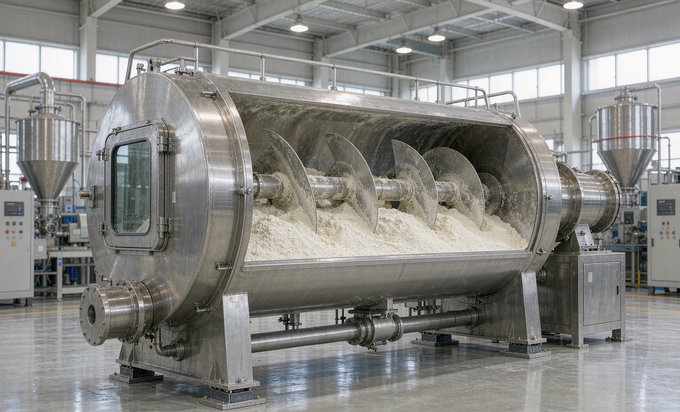
A high-speed mixer blends PVC resin with stabilizer, lubricant and other dry-blend additives.
>Quick AnswerA typical PVC dry blend contains PVC resin, a heat stabilizer, and an appropriate lubricant system. Depending on the application, it may also require processing aids, impact modifiers, fillers, pigments, plasticizers, or other functional additives. The exact formulation and mixing sequence depend on the finished product, resin characteristics, and equipment.
Key Takeaways
Heat stabilizers and lubricants are common components of PVC dry blends, but the complete formulation depends on the intended product.
Processing aids, impact modifiers, fillers, pigments, and plasticizers are selected according to specific processing and performance requirements.
Mixing order matters, particularly when formulations contain liquid ingredients or additives requiring controlled dispersion.
Hot mixing and cooling should produce a sufficiently homogeneous, free-flowing compound suitable for downstream processing.
A one-pack stabilizer may simplify dosing, but manufacturers must verify which ingredients are already included before adding separate components.
What Is a PVC Dry Blend?
A PVC dry blend is a powder-form compound prepared by mixing PVC resin with selected formulation ingredients before downstream processing, such as extrusion or other suitable conversion operations.
Unlike melt compounding, conventional PVC dry blending does not aim to fully fuse the polymer during the mixing stage. Instead, the ingredients are distributed throughout the resin to produce a powder that can be handled, conveyed, and processed consistently.
Industrial dry blending commonly uses a high-intensity hot mixer followed by a cooling mixer. Mechanical mixing generates frictional heat, promoting additive distribution and, where applicable, the absorption of liquid ingredients into the PVC resin. The material is then cooled to an appropriate discharge condition before storage or processing.
The quality of a dry blend depends on more than whether all ingredients have been added. Powder homogeneity, flow behavior, bulk density, temperature history, and handling characteristics can affect downstream production.
The Indian Vinyl Council identifies mixing uniformity, free-flowing behavior, bulk density, and storage stability as important properties of PVC dry blends [1].
For manufacturers, the starting point is therefore to define both the ingredients required by the product and the physical characteristics the finished dry blend must achieve.
Which Additives Are Used in a PVC Dry Blend?
PVC resin is the main ingredient, while the supporting additives are selected according to the finished product and manufacturing process.
Most conventional rigid PVC formulations use a heat stabilizer and a lubrication system. Additional ingredients may be needed for processing, impact resistance, color, cost control, or specific end-use requirements.
| Ingredient | Main Purpose | When It Is Commonly Used |
|---|---|---|
| PVC resin | Base polymer | All PVC dry blend formulations |
| Heat stabilizer | Protects PVC against thermal degradation | Most conventional heat-processed PVC formulations |
| Internal and external lubricants | Control friction, flow, and material release | Common in rigid PVC processing |
| Processing aid | Adjusts fusion and melt development | Many rigid PVC extrusion formulations |
| Impact modifier | Improves impact resistance | Profiles, selected pipes, fittings, and other rigid products |
| Filler | Adjusts cost, stiffness, and other compound properties | Pipes, profiles, boards, and selected compounds |
| Pigment or colorant | Provides color or opacity | Colored and opaque products |
| Plasticizer | Increases flexibility | Flexible PVC compounds |
| UV or weathering additive | Supports application-specific weathering requirements | Selected outdoor applications |
| Other functional additives | Provide specialized properties | Foam, flame-retardant, and other application-specific products |
Not every ingredient is required in every formulation. The final additive package should be based on the product specification and processing method.
Heat Stabilizers and Lubricants
PVC stabilizer solutions are among the most important components because PVC can undergo thermal degradation during processing. An appropriate stabilizer system helps control discoloration and maintain sufficient thermal stability for the intended manufacturing conditions.
Calcium-zinc stabilizers are widely used in lead-free PVC applications, including pipes, fittings, and profiles. The grade and dosage should be selected according to resin characteristics, processing conditions, and finished-product requirements.
Lubricants serve a different purpose. Internal lubricants primarily influence friction within the compound, while external lubricants help control interaction with metal surfaces. Their effects can overlap, so the total lubricant system must be considered when preparing a dry blend.
Some commercial stabilizer packages already contain lubricating ingredients. Adding separate waxes or metallic soaps without checking the package composition may unintentionally change the total lubrication balance.
This is especially relevant when manufacturers replace one stabilizer grade with another or switch from separately dosed additives to an integrated system.
Processing Aids, Modifiers and Fillers
Processing aids are commonly used in rigid PVC formulations to adjust fusion and melt development during downstream processing. Their purpose is different from that of a heat stabilizer, and they should be selected according to the application's processing needs.
Impact modifiers may be required when rigid PVC products must meet specific toughness or impact-resistance targets. The type and amount depend on the formulation, manufacturing process, and applicable product specification.
Fillers such as calcium carbonate are used in many rigid PVC compounds. Their characteristics, loading level, and dispersion can influence processing and finished-product performance.
Pigments and other functional ingredients may also be introduced when the product requires color, opacity, weathering resistance, or specialized properties.
The important consideration during dry blending is whether these materials can be distributed adequately without creating excessive agglomeration, segregation, or changes in powder handling behavior.
How Do Additive Requirements Differ Between Rigid and Flexible PVC?
Rigid and flexible PVC dry blends share some basic ingredients, but they differ significantly in their formulation priorities.
Rigid PVC formulations typically rely on resin, heat stabilizers, lubricants, and selected functional additives. Flexible PVC formulations require plasticizers to achieve the intended softness and flexibility, introducing additional requirements for liquid incorporation and powder handling.
| Formulation Aspect | Rigid PVC Dry Blend | Flexible PVC Dry Blend |
|---|---|---|
| Heat stabilizer | Needed for thermal protection | Needed for thermal protection |
| Lubricants | Often important for friction, fusion, and metal release | Selected according to plasticizer content and process |
| Processing aid | Common in many rigid extrusion applications | Application-dependent |
| Impact modifier | Used where additional toughness is required | Often less central to flexibility than plasticizers |
| Plasticizer | Generally absent or used only in limited special formulations | Major functional ingredient |
| Fillers and pigments | Based on product requirements | Based on flexibility, appearance, and other requirements |
| Mixing consideration | Dispersion, powder flow, and controlled lubricant distribution | Plasticizer absorption, dispersion, and free-flowing behavior |
Rigid PVC Pipes and Profiles
PVC pipe and profile formulations often require reliable thermal stability, suitable fusion behavior, and consistent powder feeding.
A rigid pipe dry blend may contain calcium-zinc stabilizer, lubricants, processing aid, filler, and pigment in addition to the PVC resin. Depending on the pipe specification, some components may be unnecessary or may require different levels.
Profile compounds may introduce different requirements for impact resistance, surface finish, weathering, and filler content.
For both applications, the stabilizer system must be selected with an understanding of the other additives already present.
Flexible PVC Compounds
Flexible PVC dry blends require particular attention to plasticizer incorporation.
During suitable heated mixing, liquid plasticizers are introduced under conditions that allow them to distribute through and become absorbed by the resin. The process must avoid leaving significant quantities of free liquid or producing poorly mixed agglomerates.
The correct plasticizer charging conditions depend on resin absorption characteristics, plasticizer type, mixer design, and formulation.
For cable compounds, flexible tubing, and other applications, the dry blend must also meet the requirements of subsequent processing and the finished product.
The addition of plasticizer does not eliminate the need for an appropriate heat stabilizer system.
How Is a PVC Dry Blend Prepared?
PVC dry blend preparation requires a mixing procedure that matches the formulation and production equipment. There is no universal charging sequence or temperature profile suitable for every PVC compound.
The correct order depends on the resin, additive chemistry, physical form of the ingredients, mixer design, and intended product. However, most industrial processes follow a common principle: establish suitable mixing conditions, introduce additives when they can be adequately distributed or absorbed, and cool the finished blend before further handling.
Hot Mixing and Additive Introduction
A typical high-intensity mixing operation begins with accurately weighed PVC resin and the ingredients specified for the initial charging stage.
Heat stabilizers and other dry additives may be added during the initial or subsequent mixing stages, depending on the formulation and supplier instructions.
In flexible PVC systems, liquid plasticizers are normally introduced under conditions suitable for absorption and distribution. In some rigid PVC procedures, certain fillers, pigments, or lubricants are added later to improve handling or manage their behavior during mixing.
The important point is that charging order should be established for the specific formulation rather than copied from an unrelated production recipe.
The operating procedure should define when ingredients enter the mixer, the relevant temperature or mixing condition, and the required discharge criteria.
These parameters must be verified for the equipment and material system in use.
Why Cooling Is Part of the Mixing Process
After hot mixing, the compound is normally transferred to a cooling stage.
Cooling reduces the powder temperature and helps prepare the dry blend for conveying, storage, and feeding into downstream equipment.
Inadequate cooling may contribute to handling difficulties, including unwanted agglomeration or changes in powder flow during storage.
The target discharge temperature is not universal. It depends on the formulation, equipment, handling conditions, and validated operating procedure.
A well-prepared dry blend should be sufficiently homogeneous and free-flowing for its intended processing route.
Avoid Copying Mixing Temperatures Between Formulations
Technical references may describe different hot-mixing temperatures, additive charging points, and cooling targets.
These differences do not necessarily indicate that one procedure is incorrect. They often reflect different PVC resin grades, rigid or flexible formulations, liquid ingredient requirements, and equipment conditions.
For this reason, manufacturers should use published mixing procedures as technical references rather than universal production settings.
When introducing a new stabilizer or additive package, the mixing process may also require review, particularly if the new product differs in physical form, particle characteristics, or included functional components.
How Can Manufacturers Check PVC Dry Blend Quality?
A finished dry blend should be evaluated before its preparation method is accepted for routine production.
Visual appearance can reveal obvious lumps or segregation, but it does not provide a complete picture of powder quality.
Useful measurements and observations include the following.
| Quality Indicator | What to Evaluate | Why It Matters |
|---|---|---|
| Blend uniformity | Distribution of ingredients and visible agglomerates | Identifies mixing or dispersion problems |
| Bulk density | Repeatability under a defined test method | Helps assess powder handling and feeding consistency |
| Powder flow | Flow behavior and tendency to bridge or form lumps | Relevant to storage, conveying, and feeding |
| Mixing temperature | Hot-mix and cooling-stage temperature records | Helps verify process control |
| Moisture condition | Moisture or condensation-related issues | Can affect handling and processing |
| Fusion behavior | Fusion time and torque response | Indicates downstream processing differences |
| Finished-product performance | Appearance, thermal stability, and mechanical properties | Confirms that the dry blend meets its intended purpose |
Powder tests should be interpreted against a qualified reference batch or an established acceptance range.
For example, a change in bulk density may justify investigating mixing conditions, raw material variation, or additive distribution. It does not automatically identify which ingredient caused the difference.
Laboratory mixing and torque testing can provide additional information about processing behavior. Thermo Fisher Scientific explains how torque measurements can help characterize PVC dry blend fusion behavior under controlled laboratory conditions [2].
The final decision should also consider results from the actual production line.
If a formulation appears uniform but produces unstable feeding, inconsistent fusion, or surface defects during extrusion, the manufacturer may need to review both the dry-blending procedure and downstream processing conditions.
For repeatable production, the formulation, additive dosing, mixing procedure, cooling conditions, and quality checks should be documented as a consistent operating process.
How AIMSEA Supports PVC Dry Blend Formulations
Choosing additives for PVC dry blending involves more than selecting individual ingredients. The stabilizer system and any integrated functional components must match the finished product, manufacturing process, and complete formulation.
Founded in 1997, AIMSEA develops calcium-zinc PVC stabilizers and application-specific one-pack additive solutions for PVC manufacturers. Its formulation development and testing capabilities support product matching and technical evaluation across pipes, fittings, profiles, transparent materials, and other PVC applications.
Calcium-Zinc Stabilizers for Rigid PVC Dry Blends
Rigid PVC pipe and profile production commonly uses powder-form compounds that require reliable heat stability, consistent feeding, and suitable processing behavior.
AIMSEA offers application-specific PVC pipe and fitting stabilizers for these manufacturing requirements.
For example, AIMSTA-C500P is intended for water-supply pipe extrusion, with a focus on thermal stability during continuous production. AIMSTA-C501 is positioned for drainage pipe extrusion, where initial color and processing consistency are important.
For injection-molded PVC fittings, AIMSTA-C508 provides a different application direction, emphasizing heat stability, lubrication balance, and material release.
Profile manufacturers can also consider PVC profile stabilizer solutions, which is designed for profile extrusion with good thermal stability and reduced plate-out characteristics.
These products illustrate why a stabilizer should be selected according to the processing method and finished-product requirements rather than treated as a universal ingredient.
Powder Stabilizers for Flexible and Specialized PVC Compounds
Flexible PVC dry blending introduces additional requirements for plasticizer absorption, additive dispersion, and formulation compatibility.
AIMSEA's PVC stabilizers for medical-related applications is a powder-form calcium-zinc stabilizer positioned for selected medical-related PVC dry-blended compounds and tubing materials.
Its application direction emphasizes powder dosing, dispersion, and processing compatibility, making it relevant to manufacturers evaluating stabilizers for dry-blend preparation.
For such applications, the stabilizer must be assessed alongside the PVC resin, plasticizer system, production method, and finished-product requirements.
Specific medical-use suitability and documentation requirements should be evaluated for the intended application rather than inferred from the stabilizer's product category alone.
AIMSEA Product Options for Different PVC Applications
The following AIMSEA grades provide starting points for application-specific stabilizer evaluation.
| AIMSEA Grade | Main Application | Selection Priority | Published Starting Dosage |
|---|---|---|---|
| AIMSTA-C500P | Water-supply PVC pipes | Thermal stability during continuous extrusion | 2.5–4.5 phr |
| AIMSTA-C501 | PVC drainage pipes | Initial color and extrusion consistency | 2.5–4.5 phr |
| AIMSTA-C508 | PVC pipe fittings | Heat stability, lubrication, and mold release | 4–6 phr |
| AIMSTA-5094 | PVC extrusion profiles | Thermal stability and reduced plate-out | 3.5–4.5 phr |
| AIMSTA-6809 | Selected dry-blended medical-related PVC compounds | Powder dosing, dispersion, and compatibility | 1–2 phr |
These ranges are initial product-selection references rather than fixed dry-blend recipes. Actual dosage should be confirmed through formulation evaluation and controlled processing trials.
One-Pack Additive Systems for Simplified Dosing
AIMSEA also supplies one-pack PVC stabilizer systems that integrate heat-stabilizing components with selected lubricants, co-stabilizers, and other functional ingredients.
These systems can reduce the number of materials that must be weighed and introduced separately, helping manufacturers simplify part of the dry-blending process.
However, a one-pack stabilizer is not necessarily a complete PVC compound.
Depending on the product, manufacturers may still need to add resin, fillers, pigments, processing aids, impact modifiers, plasticizers, or other application-specific ingredients.
Before finalizing a dry blend formulation, manufacturers should confirm which components are already included in the one-pack. This helps prevent unintended duplication of lubricants or other functional additives.
Formulation Matching and Sample Evaluation
AIMSEA supports manufacturers in matching stabilizer solutions to specific applications and processing conditions.
When reviewing a PVC dry blend formulation, useful information includes the finished product, PVC resin grade, current additive system, mixer type, charging procedure, discharge temperature, and downstream processing requirements.
For example, a pipe manufacturer changing from separately dosed lubricants to a one-pack stabilizer should check which lubricating components are already included in the new package before finalizing the mixing recipe.
A manufacturer producing flexible PVC tubing may instead prioritize powder dispersion, plasticizer compatibility, and consistent processing behavior.
These differences help determine which stabilizer grades and sample evaluation methods are appropriate.
AIMSEA can discuss relevant product options and formulation testing based on the customer's production requirements.
Frequently Asked Questions About PVC Dry Blend Additives
What additives are essential in a PVC dry blend?
For many conventional rigid PVC formulations, heat stabilizers and a suitable lubricant system are common requirements alongside PVC resin. Processing aids, fillers, pigments, and other ingredients are selected according to the application. Flexible PVC formulations typically also require plasticizers.
Are all PVC dry blends made with the same additives?
No. Pipe, profile, cable, transparent, and flexible PVC products have different requirements. Their additive combinations depend on the resin, manufacturing process, and finished-product specifications.
Does mixing order matter in PVC dry blending?
Yes. Charging order affects how ingredients are distributed or absorbed during mixing. The appropriate sequence depends on ingredient chemistry, physical form, resin characteristics, and mixer design.
Should plasticizer be added at the beginning of PVC dry blending?
Not necessarily. In many flexible PVC mixing procedures, plasticizer is introduced after initial resin mixing when conditions support absorption. The actual charging point should follow the validated formulation and equipment procedure.
Is a one-pack PVC stabilizer the same as a complete dry blend formulation?
No. A one-pack stabilizer combines selected functional additives, but it does not necessarily include every ingredient required for the finished PVC compound. Its composition must be confirmed before preparing the complete recipe.
How can manufacturers improve PVC dry blend consistency?
Manufacturers should control raw material quality, ingredient dosing, mixing order, temperature history, cooling, and powder handling. Dry blend properties and downstream processing results should be compared against a qualified reference.
Conclusion
The additives required in a PVC dry blend depend on the finished product and processing method. Heat stabilizers and lubricants perform important functions in many formulations, while processing aids, modifiers, fillers, plasticizers, and other components are selected according to specific requirements.
Successful dry blending also depends on how those ingredients are introduced and prepared. Suitable charging conditions, controlled mixing, effective cooling, and quality checks help establish a powder compound that can be processed consistently.
AIMSEA provides application-specific calcium-zinc stabilizers and one-pack additive systems for PVC pipes, fittings, profiles, and specialized compounds. By matching the stabilizer to the complete formulation and production process, manufacturers can make more informed decisions before moving to full-scale production.
Need help choosing a stabilizer or one-pack system for your PVC dry blend?
Contact AIMSEA with your PVC application, existing recipe, and mixing conditions to discuss suitable product grades, technical recommendations, and sample testing.
References
[1] Indian Vinyl Council — PVC Compounding & Additives
Technical information on PVC compound ingredients, dry-blend preparation, high-intensity mixing, cooling, powder homogeneity, bulk density, and handling characteristics.
https://www.indianvinylcouncil.com/pvc-compounding
[2] Thermo Fisher Scientific — Characterizing the Processing Behavior of PVC Dry Blends, Part 2 (Lab Mixer Reproducibility)
Dirk Leister, September 29, 2015. Discusses laboratory mixer testing, torque measurements, fusion behavior, and the importance of reproducible testing conditions for PVC formulations.
https://www.thermofisher.com/blog/materials/characterizing-the-processing-behavior-of-pvc-dry-blends-part-2-lab-mixer-reproducibility/