

Posted by Ms.Yan
in blog
Technical Engineer
Updated 2026-10-19
How PVC Compound Additives Work Together to Improve Processing
Read:19
Source:
PVC processing performance depends on more than the quality of the resin or the amount of heat stabilizer added. Even a formulation with adequate thermal stability can experience delayed fusion, unstable extrusion pressure, surface defects, or inconsistent product quality when its additives are not properly balanced.
The reason is that PVC compound additives do not function independently. Heat stabilizers, lubricants, processing aids, plasticizers, and fillers influence how PVC particles fuse, how the melt behaves inside the equipment, and how the finished product performs.
Understanding these interactions is particularly important for manufacturers adjusting production speed, changing raw materials, increasing filler content, or moving to calcium-zinc stabilization systems.
This article explains how the main PVC additives work together, why formulation balance affects processing, and how manufacturers can evaluate additive interactions before making production changes.
Quick Answer
PVC compound additives work together by controlling thermal degradation, friction, fusion, melt behavior, and finished-product properties. Effective processing requires balancing heat stabilizers, lubricants, and processing aids according to the resin, equipment, and application.
Key Takeaways
PVC additives perform different but connected functions. Heat stabilizers protect against degradation, lubricants control friction, and processing aids influence fusion and melt behavior.
Lubrication balance affects fusion. An unsuitable internal-to-external lubricant balance can contribute to delayed fusion, excessive friction, or surface problems.
More additive does not always mean better processing. Increasing one component may change the performance of the entire compound.
Processing conditions influence additive performance. Resin characteristics, temperature, shear, filler loading, and residence time must be considered together.
Controlled formulation trials are essential. Comparing fusion behavior, heat stability, deposits, and finished-product properties provides a stronger basis for additive adjustments.
What Do PVC Compound Additives Actually Do?
PVC resin requires appropriate additives to achieve the thermal stability, processing behavior, and finished-product properties needed for industrial manufacturing.
Different additives have distinct primary functions, but their effects often overlap during compounding and processing.
Heat stabilizers protect PVC against thermal degradation. Lubricants influence friction and adhesion during processing, while processing aids modify fusion and melt development. Other ingredients, including plasticizers, impact modifiers, and fillers, change the compound's flexibility, toughness, stiffness, and overall processing characteristics.
The European Council of Vinyl Manufacturers (ECVM) describes these additive groups as essential to the versatility of PVC, enabling different formulations for pipes, cables, flooring, medical-related products, and other applications.
The main functions can be summarized as follows.
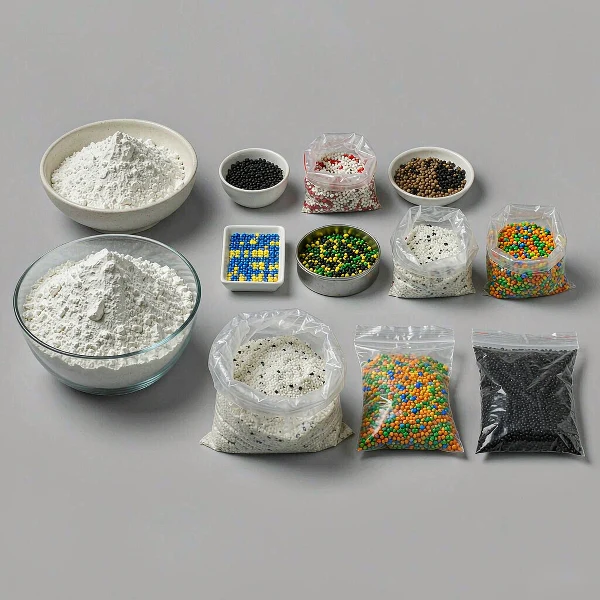
Balanced PVC formulations combine stabilizers, lubricants and processing aids.
| PVC Additive Type | Primary Function | Effect on Processing or Product Performance |
|---|---|---|
| Heat stabilizers | Limit thermal degradation during processing | Help maintain color and heat stability |
| Internal lubricants | Reduce friction within the compound | Influence melt viscosity, flow, and fusion behavior |
| External lubricants | Reduce adhesion between PVC and metal surfaces | Support material release and equipment surface control |
| Processing aids | Modify fusion and melt development | Influence fusion behavior, melt strength, and surface finish |
| Plasticizers | Increase flexibility | Change compound softness and processing characteristics |
| Impact modifiers | Improve impact resistance | May also affect fusion and mechanical properties |
| Fillers | Modify cost, stiffness, and other properties | Influence dispersion, rheology, and mechanical performance |
The important point is that these functions cannot always be separated in practice.
For example, the type and amount of lubricant may influence how quickly PVC fuses. A processing aid may improve melt development while increasing processing torque. The stabilizer system must provide adequate thermal protection under the resulting processing conditions.
A formulation should therefore be evaluated as a coordinated system rather than a collection of unrelated ingredients.
How PVC Stabilizers, Lubricants and Processing Aids Interact
Three additive groups have particularly important interactions during rigid PVC processing: heat stabilizers, lubricants, and processing aids.
Their combined performance influences how effectively the compound develops into a processable melt and how consistently that melt passes through the equipment.
Heat Stabilizers Protect the Processing Window
PVC is susceptible to thermal degradation when exposed to processing heat. Without sufficient stabilization, degradation may cause yellowing, progressive discoloration, and deterioration of material properties.
PVC heat stabilizers help limit this degradation, allowing manufacturers to process the material within an appropriate temperature and residence-time range.
Calcium-zinc stabilizers are commonly used in lead-free PVC formulations. Their effectiveness depends on the specific stabilizer composition, dosage, resin system, and processing conditions.
However, heat stability alone does not determine whether a formulation will process correctly.
A compound may retain its color during a static heat test but still exhibit delayed fusion or poor surface quality during extrusion.
This is because heat stabilizers primarily address thermal protection, while other additives influence friction, fusion, and material flow.
The stabilizer must provide suitable protection for the processing conditions created by the complete formulation.
Lubricants Control Friction and Material Release
Lubricants are essential to PVC processing because they influence friction within the material and between the compound and processing equipment.
Internal lubricants mainly reduce friction within the PVC compound and can influence melt viscosity and flow.
External lubricants primarily reduce adhesion between PVC and metal surfaces, helping the material move through the processing equipment.
In practice, the distinction is not absolute. Some lubricants provide both internal and external effects.
As described in Baerlocher's technical explanation of PVC lubricants, the balance between these effects depends on the lubricant chemistry and its interaction with the PVC system.
Excessive external lubrication can delay fusion by reducing the friction and shear transfer needed for PVC particle breakdown.
Insufficient lubrication, on the other hand, may contribute to high friction, difficult material release, excessive mechanical energy input, or surface problems.
This means lubricant selection should not focus only on reducing friction. It must also maintain suitable fusion behavior for the production process.
Processing Aids Influence Fusion and Melt Development
Plastic processing aids, particularly acrylic processing aids used in many rigid PVC formulations, influence how PVC particles fuse and develop into a continuous melt.
Depending on their chemistry and molecular characteristics, suitable processing aids may promote fusion, increase melt strength, and improve surface appearance.
These effects are valuable in applications where the compound requires controlled melt development or improved processing consistency.
However, increasing processing aid concentration can also change torque and the energy required during processing.
The relationship between processing aids and lubricants is especially important.
An external lubricant may delay fusion, while a suitable processing aid may promote melt development. The final result depends on the balance between the two, as well as the resin and equipment conditions.
For this reason, processing aid dosage should not be adjusted independently of the lubricant system.
Likewise, improving fusion does not eliminate the need for sufficient thermal stabilization. Faster or more intensive melt development may change the thermal and mechanical demands of the process.
Successful PVC compounding formulations coordinate these three functions rather than trying to maximize each one separately.
How Additive Balance Affects PVC Fusion and Extrusion
PVC fusion, sometimes referred to as gelation, is a key stage in developing the compound's processing characteristics and final properties.
During processing, PVC particles are exposed to heat, pressure, and mechanical shear. Their original particle structure progressively breaks down as the material develops into a fused melt.
The degree and consistency of fusion influence melt behavior and the performance of the finished product.
Additives affect this process because they alter friction, shear transfer, thermal protection, and interactions between formulation components.
A formulation with excessive external lubrication may require more time or energy to reach an appropriate fusion state.
By contrast, a formulation that develops fusion too rapidly under the selected equipment conditions may experience higher torque or excessive mechanical and thermal loading.
Neither extreme is desirable.
Manufacturers need a suitable fusion window in which the compound can be processed consistently without unnecessary degradation or unstable production.
Why Faster Fusion Is Not Always Better
A shorter fusion time may appear beneficial because it suggests that the compound develops into a melt more readily.
However, fusion time should not be evaluated without considering torque, temperature, heat stability, and final product properties.
A formulation that fuses rapidly but generates excessive torque may increase equipment loading or narrow the practical processing window.
Similarly, a formulation with slower fusion is not automatically unsuitable if the production equipment provides sufficient mixing and residence time for the intended product.
The objective is to obtain appropriate fusion under actual processing conditions, not simply the shortest possible fusion time.
The Effect of Resin and Filler Changes
Additive balance must also account for differences in raw materials.
PVC resin K-value, particle characteristics, and formulation composition can influence fusion and processing behavior.
Changing the resin grade may therefore alter how the same additive system performs.
Filler loading introduces another variable.
For example, increasing calcium carbonate content in a rigid PVC compound can change rheology, mixing behavior, mechanical properties, and the effective balance between additives.
If extrusion pressure or surface quality deteriorates after a filler change, adding more stabilizer may not address the underlying cause.
The manufacturer may need to reassess filler dispersion, lubrication, processing aids, and operating conditions together.
This is why additive formulations developed for one PVC grade or production line should not automatically be transferred to another without validation.
Common PVC Processing Problems Caused by Additive Imbalance
When processing becomes unstable, manufacturers often focus on the additive most closely associated with the visible symptom.
Yellowing may lead to increased stabilizer dosage, while rough surfaces may lead to additional processing aid.
Although these adjustments can sometimes help, the visible defect may result from interactions among several formulation components.
A more reliable approach is to identify the likely causes and determine which variables should be tested.
| Processing Problem | Possible Formulation-Related Causes | What to Evaluate |
|---|---|---|
| Delayed fusion | Excessive external lubrication, unsuitable processing aid balance, resin changes | Fusion time, torque, lubricant level, resin characteristics |
| Excessive torque | Lubrication imbalance, rapid fusion, high filler loading | Torque curve, temperature, formulation changes |
| Yellowing during processing | Insufficient thermal protection, excessive thermal exposure | Stabilizer system, residence time, temperature profile |
| Plate-out or deposits | Additive incompatibility, lubricant imbalance, other formulation components | Deposit characteristics, lubricant package, production duration |
| Unstable extrusion pressure | Inconsistent fusion, feeding or mixing variations, formulation changes | Pressure trend, fusion behavior, material consistency |
| Rough or inconsistent surfaces | Inadequate fusion, dispersion issues, unsuitable processing conditions | Fusion behavior, filler dispersion, die conditions |
| Inconsistent batch performance | Dosing variation, mixing inconsistency, raw-material differences | Batch records, ingredient control, compounding conditions |
These are diagnostic possibilities rather than definitive causes. Equipment condition, raw material quality, and processing settings must also be considered.
Consider a rigid PVC profile formulation that begins developing yellowing and occasional surface deposits after a change in stabilizer grade.
It may be tempting to increase the new stabilizer dosage immediately.
However, if the replacement stabilizer contains different lubricating components, the change may also have altered the formulation's total lubrication balance.
The compound could experience different fusion behavior, longer residence time in certain processing zones, or changes in material release from the equipment.
In this situation, increasing stabilizer dosage could also increase the lubricant content if the product is supplied as an integrated package.
A better investigation would compare the old and new formulations, including their total stabilizer and lubricant contributions, before selecting the next adjustment.
The same reasoning applies when a manufacturer switches resin suppliers, increases filler content, or changes production speed.
Processing problems should be investigated through the complete material and equipment system rather than assigning every symptom to a single additive.
How to Evaluate Additive Compatibility in PVC Compounding
Understanding additive interactions is useful only when manufacturers can translate that knowledge into repeatable production decisions.
A controlled PVC additive compatibility evaluation should begin with a reference formulation that already has documented processing and product-performance results.
The reference allows engineers to determine whether a proposed change improves the target property without causing unacceptable changes elsewhere.
Before testing, the manufacturer should record the resin grade, formulation dosages, mixing procedure, and relevant processing conditions.
Candidate formulations should then be compared using consistent methods.
Compare Fusion, Stability and Processing Performance
For rigid PVC compounds, torque-rheometer testing can help evaluate changes in fusion behavior and processing response.
The test may provide information about fusion time, torque development, and the compound's behavior under defined temperature and mixing conditions.
These results should be considered alongside thermal stability measurements, finished-product properties, and observations from actual production equipment.
The evaluation can be organized around the following indicators.
| Evaluation Area | Typical Measurement or Observation | Purpose |
|---|---|---|
| Fusion behavior | Fusion time and torque curve | Identify changes in melt development |
| Thermal stability | Heat-aging results and color changes | Evaluate thermal protection |
| Processing conditions | Melt temperature, pressure, equipment load | Assess operating behavior |
| Surface quality | Roughness, gloss, visible defects | Evaluate finished-product appearance |
| Plate-out | Deposits on tooling or contact surfaces | Assess compatibility during operation |
| Mechanical properties | Impact resistance, tensile properties as applicable | Confirm finished-product requirements |
| Production consistency | Output variation, batch differences, rejection rate | Evaluate repeatability |
When comparing results, it is important to distinguish between laboratory performance and production-line performance.
A formulation may demonstrate acceptable fusion behavior in a laboratory mixer but respond differently to the shear, residence time, and temperature profile of a commercial extruder.
Likewise, plate-out may not become evident during a short trial.
For this reason, promising laboratory results should be followed by representative production testing.
Changes should be made in controlled increments, and the results should be documented against the original formulation.
Evaluate the Complete Additive Package
When manufacturers use integrated stabilizer systems, changes in product dosage can affect more than one function.
A one-pack PVC stabilizer may include heat-stabilizing components, co-stabilizers, lubricants, and selected processing additives.
However, the composition varies by product, and not every additive required by the complete PVC formulation is necessarily included.
If the dosage of a one-pack system is increased, the contribution of its lubricating and functional components may also change.
Therefore, manufacturers should confirm the package's intended scope and consider the full formulation before making adjustments.
The same principle applies when combining separately supplied additives.
An individually effective stabilizer or processing aid may require additional formulation adjustments when used with a different lubricant system.
A well-designed additive package should deliver a practical balance of thermal stability, fusion behavior, processing consistency, and finished-product performance.
How AIMSEA Supports Balanced PVC Additive Formulations
For manufacturers working with challenging PVC compounds, selecting an additive supplier involves more than identifying a suitable stabilizer grade.
The supplier should also understand how stabilization and processing requirements change across different PVC applications.
Founded in 1997, AIMSEA specializes in PVC stabilizers and functional plastic additives, with experience in application-specific formulation development and manufacturing support.
Its product portfolio includes calcium-zinc PVC stabilizers, integrated one-pack stabilizer systems, and specialty additive solutions for rigid, flexible, transparent, and recycled PVC applications.
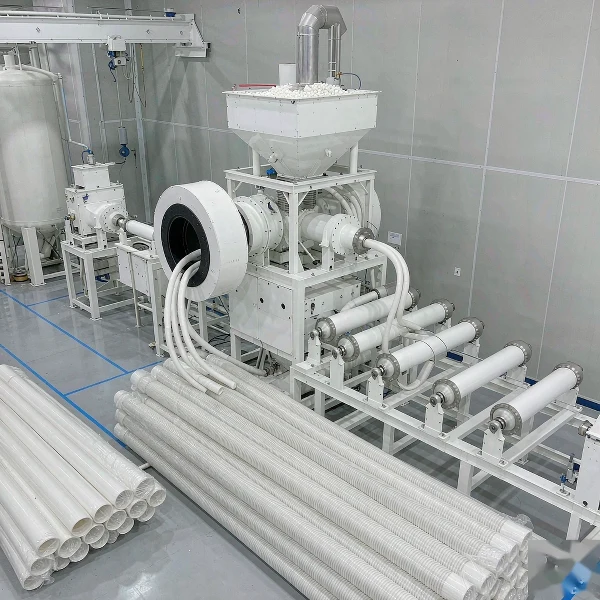
AIMSEA supplies application-specific stabilizers for pipe and profile extrusion.
AIMSEA's technical resources include formulation development and testing capabilities that support product evaluation and adjustment for different manufacturing conditions.
Application-Specific Stabilizer and Lubrication Balance
AIMSEA's calcium-zinc stabilizer solutions are developed for different processing requirements rather than a single universal PVC formulation.
For example, its AIMSTA-C500P stabilizer is positioned for water-supply pipe extrusion, where heat stability during continuous processing is an important consideration.
AIMSTA-C508 is intended for PVC pipe fittings and other injection-molded applications requiring suitable lubrication and release behavior.
These applications illustrate why the same stabilization approach may require different processing characteristics.
Pipe extrusion involves continuous melt development and material flow, while injection molding introduces different filling, residence-time, and release requirements.
In PVC profile extrusion, AIMSEA also offers products such as AIMSTA-5094, which emphasizes thermal stability and reduced plate-out for profile processing.
The specific formulation and dosage should be selected according to the resin, filler level, production equipment, and finished-product requirements.
Integrated One-Pack Stabilizer Solutions
AIMSEA also develops one-pack PVC stabilizer systems that combine stabilization with selected lubricating and functional components.
An integrated system can simplify the handling and dosing of certain additives, helping manufacturers manage formulation consistency.
However, the technical value of a one-pack is not simply the reduction in the number of ingredients weighed during production.
Its performance depends on whether the stabilizer and other included components are appropriately balanced for the intended application.
A formulation designed for PVC pipe extrusion should not automatically be used for transparent calendered film or flexible PVC tubing.
The required stabilization, lubrication, fusion behavior, and finished-product properties can differ significantly.
AIMSEA supports application-focused product selection and formulation evaluation to help manufacturers identify suitable stabilizer systems for their processing requirements.
Technical Support for Formulation Evaluation
When evaluating a PVC compound, manufacturers can provide AIMSEA with the existing formulation, resin characteristics, processing method, and observed production problems.
Useful information includes the current stabilizer and lubricant dosages, filler content, processing temperature profile, fusion behavior, and finished-product requirements.
These details help establish whether the primary concern involves thermal stability, lubrication balance, processing conditions, or interactions between several variables.
AIMSEA can then discuss suitable product directions and sample evaluation requirements, allowing the manufacturer to compare candidate formulations under controlled conditions.
For B2B buyers, this approach makes technical discussions more productive than requesting a stabilizer solely on the basis of price or a general product description.
Frequently Asked Questions About PVC Compound Additives
1. What are PVC compound additives?
PVC compound additives are ingredients added to PVC resin to provide thermal stability, control processing behavior, and achieve specific finished-product properties. They include heat stabilizers, lubricants, processing aids, plasticizers, fillers, impact modifiers, and other functional additives.
2. How do heat stabilizers and lubricants work together in PVC?
Heat stabilizers protect PVC against thermal degradation, while lubricants influence friction, melt flow, and material release. Their combined behavior affects the processing window, so both systems should be evaluated under the same formulation and operating conditions.
3. Can too much external lubricant delay PVC fusion?
Yes. Excessive external lubrication can reduce the friction and shear transfer required for PVC particle breakdown, delaying fusion under certain processing conditions. The effect depends on lubricant chemistry, resin characteristics, and equipment settings.
4. Do PVC processing aids replace heat stabilizers?
No. Processing aids primarily influence fusion and melt behavior, while heat stabilizers protect against thermal degradation. Both may be necessary, but their functions are different.
5. Why does changing a PVC stabilizer affect extrusion performance?
A change in stabilizer chemistry or formulation may alter lubrication balance, compatibility, and processing behavior. This is especially relevant when replacing a stabilizer package containing multiple functional components.
6. How can manufacturers improve PVC compounding consistency?
Manufacturers should maintain accurate formulation records, control ingredient dosing and mixing, evaluate fusion and thermal stability, and compare additive changes through controlled laboratory and production trials.
Conclusion
Effective PVC processing depends on how different additive functions work together.
Heat stabilizers protect against degradation, lubricants control friction and material release, and processing aids influence fusion and melt development. Plasticizers, fillers, and other ingredients further affect how the complete compound behaves.
The goal is not to maximize the dosage of any single additive, but to establish a suitable balance for the resin, production equipment, and finished-product requirements.
With its application-specific calcium-zinc stabilizers, one-pack additive systems, and formulation development capabilities, AIMSEA supports PVC manufacturers in evaluating stabilizer and additive combinations for their processing needs.
Need help evaluating your PVC stabilizer and additive balance?
Share your PVC application, existing formulation, and processing challenges with AIMSEA to discuss suitable product options and sample testing before full-scale production.