

Posted by Ms.Yan
in blog
Technical Engineer
Updated 2026-10-19
How to Choose Specialty PVC Additives for Challenging Formulations
Read:37
Source:
PVC manufacturers often encounter processing and product-quality problems that cannot be solved simply by increasing stabilizer dosage or adjusting processing temperatures. A formulation may offer adequate thermal stability but still experience yellowing, surface deposits, poor fusion, unpleasant odor, or inconsistent product quality.
These challenges become more complicated when working with recycled PVC, high filler loading, transparent products, or formulations requiring specific flame-retardant performance. Selecting the right specialty PVC additives requires an understanding of the complete formulation rather than focusing on individual ingredients.
This guide explains how to identify formulation challenges, select suitable additives for different PVC applications, and evaluate their performance before full-scale production.
Quick Answer
Choosing specialty PVC additives starts with identifying processing problems, matching additive functions to application requirements, and evaluating compatibility, thermal stability, and finished-product performance through controlled formulation trials before production.
Key Takeaways
Identify the underlying problem first. Yellowing, plate-out, poor fusion, and odor may require different additive solutions.
Consider the complete formulation. Heat stabilizers, lubricants, processing aids, fillers, and plasticizers influence one another.
Match additives to the application. Transparent, recycled, rigid, flexible, and flame-retardant PVC compounds have different performance priorities.
Verify performance under realistic conditions. Laboratory screening should be followed by representative production trials.
Evaluate technical support as well as product specifications. Application-specific formulation knowledge can help manufacturers select more suitable additive systems.
What Makes a PVC Formulation Challenging?
PVC formulations must balance thermal stability, processing behavior, mechanical properties, appearance, and cost. When manufacturers introduce new raw materials or change production requirements, this balance can become difficult to maintain.
PVC is particularly sensitive to heat during processing. Without adequate stabilization, thermal degradation can cause discoloration and deterioration of material properties. However, yellowing does not necessarily mean that the stabilizer dosage is too low. Excessive processing temperatures, prolonged residence time, unsuitable lubrication, or interactions between additives may also contribute.
Another common challenge is plate-out, where formulation components accumulate on equipment surfaces such as extrusion dies, calender rolls, or molds. These deposits can affect product appearance, interrupt production, and increase cleaning requirements. Their formation may depend on additive compatibility, lubrication balance, processing conditions, and other ingredients in the compound.
Fusion behavior adds another layer of complexity. A PVC formulation may exhibit poor melt development, irregular extrusion pressure, or inconsistent surface quality even when its heat stabilizer performs adequately. In such cases, adjusting processing aids or lubricants may be more relevant than adding extra stabilizer.
The challenge is therefore not always a shortage of additives. It is often an imbalance between the formulation, manufacturing process, and finished-product requirements.
As explained by the European Council of Vinyl Manufacturers (ECVM), PVC additives perform different functions, including stabilization, lubrication, flexibility modification, and other application-specific improvements. Their combined use allows PVC compounds to serve a wide range of industrial applications.
For manufacturers, this means the selection process should begin with a clear understanding of which property needs improvement and which formulation components may be influencing it.
How to Identify the Right Specialty PVC Additives
The most practical way to choose specialty PVC additives is to connect an observed processing or product-quality problem with the additive functions that may help address it.
Rather than selecting an additive based on a broad product description, manufacturers should first determine whether the challenge primarily involves thermal degradation, fusion behavior, surface quality, odor, or a specific finished-product requirement.
| PVC Formulation Challenge | Additive Functions to Evaluate | Key Evaluation Factors |
|---|---|---|
| Yellowing or poor heat stability | PVC heat stabilizers and co-stabilizers | Heat-aging performance, processing temperature, color retention |
| Poor fusion or inconsistent melt behavior | PVC processing aids and lubrication systems | Fusion time, torque, melt development |
| Plate-out and surface deposits | Stabilizer compatibility and lubrication balance | Surface deposits, tooling cleanliness, processing duration |
| Haze or reduced transparency | Transparent-grade stabilizers and compatible additives | Haze, light transmission, dispersion, color stability |
| Odor in recycled PVC | Plastic deodorants and suitable stabilization systems | Odor source, residual contaminants, processing conditions |
| High-filler processing difficulties | Stabilizers, lubricants, and processing aids | Filler dispersion, torque, mechanical properties |
| Flame-retardant formulation issues | Flame retardants and compatible additive systems | Fire-performance requirements, flexibility, mechanical properties |
These are evaluation directions, not guaranteed remedies. Multiple factors may contribute to the same processing problem.
Heat Stabilizers and Processing Additives
PVC heat stabilizers protect the polymer against thermal degradation during processing. Calcium-zinc stabilizer systems are commonly considered for applications seeking lead-free stabilization, although different formulations may offer different levels of heat stability, initial color performance, transparency, and processability.
PVC processing aids serve a different function. They influence fusion and melt behavior and may improve processing consistency in suitable formulations. They cannot replace the thermal protection provided by stabilizers.
Lubricants also play an important role. Internal lubricants influence friction within the compound, while external lubricants help reduce adhesion between PVC and processing equipment. Their functions can overlap, and an unsuitable lubrication balance may delay fusion or contribute to surface problems.
These interactions explain why increasing one additive does not always improve the overall formulation. A compound may require adjustments to several components, but those adjustments should be based on controlled evaluation rather than trial-and-error dosing.
Choosing PVC Additives for Different Applications
Different PVC products require different combinations of processing and performance properties. An additive system suitable for rigid pipe extrusion may not meet the transparency requirements of a clear sheet or the odor requirements of a recycled PVC compound.
The following applications illustrate why additive selection should be based on actual manufacturing conditions.
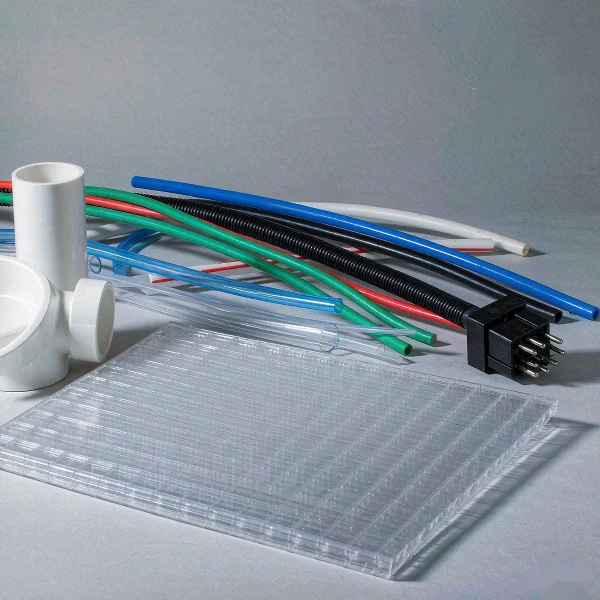
Different PVC applications rely on different additive systems.
Transparent PVC and Low-Plate-Out Requirements
Transparent PVC is particularly sensitive to additive compatibility, dispersion, and thermal discoloration. Small changes in haze, yellowing, gloss, or surface deposits can directly affect finished-product acceptance.
For manufacturers producing transparent films, sheets, hoses, or consumer products, the stabilizer system must provide an appropriate balance of thermal stability and optical performance.
AIMSEA offers application-specific ultra-clear calcium-zinc stabilizer solutions, including AIMSTA-T191 and AIMSTA-6809T.
AIMSTA-T191 is positioned for semi-rigid transparent PVC products where clarity, heat resistance, color retention, and low-odor characteristics are important. AIMSTA-6809T is designed for ultra-clear PVC applications, including transparent tubing and products where resistance to copper-related staining may be relevant.
AIMSEA also emphasizes low-odor and reduced plate-out behavior in its transparent PVC stabilizer development. These technical directions are particularly relevant to manufacturers concerned about deposits on molds and metal surfaces during continuous processing.
However, low plate-out performance should be evaluated under representative production conditions. Actual results depend on the complete formulation, equipment, operating temperature, and production duration.
For transparent PVC manufacturers, a suitable stabilizer should therefore be evaluated through a combination of heat-aging tests, optical measurements, surface inspection, and extended processing trials.
Recycled PVC and Odor Control
Recycled PVC can contain residual additives, degraded materials, or contaminants from previous manufacturing and use. Variations in raw material composition may also affect thermal stability, processing behavior, and odor.
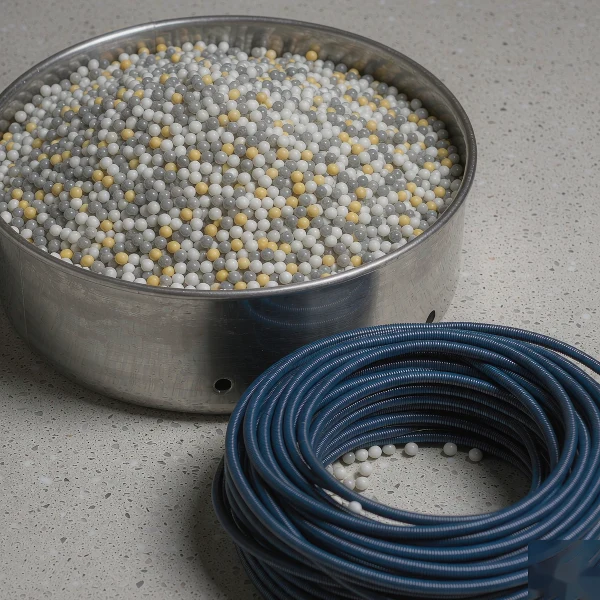
Recycled PVC requires stabilization and odor control to be evaluated together.
Before introducing a plastic deodorant, manufacturers should investigate the source of the odor. Residual contaminants, inappropriate processing temperatures, and thermal degradation may require different corrective actions.
Plastic deodorants may help address certain odor problems, but they should not replace material cleaning, contaminant control, or appropriate heat stabilization.
AIMSEA provides plastic deodorant and recycled PVC additive solutions for application-specific evaluation. Manufacturers can use representative samples to compare odor characteristics, heat stability, and finished-product performance before adopting a new additive system.
High-Filler PVC and Processing Stability
High-filler PVC formulations can create difficulties in fusion, dispersion, surface quality, and mechanical performance. Increasing filler loading changes the balance of the compound and may require adjustments to lubrication, processing aids, and stabilizers.
For example, if a high-calcium-carbonate PVC formulation develops irregular extrusion pressure or rough surfaces, increasing stabilizer dosage alone may not resolve the problem.
The manufacturer should first assess filler properties, dispersion, fusion behavior, and the existing lubrication system.
An appropriate specialty additive package can then be evaluated based on the required processing characteristics and finished-product specifications.
Flame-Retardant PVC Compounds
Flame-retardant PVC formulations must satisfy specific fire-performance requirements without unnecessarily compromising processing behavior or mechanical properties.
The addition of flame-retardant ingredients may influence compound flexibility, tensile performance, dispersion, and thermal processing conditions.
For cable insulation, sheathing, and other technical products, manufacturers should evaluate the additive system against the relevant finished-product standard.
AIMSEA supplies functional flame-retardant additives for plastic compounds. Selection should be based on the required fire-performance test, formulation compatibility, and application conditions rather than additive content alone.
Why PVC Additive Compatibility Matters
One of the most common mistakes in PVC formulation development is evaluating each additive independently.
A stabilizer, lubricant, or processing aid may perform well in isolation but behave differently when introduced into a complete compound.
For example, increasing external lubricant content may reduce adhesion to processing equipment but also affect PVC fusion. Changing a stabilizer system may influence thermal stability while altering surface behavior or compatibility with other formulation components.
Similarly, increasing filler loading may change processing demands even when the stabilizer concentration remains unchanged.
Consider a rigid PVC compound that begins showing yellow discoloration and surface deposits during continuous extrusion.
The manufacturer may initially suspect inadequate stabilization and increase the stabilizer dosage. However, the actual cause could involve excessive residence time, lubricant imbalance, or changes in filler and processing conditions.
Adding more stabilizer in this situation could increase formulation cost without resolving the problem.
A better approach is to compare current production conditions with a previously successful batch, identify which materials or operating parameters have changed, and evaluate suspected variables individually.
This is particularly important for manufacturers transitioning from conventional stabilizer systems to lead-free calcium-zinc formulations. Changes in stabilization chemistry may require corresponding adjustments to lubrication and processing conditions.
A customized PVC additive package may be worth considering when a standard formulation cannot meet several critical requirements simultaneously. For example, a manufacturer may need high transparency, low odor, good thermal stability, and reduced plate-out during extended calendering.
In such cases, a coordinated additive system may offer a more practical development approach than repeatedly adjusting separate components.
Customization is not always necessary, however. When a standard product already meets the technical requirements, additional formulation complexity may not provide meaningful benefits.
How to Evaluate Specialty PVC Additives Before Production
Selecting an additive from a technical data sheet is only the beginning. Its effectiveness must be confirmed in the actual PVC formulation and, where necessary, under representative manufacturing conditions.
A reliable evaluation begins by documenting the existing recipe, including PVC resin grade, stabilizer system, lubricants, plasticizers, fillers, and other relevant ingredients. Processing temperatures, equipment type, and current defects should also be recorded.
Candidate additives can then be tested against this baseline. Wherever practical, trials should maintain consistent processing conditions and change only the variables necessary to evaluate the proposed solution.
The appropriate measurements will depend on the application.
| Evaluation Item | What to Check | Why It Matters |
|---|---|---|
| Thermal stability | Heat aging and color change | Determines resistance to processing degradation |
| Fusion behavior | Fusion time, torque, melt development | Evaluates processing compatibility |
| Surface quality | Gloss, defects, roughness, deposits | Identifies appearance and plate-out concerns |
| Transparency | Haze and light transmission | Important for clear PVC applications |
| Odor | Odor assessment under defined conditions | Relevant to recycled and consumer-facing products |
| Mechanical properties | Tensile, impact, elongation as applicable | Confirms finished-product requirements |
| Production consistency | Pressure, output, color, batch variation | Assesses performance under operating conditions |
Laboratory tests can identify promising candidates, but they may not reveal problems that develop during extended production. Plate-out, for example, may become noticeable only after prolonged equipment operation.
Manufacturers should therefore confirm important laboratory findings through representative production trials before final approval.
Cost evaluation should also go beyond the price per kilogram of additive. Actual dosage, product rejection rates, cleaning requirements, line interruptions, and qualified material yield all influence the effective production cost.
A more expensive additive may be economically justified if controlled trials demonstrate a reduction in overall production cost. Conversely, a higher-priced formulation should not be selected without measurable technical or operational benefits.
The most reliable decision is based on documented test results and finished-product acceptance criteria rather than supplier claims alone.
How AIMSEA Supports Application-Specific PVC Additive Solutions
Choosing a suitable PVC additive supplier involves more than comparing product catalogs. For challenging formulations, the supplier's technical experience, development capabilities, and understanding of industrial PVC applications can be equally important.
Founded in 1997, AIMSEA has built nearly three decades of experience in PVC stabilizers and functional plastic additives. Its product development focuses on application-specific formulation requirements, particularly lead-free stabilization, processing consistency, transparent PVC performance, and specialty additive solutions.
AIMSEA combines in-house formulation development with a dedicated research and technical team. Its technical resources include more than 30 patented technologies, over 50 advanced testing equipment units, and an annual production capacity of 60,000 tons, supporting product development, quality control, and industrial supply requirements.
This combination of formulation experience, testing resources, and manufacturing capability enables AIMSEA to support customers from initial additive selection through sample evaluation and production-scale implementation.
Application Experience Across PVC Manufacturing
AIMSEA serves a broad range of PVC manufacturing applications, including wire and cable, pipes and fittings, building materials, medical-related products, injection-molded products, foamed materials, and transparent PVC items.
Each application requires a different balance of thermal stability, processing characteristics, appearance, and finished-product performance.
For example, transparent PVC manufacturers may prioritize clarity, color stability, and low plate-out behavior, while pipe producers may focus more on processing stability, long-term performance, and consistency across production batches.
AIMSEA's product portfolio includes calcium-zinc PVC stabilizers, one-pack stabilizer systems, plastic deodorants, and functional additives for specialized compounds.
Its transparent PVC stabilizers, including AIMSTA-T191 and AIMSTA-6809T, illustrate how additive development can be tailored to specific applications rather than relying on a universal stabilizer formulation.
Low-odor processing and reduced plate-out are also important development priorities within AIMSEA's selected stabilizer solutions. These characteristics are particularly relevant to manufacturers aiming to maintain cleaner processing conditions and consistent product appearance.
By combining application knowledge with formulation development and testing resources, AIMSEA can help manufacturers identify suitable additive options and establish practical evaluation plans.
Environmental Requirements and Product Documentation
Environmental performance and regulatory requirements are important considerations when selecting PVC additives, particularly for manufacturers supplying European and other regulated markets.
AIMSEA develops lead-free PVC stabilizer solutions and supports customers with product selection for applications involving requirements such as RoHS, REACH, and relevant industry standards.
Because requirements vary by substance, product type, and end-use application, manufacturers should evaluate compliance based on the specific additive grade and intended market.
The European Chemicals Agency (ECHA) provides information on REACH restrictions, including conditions that may apply to specific substances, mixtures, and articles.
For applications such as medical-related products, toys, and electrical components, appropriate technical documentation and product-specific testing are particularly important.
AIMSEA's technical and application support helps customers evaluate additive options alongside their processing, performance, and documentation requirements.
What Information Should Buyers Provide to Get the Right PVC Additive?
When contacting a supplier, manufacturers can improve the accuracy of technical recommendations by providing more than a product name or target price.
A useful inquiry describes the finished product, existing formulation, processing method, and problem to be solved.
| Information | Example |
|---|---|
| PVC product | Transparent sheet, rigid pipe, cable compound, recycled PVC |
| Resin information | PVC grade and K-value |
| Existing formulation | Stabilizer, lubricant, filler, plasticizer, processing aid |
| Manufacturing process | Extrusion, calendering, injection molding |
| Current problem | Yellowing, plate-out, odor, poor fusion |
| Required performance | Transparency, heat stability, mechanical properties |
| Operating conditions | Temperature profile, equipment, line speed |
| Target market | Applicable standards and documentation requirements |
For example, a transparent PVC manufacturer experiencing yellowing and deposits during calendering should describe both problems instead of simply requesting a higher-performance stabilizer.
This allows the supplier to consider whether the issue involves thermal stability, lubrication balance, additive compatibility, or processing conditions.
AIMSEA can use this information to discuss suitable additive options, relevant product grades, and an appropriate sample evaluation approach.
Frequently Asked Questions About Specialty PVC Additives
What are specialty PVC additives?
Specialty PVC additives are functional ingredients or additive systems selected for specific processing or product requirements. They may address thermal stability, fusion, transparency, odor, flame retardancy, or other performance characteristics.
How do I choose the right PVC additive for my formulation?
Start by identifying the main processing or product-quality problem. Review the existing formulation, determine which additive functions may be relevant, and compare suitable candidates through controlled testing.
Can PVC additives help reduce plate-out?
An appropriate formulation may reduce plate-out when the problem is related to additive compatibility or lubrication balance. Results depend on the complete compound and processing conditions, so representative production testing is important.
Are calcium-zinc stabilizers suitable for transparent PVC?
Certain calcium-zinc stabilizers are specifically formulated for transparent PVC applications. Their suitability depends on optical requirements, heat stability, formulation compatibility, and processing conditions.
Do recycled PVC compounds need different additives?
They may require formulation adjustments because recycled materials can contain residual additives, degradation products, or contaminants. Appropriate stabilization and odor-control measures depend on the material source and intended application.
When should manufacturers consider a customized PVC additive system?
A customized system may be useful when standard additives cannot provide the required combination of thermal stability, processing behavior, appearance, and finished-product performance. The need should be confirmed through formulation review and comparative trials.
Conclusion
Selecting specialty PVC additives requires a clear understanding of the manufacturing problem, the complete formulation, and the performance expected from the finished product.
Heat stabilizers, processing aids, lubricants, and functional additives each serve different purposes, but their interactions often determine whether a formulation performs consistently in production.
For transparent PVC, recycled compounds, high-filler materials, and flame-retardant applications, selection should be based on application-specific requirements and controlled evaluation.
With nearly three decades of industry experience, application-focused product development, and dedicated technical resources, AIMSEA supports manufacturers in identifying and evaluating suitable PVC additive solutions.
The goal is not simply to add more ingredients, but to develop a formulation that meets processing requirements, product specifications, and practical production objectives.
Need a specialty PVC additive solution for a challenging formulation?
Contact AIMSEA with your PVC application, processing conditions, and current formulation concerns to discuss suitable products and sample testing.