

Posted by Ms.Yan
in blog
Technical Engineer
Updated 2026-09-28
Why PVC Cable Insulation Resistance Falls After Water Immersion
Read:16
Source:
PVC cable insulation resistance after water immersion can fall because absorbed moisture and wet or contaminated surfaces allow greater electrical leakage. At the same applied voltage, more leakage current produces a lower resistance reading. Test temperature, specimen geometry and physical defects can also affect the result, so the cause should be established before changing the formulation.
The practical sequence is to check the measurement, compare specimens before and after immersion, assess recovery where appropriate, and trace material or processing changes. Drying may restore resistance when the moisture effect is reversible. It does not establish that the cable passed its required wet-condition test.
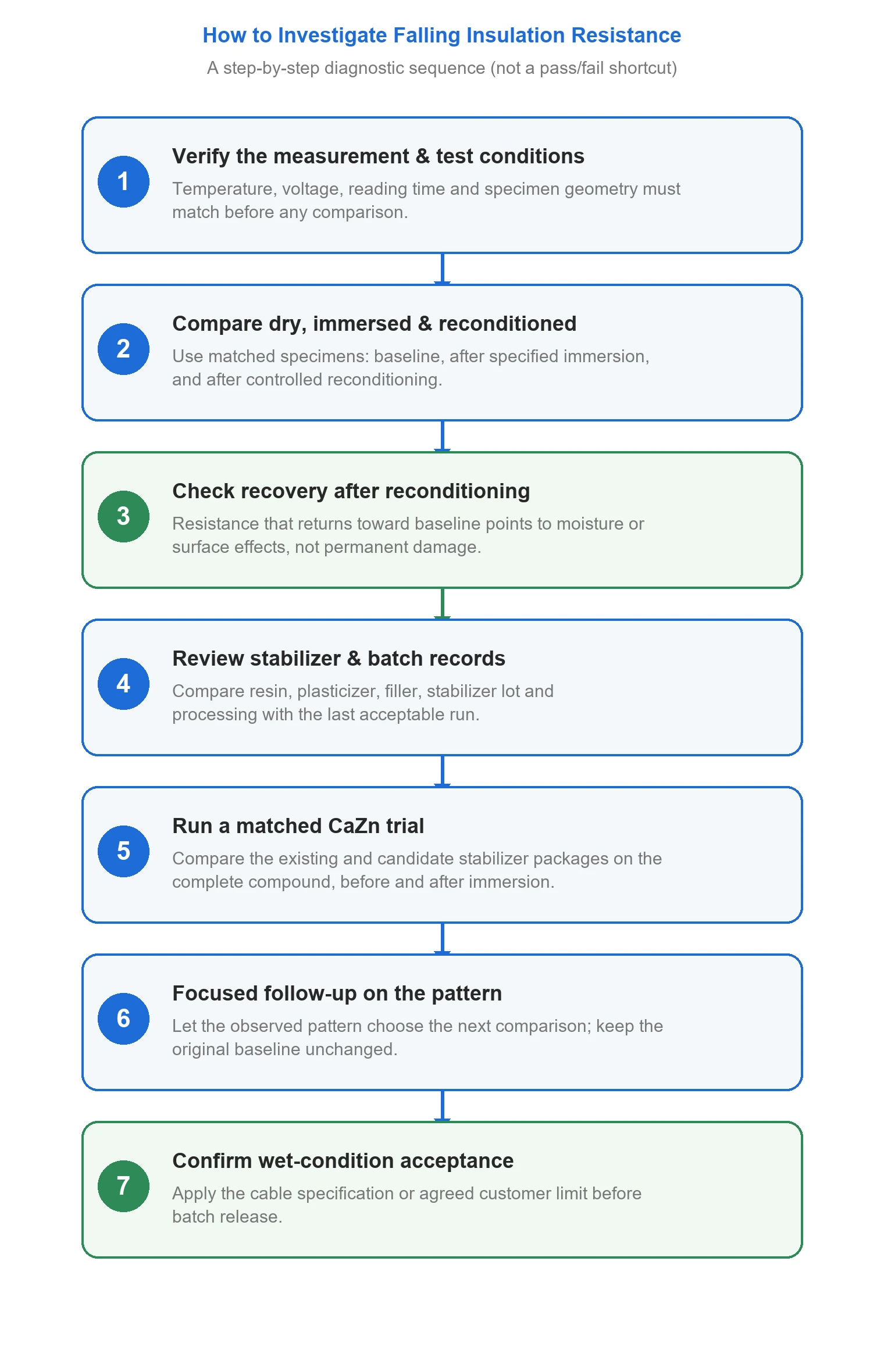
Figure 1. Investigation sequence: verify the measurement, compare dry, immersed and reconditioned specimens, review batch records, run a matched trial, then confirm acceptance.
Why Water Exposure Can Lower PVC Insulation Resistance
PVC insulation is not an absolute barrier to moisture. During prolonged exposure, moisture can enter the material. Dissolved salts and other ionic contaminants can also increase water conductivity, contributing to leakage at wet surfaces or damaged areas. The resulting leakage depends on the compound, water conditions, exposure history and test arrangement.
This is why clean laboratory water and contaminated site water should not be treated as equivalent exposures. Record the specified water quality rather than assuming that every immersion test imposes the same conditions.
Separate Moisture Absorption from Direct Water Entry
Moisture within an intact insulation layer is different from water reaching a conductor through an open end, split, joint or damaged sheath. Wet ends can introduce surface leakage, while direct ingress may expose metallic components to corrosion. A recovered resistance reading cannot establish that those components are undamaged.
Check the cable construction as well. A PVC outer sheath does not mean that the conductor insulation is PVC. Identify the insulation material before applying an explanation or test criterion intended for a different cable system.
Does a Lower Reading Mean Permanent Damage?
Not necessarily. Resistance can recover as moisture leaves an otherwise intact PVC insulation compound, but recovery depends on the material and exposure conditions. It should be demonstrated through controlled measurements rather than assumed.
Water treeing discussed for polyethylene-based cable insulation under electrical stress should not be used as the default explanation for a PVC immersion-test failure. Equally, a potentially reversible moisture effect does not make every water-exposed cable acceptable. Separate material recovery from damage, contamination and the product’s wet-service requirements.
Check the Test Conditions Before Comparing Results
Begin with the actual test report and specimen arrangement. Identify whether the measurement concerns an insulated conductor in a water bath, a finished cable or a molded compound specimen. Results from these configurations cannot automatically be compared on the same basis.
Distinguish Insulation Resistance from Volume Resistivity
Insulation resistance is measured in ohms, often reported as megohms or gigohms. Volume resistivity accounts for specimen geometry and is commonly expressed in ohm-metres or ohm-centimetres. A resistivity figure from a compound data sheet is therefore not directly equivalent to a resistance reading from a cable.
ASTM D257 distinguishes resistance from resistivity calculated using specimen geometry. Use the quantity, method and acceptance criterion specified for the cable being tested.
Check sample length, insulation thickness and electrode arrangement before comparing batches. Where a specification requires a length-normalized result, retain the original measurement and apply its prescribed calculation. This keeps a dimensional difference from being mistaken for a formulation change.
Keep Temperature, Voltage and Reading Time Comparable
A room-temperature dry reading and a reading taken immediately after a warm-water test include more than a moisture difference. Record measurement temperature separately from bath temperature, together with the elapsed time between conditioning and measurement.
Use the specified test voltage and reading time consistently. If measurement must take place while the specimen remains immersed, preserve that condition. Cooling or drying it first would answer a different question.
Label additional diagnostic conditions separately. Use temperature correction only where an applicable method supports it.
Inspect Cable Ends and Test Connections
Check exposed ends, fixtures and leads for moisture, contamination or unintended contact. Record the original arrangement before making corrections so that an improved result can be linked to a specific change.
Where permitted by the method, a guard terminal can help exclude selected surface-leakage currents from the measurement. Its use must follow the instrument instructions and preserve the leakage paths that the acceptance test is intended to assess.
Testing belongs with qualified laboratory personnel using isolated specimens and the required discharge procedure. Have the laboratory verify the instrument and fixture through its normal quality-control checks before using repeated low readings to justify reformulation.
Compare Dry, Immersed and Reconditioned Specimens
Prepare matched specimens from the same production length where practical, and include a retained reference batch with established performance. Testing the reference alongside the suspect material helps distinguish a batch-specific change from a shift affecting the whole test run.
The three conditions below answer different questions. Recovery is an additional diagnostic stage; acceptance follows the specified wet test.
| Condition | Main question | Details needed for comparison |
|---|---|---|
| Baseline, before immersion | Was electrical performance already low? | Specimen preparation, dimensions, conditioning and measurement temperature |
| After specified immersion | Does the specimen meet the wet-condition requirement? | Immersion time, bath conditions, end preparation and measurement arrangement |
| After controlled reconditioning | Does resistance recover under the selected recovery conditions? | Recovery time, temperature, humidity and any drying treatment |
“Dry” should describe a defined conditioning procedure, not simply a surface that feels dry. Keep water quality, immersion depth and any required water-renewal schedule consistent. Document changes rather than assuming they have no effect.
What Recovery Can Reveal
If resistance falls after immersion and moves back toward the baseline after reconditioning, investigate reversible moisture and surface effects. The recovery pattern helps narrow the investigation, but it does not establish suitability under the original wet condition.
If readings remain low, inspect for persistent contamination, physical defects or a material change. Also check whether the recovery procedure was appropriate and whether the reference batch behaved normally. Lack of recovery does not identify a specific chemical cause by itself.
A shift in both the reference and suspect specimens points first toward shared conditions: the bath, instrument, preparation or test sequence. A repeatable difference confined to the suspect batch gives a stronger reason to investigate its materials and processing history.
Review the PVC Wire and Cable Stabilizer with Other Batch Changes
Place the first failing production run on a timeline. Compare it with the last acceptable run, including raw-material lots, weighing records, mixing conditions and extrusion settings. A change in the PVC wire and cable stabilizer matters, but it should not obscure changes elsewhere in the compound.
| Investigation area | Records to compare | Practical next step |
|---|---|---|
| Resin and plasticizer | Grade, supplier, lot and material specifications | Compare retained lots in a controlled blend |
| Fillers and pigments | Grade, substitutions, storage and handling | Check whether failures track a particular lot or handling change |
| Stabilizer and other additives | Product designation, lot, dosage and weighing records | Confirm the intended package and actual addition |
| Mixing and extrusion | Sequence, temperatures, interruptions and dimensional records | Compare affected and unaffected production periods |
| Specimen preparation | Cutting, identification, storage and end treatment | Repeat preparation consistently before changing the formulation |
A difference in the records identifies a candidate cause, not a conclusion. The next trial should test whether that difference reproduces the behavior.
Look at individual specimens as well as batch averages. An isolated damaged section calls for a different investigation from a consistent decline across all samples. Compare insulation thickness and visible condition along the sampled length, keeping photographs linked to specimen identities.
Water-absorption measurements may add useful information, but absorbed mass and insulation resistance are separate results. A low absorption value cannot substitute for the required electrical measurement. Record both under their own methods and conditions.
Evaluate a CaZn Stabilizer for PVC Cable Through a Matched Trial
If the evidence points toward the stabilization package, compare the existing and candidate systems in the same base formulation. Keep resin, plasticizer, filler, specimen preparation and testing comparable wherever feasible. Record any adjustments needed to process the candidate successfully.
The useful comparison is how the complete compound behaves before and after immersion. A candidate that produces a higher initial resistance but still fails the wet requirement has not resolved the problem. Likewise, a better wet result needs to be repeatable under the specified conditions before it supports a production decision.
When several ingredients change together, the trial evaluates the combined formulation. A favorable result may justify further work on that combination, but it cannot isolate the contribution of the stabilizer alone.
Check More Than PVC Heat Stabilizer Performance
A PVC heat stabilizer must suit the processing conditions, but good thermal-stability results do not predict wet electrical acceptance on their own. Keep heat-stability, water-absorption and electrical measurements as separate checks within the trial.
Include the relevant aging and temperature-grade checks in the PVC cable compound testing plan. This helps confirm that a change made to address wet resistance also preserves the other properties required of the cable.
Select a Stabilizer for the Insulation Compound
Match the stabilizer to the insulation layer being produced. AIMSTA-6703W is intended for PVC insulation applications and is one of AIMSEA’s stabilizers for PVC wire and cable. Its suitability should be assessed with the actual resin, plasticizer and filler system under the intended processing conditions.
Include the existing stabilizer package as the reference when evaluating a candidate. Establish whether the new grade replaces that package or supplements it, and record the resulting total additive loading. The comparison should cover initial electrical performance, the change after immersion and the other properties required by the cable specification.
If the candidate processes well but the wet resistance remains below the required limit, revisit the complete formulation and the observed failure pattern. Increasing stabilizer dosage without a controlled comparison may leave the underlying cause unresolved.
Turn the Test Pattern into a Focused Follow-Up
Use the observed pattern to choose the next comparison, then confirm the suspected cause through repeat testing.
| Observed pattern | Next step |
|---|---|
| Resistance improves after a documented connection or fixture correction | Repeat the prescribed test and confirm that the correction explains the low result |
| Only immersed specimens show low resistance, followed by recovery | Examine moisture and surface contributions while retaining the original wet result |
| The behavior follows one material lot in repeated trials | Compare that lot with retained reference material under matched conditions |
| Molded specimens perform well but extruded cable specimens do not | Review geometry, extrusion, preparation and differences between the test methods |
| Reference and suspect specimens both shift unexpectedly | Check shared equipment, conditioning and preparation before reformulating |
Keep the original baseline. Changing several variables between runs can produce an acceptable sample without explaining the earlier failure.
When a correction appears effective, repeat it using representative production specimens. Include the required number of measurements and review the spread of results, not only the best reading. A consistent response provides a stronger basis for action than a single successful retest.
Confirm Wet-Condition Acceptance Before Batch Release
Use the acceptance limit from the applicable cable specification or agreed customer requirement. A megohm threshold taken from a different cable length, voltage or test arrangement may not answer the question for your product.
Keep the required value, measured value, conditions and specimen identity together in the release record. If the specified wet test fails, a later dry result does not override it. The batch remains subject to the established quality procedure until an authorized disposition is made.
Confirm the correction against both the immersion requirement and other affected properties, including any implications for existing product approvals.
For a formulation review with AIMSEA, provide the current stabilizer grade and dosage, resin and plasticizer system, filler loading, and the baseline, immersed and recovery results. Include the test conditions and required acceptance value so the discussion can focus on a suitable candidate and a practical comparison plan.