
AIMSEA Ultra-Clear Ca-Zn Stabilizer T191 and 6809T: How to Choose for Transparent PVC?
Read:249
Source:
Abstract
Transparent PVC manufacturers do not choose stabilizers only for heat resistance. They choose them for clarity, low haze, initial color, low odor, low plate-out, processing stability and compliance direction. AIMSEA Ultra-Clear Ca-Zn Stabilizer AIMSTA-T191 and AIMSTA-6809T are designed for high-transparency PVC applications, but they should not be selected in the same way.
AIMSTA-T191 is suitable for semi-rigid ultra-clear PVC products where transparency, heat resistance, low odor and long-lasting color are important. AIMSTA-6809T is designed for ultra-clear PVC products, transparent toys, clear tubes and high-transparency applications that require excellent clarity, heat resistance and anti-copper-staining performance. This guide explains how to choose between T191 and 6809T by application, processing requirement and testing target—without discussing price or formula.
Why Transparent PVC Needs Application-Specific Ca-Zn Stabilizers?
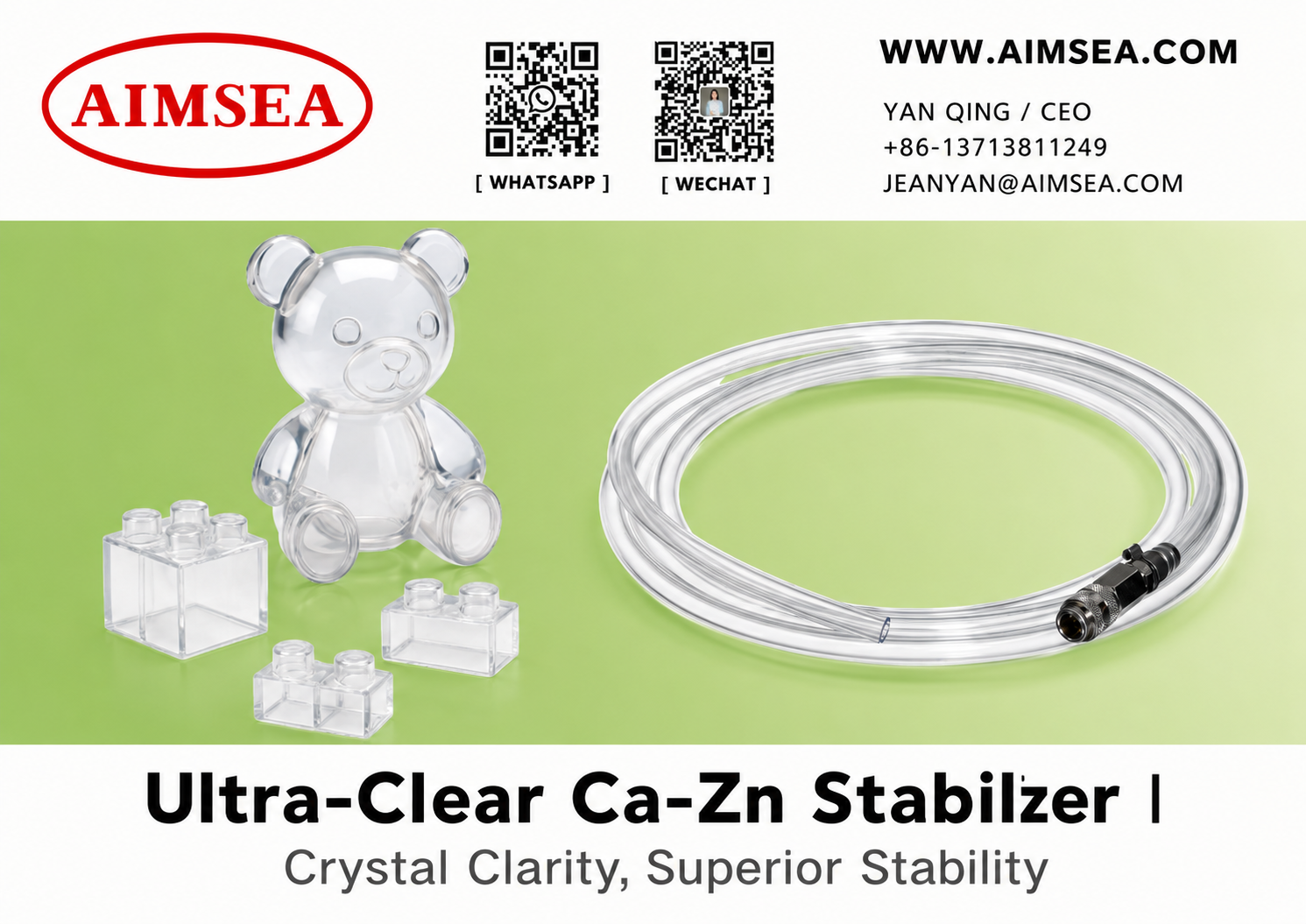
Transparent PVC looks simple from the outside, but it is one of the most demanding PVC categories. In opaque PVC, a slight color shift or surface issue may be hidden by pigment or filler. In transparent PVC, every issue becomes visible: haze, yellow tone, fogging, roller marks, plate-out, poor gloss or inconsistent transparency.
AIMSEA positions its ultra-clear Ca-Zn stabilizer solutions for clear PVC sheet, rigid sheet, shrink film, transparent film, white film, hose and packaging, with key targets including high clarity, low haze, yellowing control and low-odor processing.
This is why choosing a pvc heat stabilizer for transparent products should start from product type and processing conditions, not only from the stabilizer name.
Quick Answer
Choose AIMSTA-T191 when the product is mainly semi-rigid transparent PVC and requires good transparency, low odor, heat resistance and stable color. Choose AIMSTA-6809T when the application needs ultra-clear performance for transparent PVC products, toys, transparent tubes or applications where clarity and anti-copper-staining performance are important.
What Overseas Buyers Usually Care About?
Buyer Question | Why It Matters in Transparent PVC |
Will the product stay clear? | Transparency directly affects product grade and buyer acceptance |
Will it yellow during processing? | Poor heat stability causes visible color change |
Will there be odor? | Toys, tubes and packaging are sensitive to user experience |
Will it plate out? | Plate-out causes surface defects, roller deposits and downtime |
Is it lead-free and cadmium-free? | Export buyers increasingly request safer formulation direction |
Can the sample be tested first? | Transparent PVC requires real formulation and process validation |
A transparent PVC stabilizer is not just a thermal additive. It is part of the product’s appearance, processing behavior and market positioning.
AIMSEA T191 Transparent PVC Stabilizer: Best Fit and Selection Logic
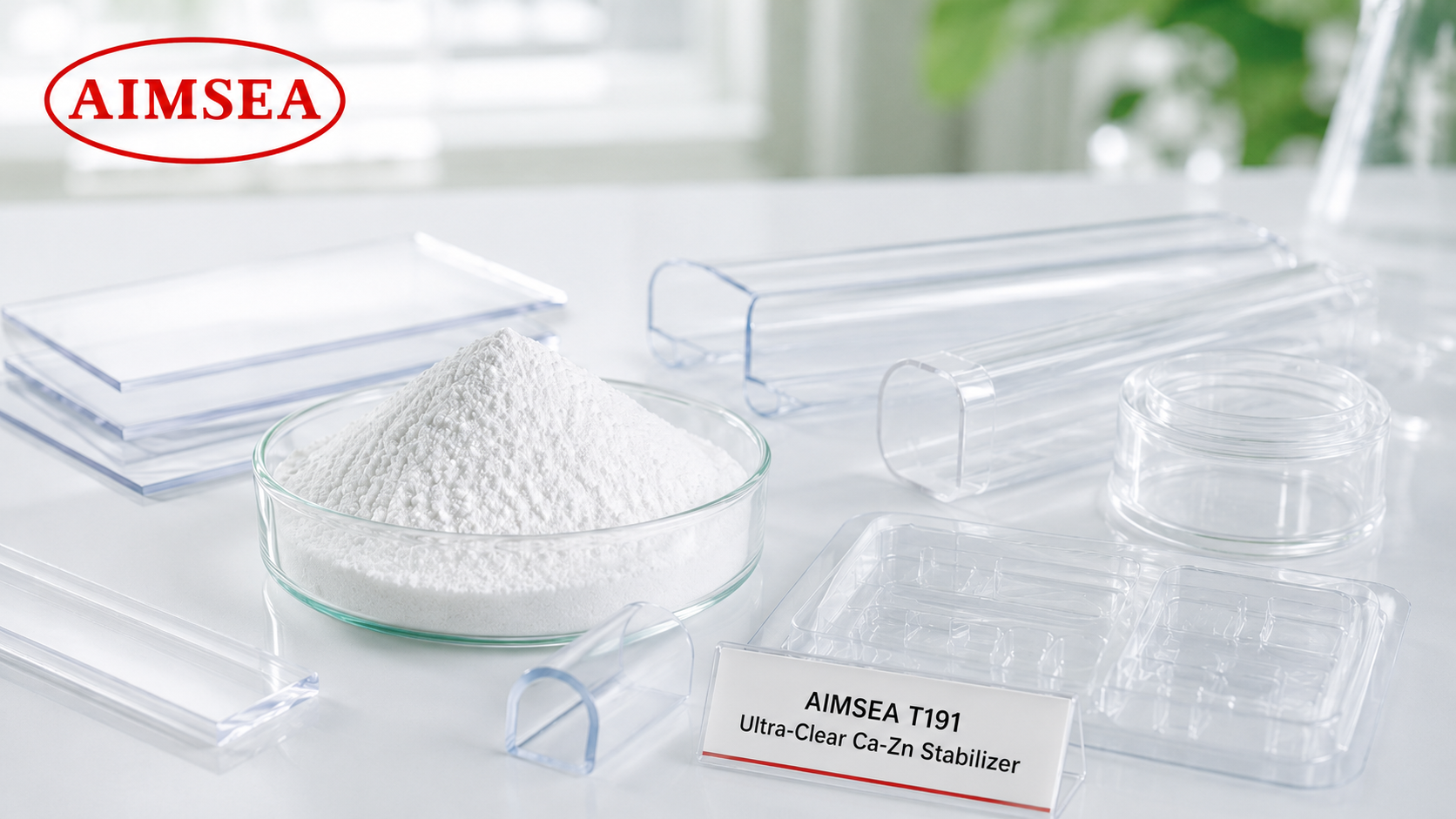
AIMSTA-T191 is an ultra-clear Ca-Zn stabilizer designed for semi-rigid transparent PVC products. Based on AIMSEA’s product sheet, it is positioned as a non-toxic, lead- and cadmium-free, odorless and non-volatile stabilizer with excellent transparency for super-clear PVC products. It is also described as heat resistant with long-lasting color and suitable for semi-rigid applications.
For manufacturers, this means T191 is not simply a “clear PVC stabilizer.” Its stronger logic is semi-rigid transparent processing where the product needs a balance of clarity, safety direction, heat resistance and stable appearance.
Recommended Applications for T191
Application Direction | Why T191 May Fit |
Semi-rigid transparent PVC products | Good match for products between soft flexible PVC and rigid clear PVC |
Transparent sheets with moderate rigidity | Requires clarity plus stable heat performance |
Semi-rigid clear packaging | Needs visual cleanliness and low odor |
Transparent decorative parts | Requires stable color and surface appearance |
Clear semi-rigid consumer products | Benefits from lead-free, cadmium-free and low-odor positioning |
T191 should be considered when the manufacturer’s main concern is not only maximum clarity, but a balanced semi-rigid transparent PVC solution.
Selection Notes for T191
T191 is more suitable when:
1.The product is semi-rigid rather than highly flexible.
2.The buyer wants lead-free and cadmium-free formulation direction.
3.Odor and volatile components need to be controlled.
4.The product needs heat resistance and long-lasting color.
5.The production line needs a stabilizer with good transparency and stable appearance.
It should still be tested against the buyer’s actual resin, plasticizer system, processing temperature and transparency target.
AIMSEA 6809T Ultra-Clear Ca-Zn Stabilizer: Best Fit and Selection Logic
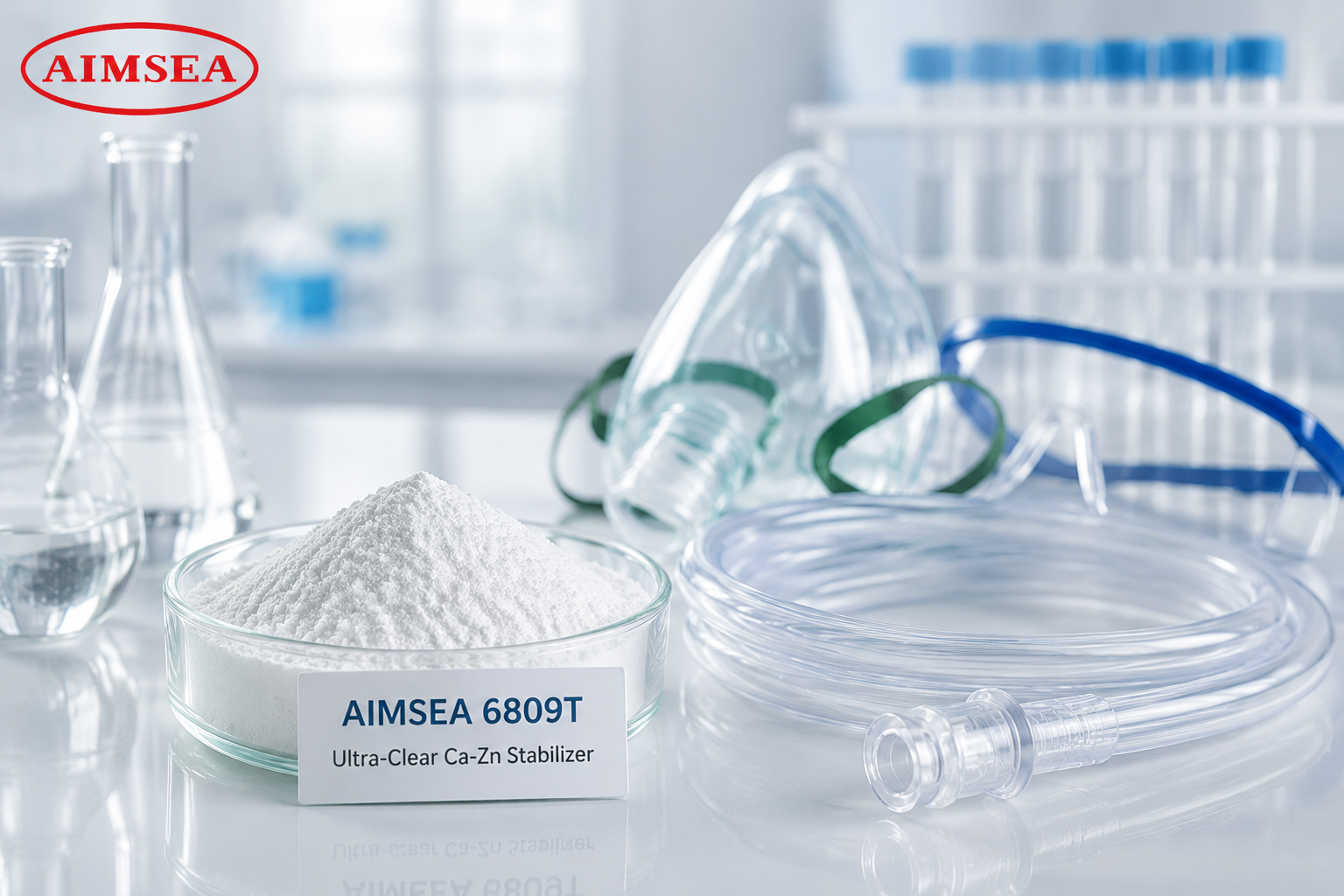
AIMSTA-6809T is positioned for ultra-clear PVC products, transparent toys and transparent pipes/tubes. AIMSEA’s product sheet highlights it as non-toxic, lead-free and odorless, with excellent clarity, heat resistance and anti-copper-staining performance.
AIMSEA’s internal PVC stabilizer overview also lists AIMSTA-6809T as a powder stabilizer suitable for transparent hose, transparent cable and medical devices.
This makes 6809T especially relevant for applications where transparency is highly visible and where odor, safety direction and contact with metal-related systems may become important.
Recommended Applications for 6809T
Application Direction | Why 6809T May Fit |
Ultra-clear PVC products | Designed for high-transparency appearance |
Transparent toys | Low odor and lead-free direction are important |
Transparent pipes and clear tubes | Requires clarity, smooth extrusion and heat resistance |
Transparent cable or clear insulation-related products | Anti-copper-staining performance can be valuable |
High-transparency flexible or semi-flexible items | Needs clarity plus stable processing behavior |
6809T is the better starting point when the application is more visibly transparent, closer to consumer-facing products, or involves transparent tubing, toys or wire/cable-related transparency.
Selection Notes for 6809T
6809T is more suitable when:
1.The product needs stronger ultra-clear visual positioning.
2.The buyer cares about transparent toys, transparent tubes or high-transparency applications.
3.Anti-copper-staining performance is relevant.
4.Low odor and lead-free direction are important.
5.The product will be judged by clarity and color stability after processing.
For clear tube or transparent toy manufacturers, 6809T may be the more direct inquiry model.
T191 vs 6809T: Transparent PVC Stabilizer Selection Table
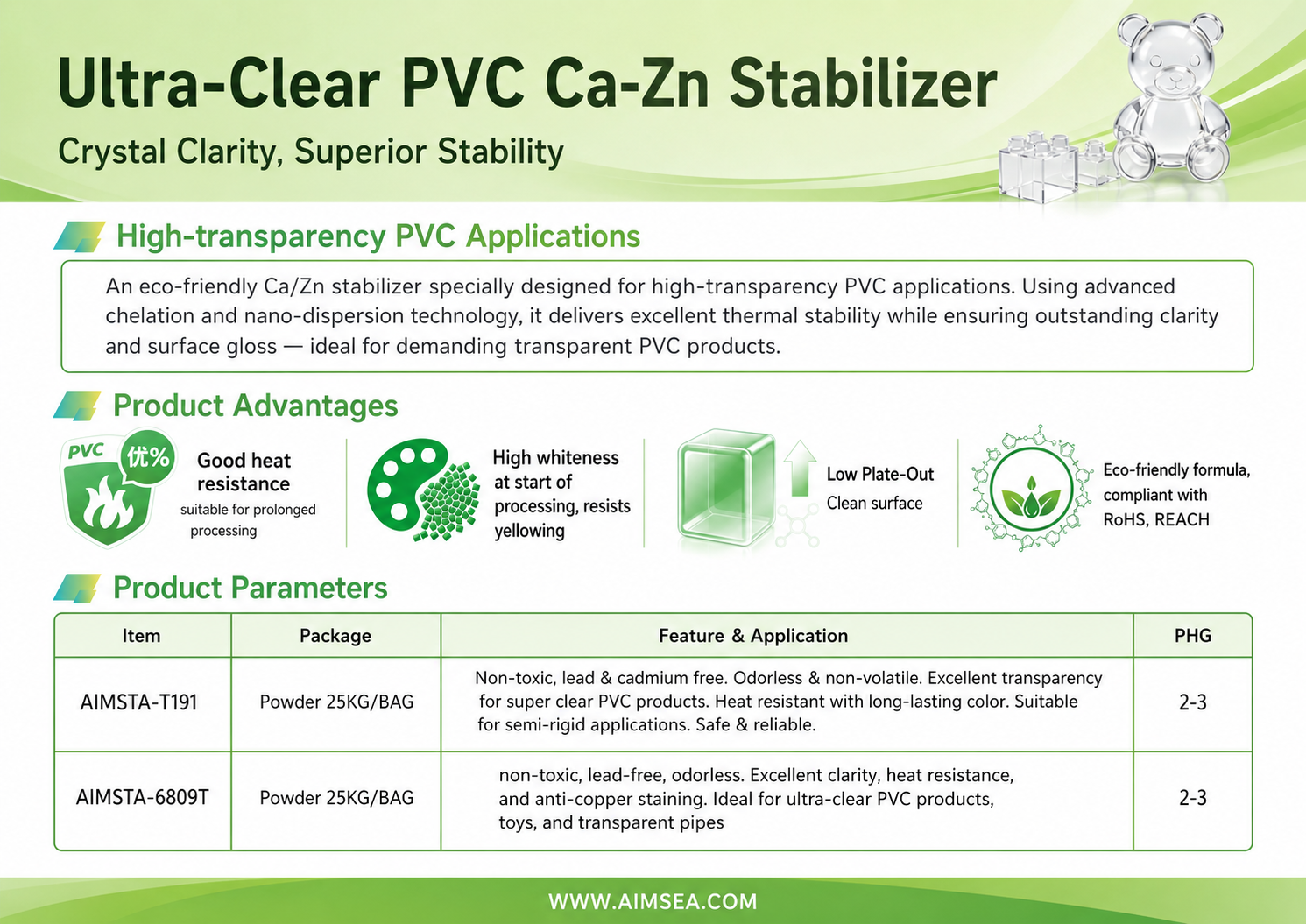
The best way to choose between T191 and 6809T is to match the stabilizer to the application, not to compare them as “better or worse.”
Selection Factor | AIMSTA-T191 | AIMSTA-6809T |
Main positioning | Semi-rigid ultra-clear PVC products | Ultra-clear PVC products, toys, transparent tubes |
Product form | Powder, 25kg/bag | Powder, 25kg/bag |
Key direction | Transparency, heat resistance, long-lasting color | Excellent clarity, heat resistance, anti-copper staining |
Safety direction | Non-toxic, lead- and cadmium-free, odorless | Non-toxic, lead-free, odorless |
Best-fit products | Semi-rigid transparent PVC items | Transparent toys, clear tubes, ultra-clear PVC products |
Processing concern | Semi-rigid balance, color stability, low odor | Ultra-clear appearance, tubing/toy application fit, copper-staining resistance |
Inquiry logic | “I produce semi-rigid transparent PVC products.” | “I produce ultra-clear PVC products, toys or transparent tubes.” |
If the buyer only says “I need a transparent PVC stabilizer,” the supplier should ask more questions. If the product is semi-rigid and needs stable color, T191 can be evaluated first. If the product is transparent tubing, toys or ultra-clear PVC, 6809T is usually the more relevant starting point.
Performance Priorities: Clarity, Heat Stability, Odor and Plate-Out
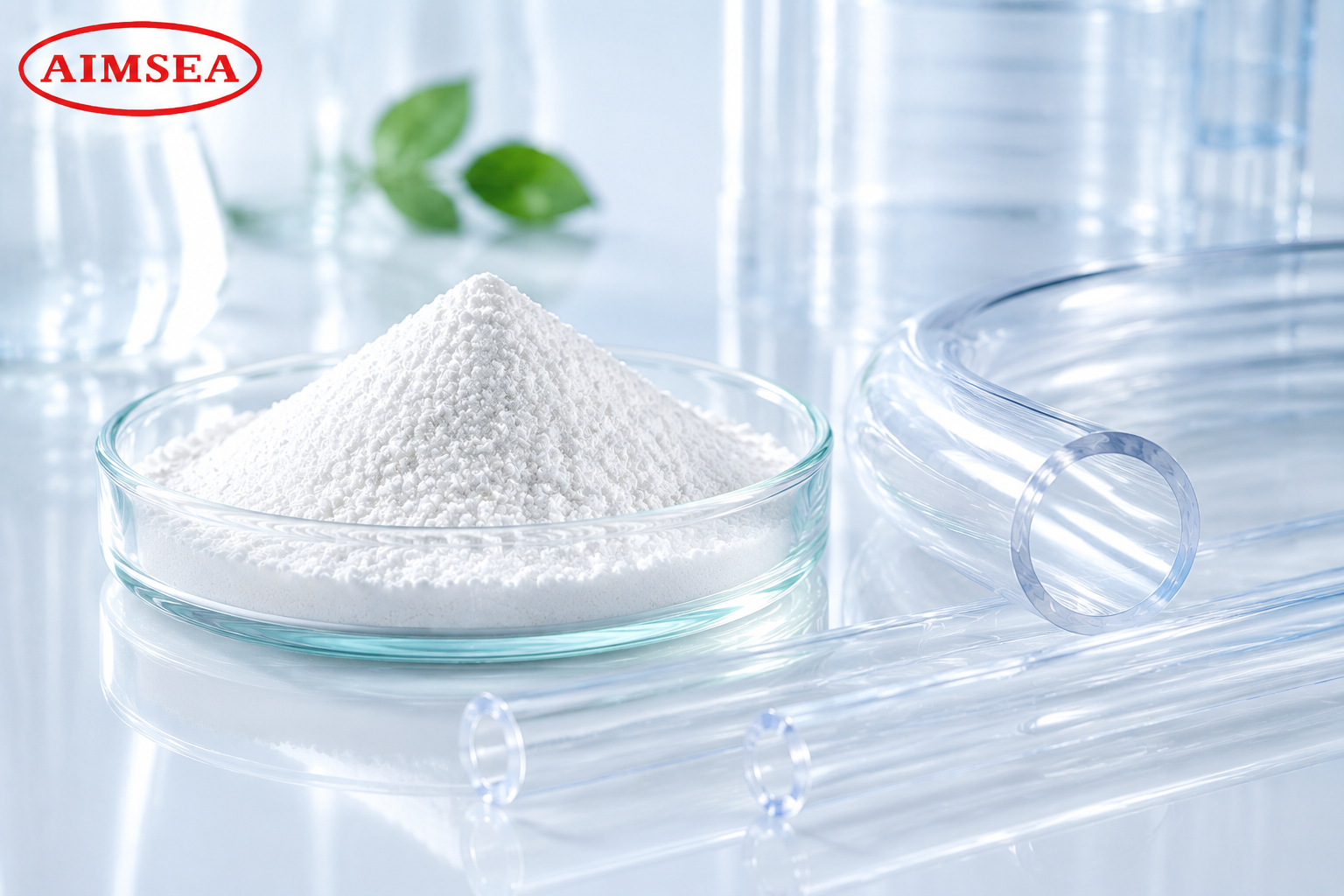
The most common mistake in selecting a pvc heat stabilizer for transparent products is testing only one property. Transparent PVC requires a complete performance view.
1. Transparency and Haze
Transparency is the first visible standard. However, a product may look clear in a small sample but become hazy in production. Haze is light scattering through a transparent material, while luminous transmittance measures how much light passes through the sample.
For T191 and 6809T, buyers should test both visual clarity and numerical optical data.
2. Heat Resistance and Anti-Yellowing
PVC is sensitive to heat. During processing, weak stabilization can lead to yellowing or deeper color change. AIMSEA’s technical material on PVC stabilization explains that PVC heat degradation involves dehydrochlorination and formation of conjugated polyene structures, which deepen product color during heating.
For transparent products, even slight yellowing is easy to notice. This is why heat aging tests should be included before bulk ordering.
3. Low Odor and Low Volatility
Transparent toys, tubes and packaging often face stricter customer expectations. Low odor is not just a technical claim; it affects buyer acceptance, warehouse smell, finished-product quality and downstream brand confidence.
AIMSEA’s product direction for ultra-clear Ca-Zn stabilizers highlights low-odor processing as a key performance point for transparent PVC applications.
4. Low Plate-Out and Clean Surface
Plate-out can cause roller deposits, mold deposits, fogging, surface marks and line cleaning problems. AIMSEA’s PVC stabilizer materials describe precipitation and blooming as migration of additive components to metal surfaces or product surfaces, and identify transparency testing, weathering testing and health/environmental testing as important stabilizer evaluation items.
For high-clear products, low plate-out is not optional. It is part of the optical quality system.
Testing Suggestions Before Switching Transparent PVC Stabilizer
A buyer should not switch from an existing stabilizer to T191 or 6809T based only on a product sheet. Transparent PVC must be tested under the buyer’s own formula and equipment conditions.
Recommended Lab and Production Tests
Test Item | Why It Matters |
Light transmittance | Confirms clarity quantitatively |
Haze | Measures cloudiness and light scattering |
Static heat aging | Shows anti-yellowing and long-term thermal stability |
Dynamic processing test | Simulates heat and shear during production |
Color Lab / yellowness index | Converts color difference into measurable data |
Plate-out observation | Checks roller, die or mold cleanliness |
Odor evaluation | Important for toys, tubes and packaging |
Surface gloss | Confirms premium visual finish |
Production trial | Confirms real-line stability and processing window |
ASTM D1003 covers the evaluation of light-transmitting and wide-angle light-scattering properties of planar transparent materials, which makes it relevant for transparent sheet and film evaluation.
T191 and 6809T Testing Direction
Product Type | Suggested Starting Model | Key Tests |
Semi-rigid transparent PVC product | T191 | Haze, transmittance, heat aging, odor |
Transparent toy | 6809T | Odor, color stability, compliance documents, haze |
Clear PVC tube | 6809T | Extrusion trial, transparency, odor, surface quality |
Ultra-clear flexible or semi-flexible product | 6809T | Clarity, heat aging, plate-out |
Semi-rigid clear packaging | T191 | Color, haze, low odor, surface gloss |
Transparent cable / clear insulation-related product | 6809T | Anti-copper staining, heat stability, clarity |
This approach helps overseas buyers reduce trial cost and avoid selecting a stabilizer only by name.
What to Provide When Requesting T191 or 6809T Samples?
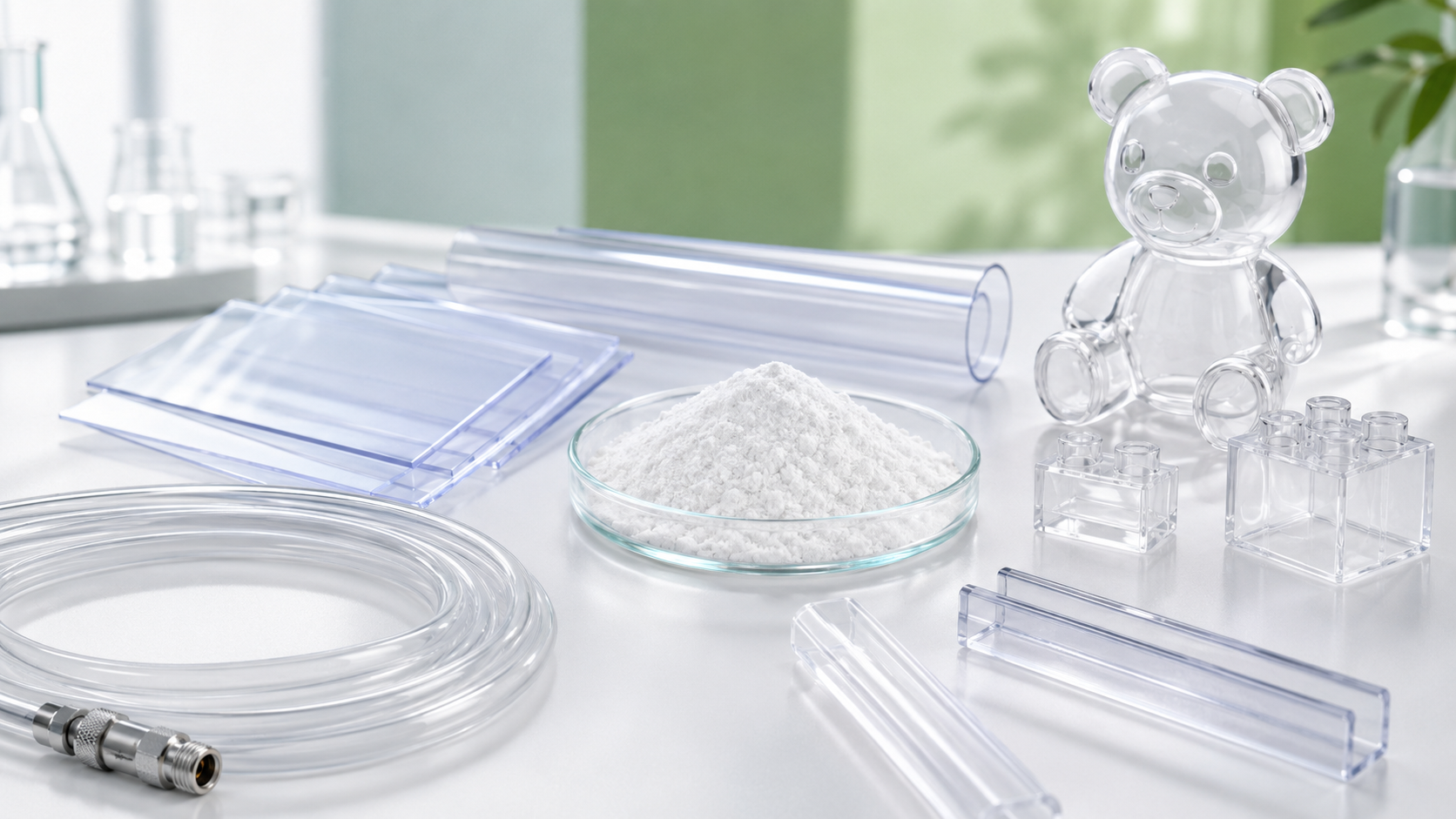
To get a useful sample recommendation, buyers should provide clear technical information. AIMSEA’s homepage states that it supports rapid custom formulations from in-house R&D and more than 50 testing facilities. The more complete the sample request, the more accurate the technical response.
Recommended Inquiry Information
Information to Provide | Why AIMSEA Needs It |
Product type | T191 and 6809T serve different transparent PVC directions |
Rigid, semi-rigid or flexible PVC | Determines stabilizer and lubrication balance |
Processing method | Extrusion, calendering and injection need different behavior |
Resin grade / K value | Affects fusion and transparency |
Plasticizer type and dosage | Important for odor, migration and flexibility |
Current stabilizer system | Helps compare performance and solve existing issues |
Main problem | Haze, yellowing, odor, plate-out or copper staining |
Target market | Helps determine compliance document needs |
Required test data | Haze, transmittance, heat aging, odor or production trial |
Sample Request Example
A useful inquiry should sound like this:
“We produce semi-rigid transparent PVC parts by extrusion. The main issue is slight yellowing and odor after processing. We want to test a lead-free Ca-Zn stabilizer with good transparency, low haze and low plate-out. Please recommend whether AIMSTA-T191 or AIMSTA-6809T is more suitable and advise sample testing items.”
This gives the supplier enough context to recommend the right direction.
FAQs About AIMSEA T191 and 6809T
What is AIMSTA-T191 used for?
AIMSTA-T191 is suitable for semi-rigid ultra-clear PVC products. It is positioned for transparent PVC applications that require non-toxic, lead- and cadmium-free direction, low odor, good transparency, heat resistance and long-lasting color.
What is AIMSTA-6809T used for?
AIMSTA-6809T is suitable for ultra-clear PVC products, transparent toys, transparent tubes and high-transparency applications. It is also relevant where excellent clarity, heat resistance and anti-copper-staining performance are required.
Which model should I choose for transparent PVC tube?
AIMSTA-6809T is usually the more direct starting point for clear PVC tubes and transparent pipe applications because it is positioned for ultra-clear PVC products and transparent pipes/tubes.
Which model is better for semi-rigid transparent PVC?
AIMSTA-T191 is the better starting point for semi-rigid transparent PVC products, especially where stable color, low odor and heat resistance are important.
Are T191 and 6809T lead-free stabilizers?
Based on AIMSEA’s product positioning, T191 is described as non-toxic, lead- and cadmium-free, while 6809T is described as non-toxic and lead-free. Buyers should request the latest compliance documents for their target market.
Do T191 and 6809T include formula or price information?
No. This article only covers application direction, performance focus, testing suggestions and inquiry information. Specific formulas and pricing should be discussed directly with AIMSEA based on the buyer’s product and process.
How should I test a PVC heat stabilizer for transparent products?
Test haze, light transmittance, static heat aging, dynamic processing stability, color change, odor, plate-out and surface appearance. A production trial is recommended before bulk purchase.
Conclusion
AIMSTA-T191 and AIMSTA-6809T are both AIMSEA ultra-clear Ca-Zn stabilizer solutions, but they should be selected by application.
Choose AIMSTA-T191 when the product is mainly semi-rigid transparent PVC and the focus is balanced transparency, low odor, heat resistance and long-lasting color.
Choose AIMSTA-6809T when the application is ultra-clear PVC products, transparent toys, clear PVC tubes or applications that require excellent clarity, heat resistance and anti-copper-staining performance.
For overseas buyers, the most reliable way to choose a pvc heat stabilizer for transparent products is not to compare only product names. The better path is to define the application, identify the main production risk, test clarity and heat stability, check odor and plate-out behavior, and confirm compliance documents before bulk ordering.
AIMSEA’s role is not only to supply a Ca-Zn stabilizer, but to help transparent PVC manufacturers match the right stabilizer to the right product and production condition.
References
1.AIMSEA homepage: Ultra-Clear Ca-Zn Stabilizer positioning, custom formulation support and 50+ testing facilities.
2.AIMSEA PVC Stabilizer page: transparent PVC applications including clear sheet, rigid sheet, shrink film, transparent film, white film, hose and packaging, with high clarity, low haze, yellowing control and low-odor processing.
3.AIMSEA internal PVC stabilizer overview: AIMSTA-6809T is listed as a powder transparent stabilizer for transparent hose, transparent cable and medical devices.
4.AIMSEA transparent Ca-Zn stabilizer material: transparent-grade Ca-Zn positioning includes no organotin, low odor, non-toxic direction, no precipitation/fogging tendency and high transparency.
5.Intertek ASTM D1003 summary: haze is light scattering through transparent material; luminous transmittance measures the amount of light passing through a sample.
6.TÜV Rheinland: EU REACH restriction limits lead in PVC articles to no more than 0.1% by weight of PVC material from November 29, 2024, with defined derogations.