Why PVC Fails at High Temperatures
Polyvinyl chloride is prized for flame resistance and price, yet its molecular backbone begins de-HCl as low as 100 °C. Once HCl escapes, a self-catalytic chain scission turns a clear compound brown, brittle, and electrically leaky. That is why engineers repeatedly ask: Is PVC heat-resistant? Strictly speaking, not by itself. Unstabilised PVC fails most thermal stability test for PVC protocols in under ten minutes at 180 °C.
Typical Fail Modes
| Temperature Band | Observable Symptom | Root Cause |
|---|
| 100 – 120 °C | Light yellowing, viscosity drop | First HCl release – no heat buffer |
| 120 – 160 °C | Brown streaks on die, torque spike | Autocatalytic oxidation + metal-ion catalysis |
| > 160 °C (wire draw-down or calender) | Black specks, copper wire verdigris, insulation cracks | Uncontrolled chain scission + metal chloride corrosion |
So if you are about to discuss the thermal stability of PVC in any high-temperature PVC cable, profile, or SPC flooring line, the conversation is really about the pvc thermal stabilizer you select.
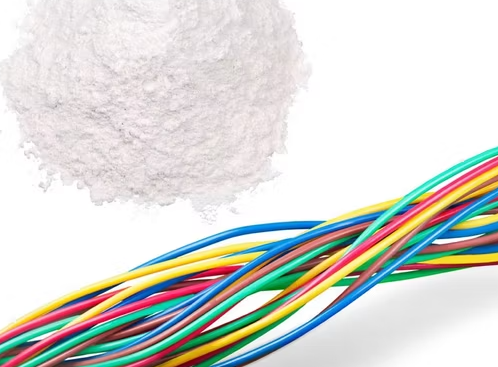
How Much Heat Can PVC Hold?
With adequate stabilisation and controlled shear, PVC compounds can survive continuous service at 125 °C (J-125 grade cables) and short peaks up to 150–160 °C. The chart below shows typical thermal stability of PVC resin across stabiliser chemistries (measured by Congo-Red time at 200 °C):
| Stabiliser Family | Congo-Red Time (200 °C) | Continuous Service Temp |
|---|
| Lead salts | 135 min | 105 °C |
| Mercaptide tin | 110 min | 105 °C |
| Calcium-zinc AIMSTA-6815 | 168 min | 125 °C |
| Commodity Ca/Zn | 90 min | 90 °C |
(Data from thermal stability test of PVC performed on a torque rheometer at 60 rpm.)
What Are the Examples of Heat Stabilizers?
| Category | Typical Chemistry | Pros | Cons | Trend |
|---|
| Lead | PbCO₃ / PbSO₄ mixes | Cheap, robust | Toxic heavy metal, RoHS banned | Phasing-out |
| Organic tin | Methyl-, Butyl-tin mercaptides | Colour, clarity | Strong odour, high cost, SVHC risk | Shrinking |
| Calcium-Zinc | Ca-Zn carboxylates + β-diketone | Heavy-metal-free, low VOC | Historically limited heat ceiling | Rapid growth |
| Mixed metal (Ba/Zn) | BaZn + epoxy | Early colour | Ba hazard; not RoHS | Niche |
| Rare-earth | La/Ce carboxylates | Excellent colour hold | Expensive | R&D stage |
Because advanced Ca/Zn blends can now pass 125 °C cable standards, they are replacing both lead and tin in many “green” specifications.
AIMSTA-6815
AIMSEA devoted the last three years to a research programme aimed at one question: Can a lead-free package nail J-125 °C cable requirements without sacrificing cost or processing window? The answer is AIMSTA-6815.
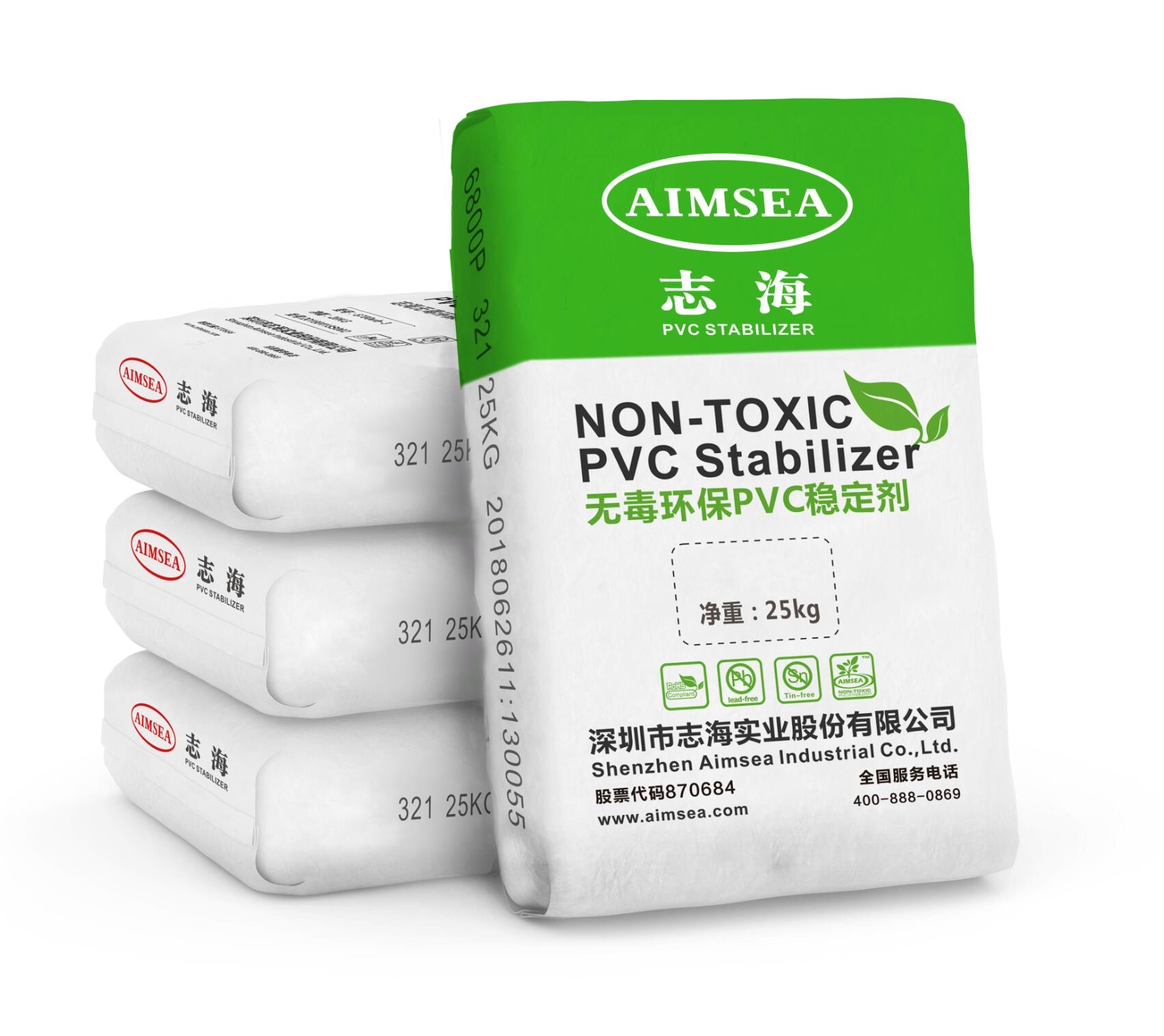
Dual Innovation
Ultra-Dispersive “Sea-Island” Architecture – nano-level dispersants embed Ca/Zn micro-domains throughout the PVC matrix, lifting impact strength and early-stage fusion.
Hyper-branched Poly-Hydroxyester Booster – molecular “arms” wedge into PVC chains, decreasing inter-chain forces, lowering melt temperature 5–8 °C, and broadening the thermal stability of PVC compound window.
Key Test Results
| Test Method | Spec Limit (J-125) | Lead Salt | AIMSTA-6815 |
|---|
| Static torque @ 190 °C (6 min) | Peak ≤ 40 N·m | 38 | 36 |
| Congo-Red 200 °C | ≥ 120 min | 135 | 168 |
| 158 °C × 168 h Oven | Strength Retention ≥ 80 % | 86 % | 88 % |
| VDA 270 Odour | ≤ 3 | 3.2 | 2.5 |
| RoHS Pb (ppm) | < 1000 | 180 000 | < 50 |
Conclusion: AIMSTA-6815 equals lead salts on static ageing, surpasses them on long-term heat, while meeting every green list.
Thermal Stability Tests Every PVC Engineer Should Know
| Test Name | Standard | What It Measures | Why It Matters |
|---|
| Static Torque Rheometer | ISO 182-2 | Fusion behaviour, plate-out risk | Gateway QC for every batch |
| Congo-Red Time | ISO 182-3 | Mid-term HCl capture reserve | Quick screen of stabiliser strength |
| Aging Oven 158 °C/168 h | IEC 60811- 1-2 | Long-term mechanical retention | Mandatory for J-125 °C cable |
| Hot Deformation (SPC) | ASTM F3261 | Dimensional stability under load | Determines click-lock durability |
| PVDF Copper Strip | ASTM D2671 | Corrosion of conductor | Cable OEM spec “must-pass” |
These tests collectively discuss the thermal stability of PVC across all time-scales—seconds (fusion) to months (ageing).
Real-World PVC Cable Trials
Six factories, both conical-twin and parallel-twin screws, trial-ran AIMSTA-6815 with identical base resin (K-65), CaCO₃ 50 phr, and DINP 35 phr. Performance table:
| Plant | Screw | Thickness | MOR (MPa) | Retention After 158 °C/168 h | Comments |
|---|
| #1 | φ92 twin | 4 mm | 20.6 | 87 % | Zero plate-out 8 h run |
| #2 | φ92 twin | 4 mm | 26.7 | 86 % | Deep colour hold |
| #3 | φ110 twin | 5 mm | 23.8 | 88 % | Click tear > 10 N |
| #4 | φ110 twin | 4 mm | 17.1 | 85 % | Slightly lower CaCO₃ load |
| #5 | φ130 twin | 4 mm | 27.8 | 90 % | Automotive wire trial |
| #6 | φ135 twin | 5 mm | 23.3 | 86 % | Hi-lo cycle 100× pass |
The data confirm the thermal stability of PVC resin when married to AIMSTA-6815 is line-agnostic.
Frequently Asked Questions
How much heat can PVC hold?
With AIMSTA-6815, up to 125 °C continuous, 150 °C short-term.
Is PVC heat-resistant compared with XLPE?
Not intrinsically; however, a strong pvc thermal stabilizer narrows the gap for low-voltage applications.
What are common PVC thermal stability tests?
Static torque, Congo-Red, aging oven, and hot-set—collectively termed pvc thermal stability test battery.
Can calcium-zinc replace tin in transparent tubing?
Yes. Refraction index match is possible; odour lowers sharply.
Where to Source High-Heat Calcium-Zinc Packages
| Buying Scenario | Aim | Tip |
|---|
| Lab scale | 10–20 kg | Ask for 25 kg bag, free side TDS |
| Cable OEM | 2–5 t month | Seek pvc thermal stability supplier offering on-site Brabender demo |
| Distributor | 1 FCL | Verify “one-pack pellet” shape to cut dust |
Prices trend +5 % YoY as lead bans tighten, but scrap reduction offsets premium.
Key Takeaways
Thermal stability of PVC compounds hinges on the heat stabiliser; PVC alone cannot hold beyond 100 °C.
AIMSTA-6815 calcium-zinc one-pack reaches 125 °C cable grade, equalling lead salts on static ageing and surpassing on Congo-Red reserve time.
Comprehensive thermal stability tests for PVC—torque, Congo-Red, oven aging—validate long-term performance.
Migrating from lead or tin to Ca/Zn is now feasible without sacrificing processing or cost, aligning products with RoHS and automotive OEM green lists.
Need data packs, pvc thermal stability test protocols, or samples? Contact AIMSEA's technical desk—we'll help you convert to lead-free heat-resistant PVC today.