
What Documents Should PVC Exporters Request from a Stabilizer Supplier? REACH/RoHS Checklist
Read:300
Source:
Abstract
For PVC exporters, choosing a PVC stabilizer supplier is not only about price, dosage or processing performance. When PVC products are exported to Europe and other overseas markets, buyers also need reliable compliance documents to confirm whether the selected stabilizer meets customer, regulatory and restricted-substance requirements.
This guide explains which PVC stabilizer documents exporters should request, how to review REACH and RoHS files, what fields buyers should check, and how suppliers can support export-oriented PVC projects with clear technical and compliance evidence.
Why Compliance Documents Matter for PVC Exporters?

PVC exporters often serve customers who need more than a stable formula. A PVC heat stabilizer may perform well during extrusion, injection molding, calendering or compounding, but overseas buyers still need proof that the material matches compliance expectations.
For export projects, documentation helps answer three key questions:
1. Is the stabilizer suitable for the target application?
2. Does the stabilizer avoid restricted substances required by the buyer?
3. Can the supplier provide traceable documents for samples, trial batches and bulk shipments?
This is especially important for PVC products exported to Europe, electrical and electronic markets, cable projects, building materials, transparent PVC products, flooring and other applications where customers may request REACH, RoHS, heavy metal or customer-specific restricted substance information.
Compliance is part of supplier qualification
A qualified PVC additives supplier should not only describe a product as “eco-friendly,” “lead-free” or “export grade.” The supplier should provide specific documents to support these claims.
For example, an SDS helps confirm safety and handling information. A COA supports batch consistency. A RoHS report supports restricted-substance review. A REACH or SVHC declaration helps buyers communicate chemical compliance information to downstream customers.
For PVC exporters, these documents reduce approval risk and make communication with overseas customers more efficient.
Documentation should match the actual product grade
One common mistake is accepting a generic compliance file that does not match the stabilizer being purchased. Buyers should confirm that the document shows the same product name, grade number, supplier name and sample description as the material used in the production trial.
If the document refers to a product family rather than a specific grade, the buyer should ask the supplier to explain the relationship or provide a product-specific statement.
Core Documents to Request from a PVC Stabilizer Supplier
Before approving a PVC stabilizer supplier, exporters can use the following checklist to organize document requests.
Document Name | Main Use | Buyer Should Check | Supplier Should Provide |
SDS / Safety Data Sheet | Safety, handling, storage and hazard communication | Product name, revision date, hazard classification, storage guidance | Latest SDS for the selected stabilizer grade |
TDS / Technical Data Sheet | Technical properties and application guidance | Appearance, dosage, application, processing range, storage condition | Product-specific TDS |
COA / Certificate of Analysis | Batch quality confirmation | Batch number, production date, test values, inspection items | COA linked to sample or shipment batch |
REACH / SVHC Declaration | EU chemical compliance communication | Product name, declaration date, SVHC status, Candidate List reference | REACH/SVHC statement or test support |
RoHS Report / Declaration | Restricted substance review for EEE-related projects | Ten RoHS substances, sample name, test method, report date | RoHS report or declaration |
Heavy Metal Test Report | Lead, cadmium, mercury and chromium control | Pb, Cd, Hg, Cr(VI), detection limits, tested sample | Internal or third-party test report |
Trial Test Report | Processing and performance verification | Heat stability, color change, plate-out, haze, tensile data | Lab or production trial results |
Supplier Quality Documents | Factory qualification and traceability | QC process, inspection flow, production capability | Quality system or audit support |
These documents help exporters build a complete compliance file before sending PVC products to overseas customers.
REACH Checklist for PVC Stabilizer Documents

REACH is often requested by European customers. For PVC exporters, a REACH compliant PVC stabilizer should be supported by clear documentation rather than a simple verbal statement.
REACH/SVHC declaration
A REACH/SVHC declaration should clearly show:
Supplier name
Product name or grade number
Declaration date
Reference to the latest SVHC Candidate List
Whether any SVHC is present above the relevant reporting threshold
Signature or responsible department
Buyers should avoid outdated declarations, especially if the document is several years old or does not specify the product grade.
SDS for PVC stabilizer
An SDS for PVC stabilizer is one of the most basic documents in export communication. It supports safe handling, storage, emergency response and transportation review.
When checking the SDS, buyers should confirm:
The product name matches the purchased stabilizer
The revision date is recent
The document follows a complete safety data sheet structure
Hazard, storage and disposal information is clear
Transport information is included where applicable
For overseas projects, English SDS files are usually preferred. Some customers may also require a local language version.
Material composition communication
PVC stabilizers are normally supplied as chemical mixtures. The final PVC product may later become an article, such as a pipe, fitting, cable sheath, profile or film. If downstream customers ask about restricted substances, exporters need supplier support to answer quickly.
This is why buyers should ask the supplier whether they can support ingredient-level communication, customer restricted substance lists or additional declarations when needed.
RoHS Checklist for PVC Heat Stabilizer Projects
RoHS is especially important when PVC materials are used in electrical and electronic equipment, such as wire and cable insulation, cable sheathing, plugs, connectors, sleeves and other EEE-related PVC components.
A RoHS compliant PVC stabilizer should be reviewed carefully, especially when the finished PVC product is exported to Europe or supplied to global electrical equipment manufacturers.
Restricted substances buyers should check
RoHS review generally focuses on the following restricted substances:
Lead
Cadmium
Mercury
Hexavalent chromium
PBB
PBDE
DEHP
BBP
DBP
DIBP
For PVC stabilizer projects, lead and cadmium are usually the first concerns. However, buyers should not stop there. Plasticizers, flame retardants, pigments and other PVC additives may also affect the restricted-substance profile of the final compound.
Lead-free does not always mean full RoHS compliance
A lead-free PVC stabilizer is a strong starting point for export markets, especially when replacing traditional lead salt stabilizers. However, “lead-free” is not the same as full RoHS compliance.
A buyer should still request a RoHS report or declaration for the actual stabilizer grade. If the PVC formulation contains other additives, the exporter should also review those materials to avoid compliance gaps in the final product.
Check report identity and validity
When reviewing a PVC stabilizer test report, buyers should check:
Tested sample name
Product grade
Report date
Testing laboratory
Test method
Detection limit
Result for each restricted substance
Whether the report applies to the current batch or general product grade
If the stabilizer code in the report does not match the purchased product, the buyer should confirm the relationship before using the document for customer approval.
Application-Based Document Requirements for PVC Exporters
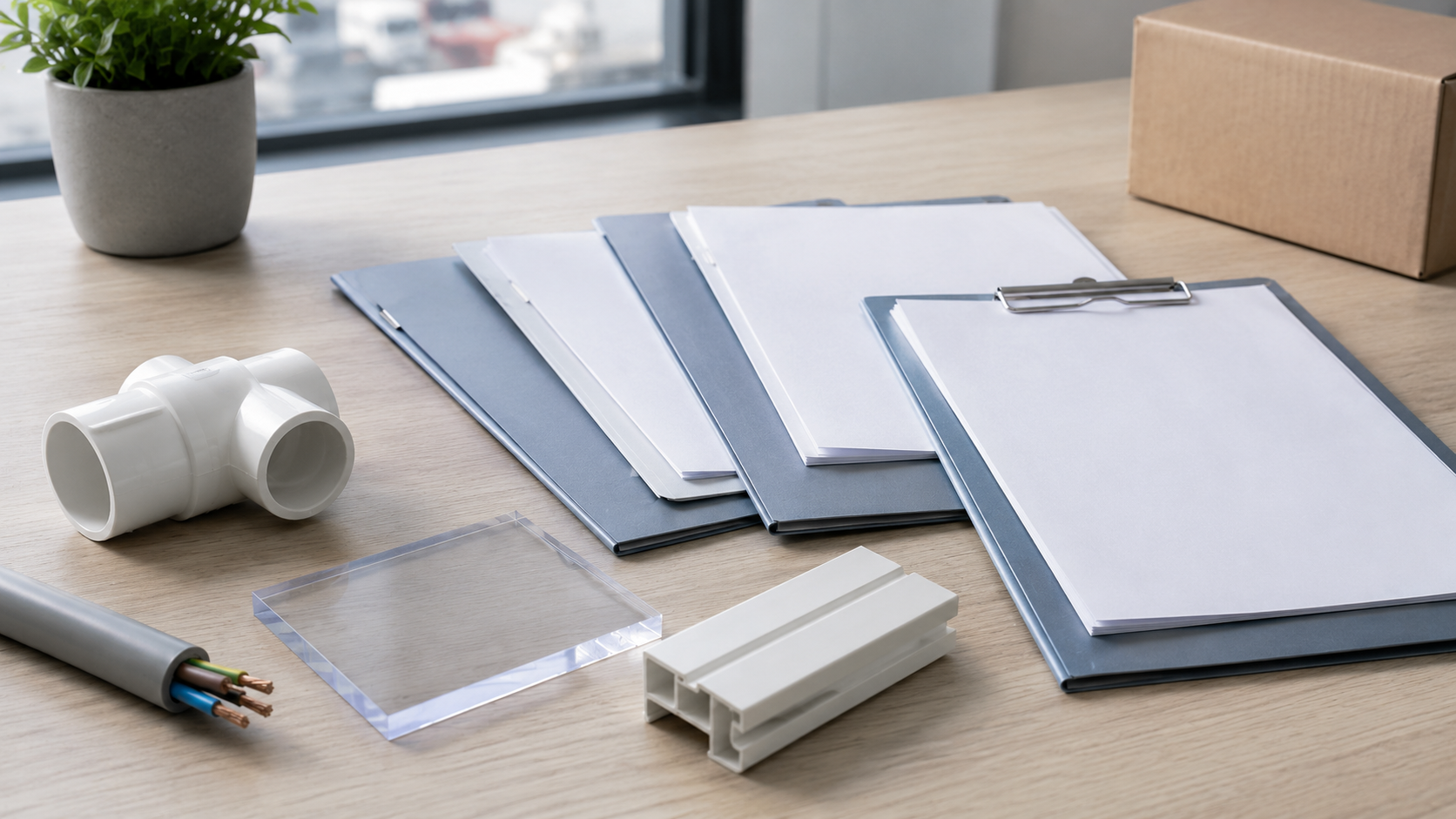
Different PVC products require different document depth. A pipe exporter, a cable compounder and a transparent film manufacturer may all use a calcium zinc stabilizer, but their compliance and testing priorities are not the same.
PVC pipes, fittings and profiles
For rigid PVC pipes, fittings and profiles, buyers usually request:
SDS
TDS
COA
REACH/SVHC declaration
RoHS report if required by the customer
Heavy metal test report
Heat stability or oven aging data
Processing trial support
For these applications, the stabilizer should support good thermal stability, lubrication balance, surface quality and long-term color performance.
PVC wire and cable
PVC wire and cable projects often need stricter documentation because the finished product may be used in electrical systems.
Recommended documents include:
SDS
TDS
COA
RoHS report
REACH/SVHC declaration
Heavy metal report
Heat aging data
Congo red test data
Flame retardant compatibility support if required
For cable applications, a Ca-Zn stabilizer should be evaluated together with plasticizers, fillers, flame retardants and other compounding additives.
Transparent PVC products
Transparent PVC products need both compliance and appearance performance. Buyers should request:
SDS
TDS
COA
REACH/RoHS support
Haze and transmittance data
Oven aging or color stability data
Odor information if required
Trial sample comparison
For transparent PVC sheet, film or packaging-related applications, stabilizer selection should balance clarity, initial color, heat stability, odor and cost.
Flooring, artificial leather and indoor PVC products
Flooring and artificial leather exporters may face additional customer questions related to odor, VOCs, heavy metals and restricted substances.
In addition to the standard document package, buyers may request:
VOC-related test support
Odor evaluation data
Phthalate-related information
Customer RSL support
Low-odor formulation recommendations
These products are often used in indoor environments, so document clarity is important for overseas customer confidence.
Food contact, medical and sensitive PVC applications
For food contact, medical or other sensitive PVC applications, general REACH and RoHS documents may not be enough. Buyers should define the target market and application clearly before requesting documents.
Possible documents may include:
Food contact compliance support
Migration test information
Biocompatibility-related support
Low-odor or low-extractable data
Customer-specific declarations
These projects should be reviewed case by case because regulatory requirements depend on the final product, application and target market.
How AIMSEA Supports Export-Oriented PVC Projects?

AIMSEA provides PVC stabilizer solutions for pipes, fittings, profiles, flooring, wire and cable, transparent PVC products, recycled PVC and other applications. Its product direction focuses on lead-free calcium-zinc systems, customized stabilizer solutions and one-pack additive support for different PVC processing needs.
For exporters, this application-based approach is useful because compliance documents and technical performance must work together. A stabilizer should not only meet document requirements but also support stable processing, good appearance and reliable production performance.
Lead-free calcium-zinc stabilizer solutions
AIMSEA’s calcium zinc stabilizer solutions are suitable for manufacturers looking to replace lead-based systems and improve environmental positioning. For export projects, this helps buyers build a stronger compliance foundation before discussing REACH, RoHS, heavy metals or customer-specific requirements.
Customized PVC heat stabilizer support
Different PVC products require different stabilizer logic. A rigid pipe formula may need strong heat stability and lubrication balance. A cable compound may need heat aging and flame-retardant compatibility. A transparent PVC product may need clarity and low odor.
AIMSEA can support buyers by matching stabilizer recommendations with the actual application, process and export market.
What buyers should provide when requesting documents?
To receive the most relevant documents and product recommendations, buyers should provide:
PVC product type
Processing method
Current formula or stabilizer dosage
Target export market
Required compliance documents
Customer restricted substance requirements
Sample testing plan
Expected production conditions
Required document language
This helps the supplier prepare accurate technical and compliance support instead of sending generic files.
FAQ About PVC Stabilizer Documents
What documents should I request first from a PVC stabilizer supplier?
Start with SDS, TDS, COA, REACH/SVHC declaration, RoHS report and heavy metal test report. For special applications, also request VOC, odor, food contact, medical or customer-specific restricted substance documents.
Does every PVC exporter need RoHS documents?
Not always. RoHS is mainly related to electrical and electronic equipment, but many overseas customers request RoHS-style reports for PVC cable, insulation, plugs, connectors and other export products. It is best to confirm the final application and customer requirement early.
Is a calcium zinc stabilizer automatically REACH and RoHS compliant?
No. A calcium zinc stabilizer is usually a good direction for lead-free PVC, but compliance still needs product-specific documents, test reports and supplier declarations.
What is the difference between COA and a test report?
A COA confirms batch quality for a specific production lot or shipment. A test report confirms restricted substances or performance data for a tested sample. Exporters often need both.
How often should REACH documents be updated?
REACH/SVHC documents should be reviewed whenever the Candidate List is updated, when the formulation changes, when raw material sources change or when a customer requests updated compliance information.
Can one document cover all PVC stabilizer grades?
Usually not. Buyers should request documents that match the actual product grade. If one report covers a product family, the supplier should explain which grades are included and why the document applies.
Conclusion
For PVC exporters, compliance review should begin before sample approval and bulk purchasing. A reliable PVC stabilizer supplier should provide a clear document package that includes SDS, TDS, COA, REACH/SVHC declaration, RoHS report, heavy metal report and application-based test support.
The best approach is simple: match the document to the product grade, match the COA to the batch, match the test report to the target market, and match performance data to the real PVC application.
For exporters working with pipes, cables, profiles, flooring, transparent PVC or recycled PVC, AIMSEA’s lead-free calcium-zinc and customized PVC heat stabilizer solutions can help combine processing performance with export-oriented compliance support.