

Posted by Ms.Yan
in blog
Technical Engineer
Updated 2026-10-29
What Does Hydrotalcite Do in PVC Stabilizer Formulations?
Read:11
Source:
Hydrotalcite is used in certain PVC heat stabilizer formulations to improve resistance to thermal degradation. Its value comes primarily from its ability to react with hydrogen chloride (HCl) released as PVC degrades, but the effectiveness of a hydrotalcite depends on more than its chemical name.
Different layered structures, particle sizes, surface treatments, and combinations with other stabilizing ingredients can produce different results. A material that extends heat stability in one compound may affect initial color, transparency, or dispersion differently in another.
For PVC formulators, the important question is therefore not simply whether to add hydrotalcite, but how to evaluate its contribution within a complete stabilization system.
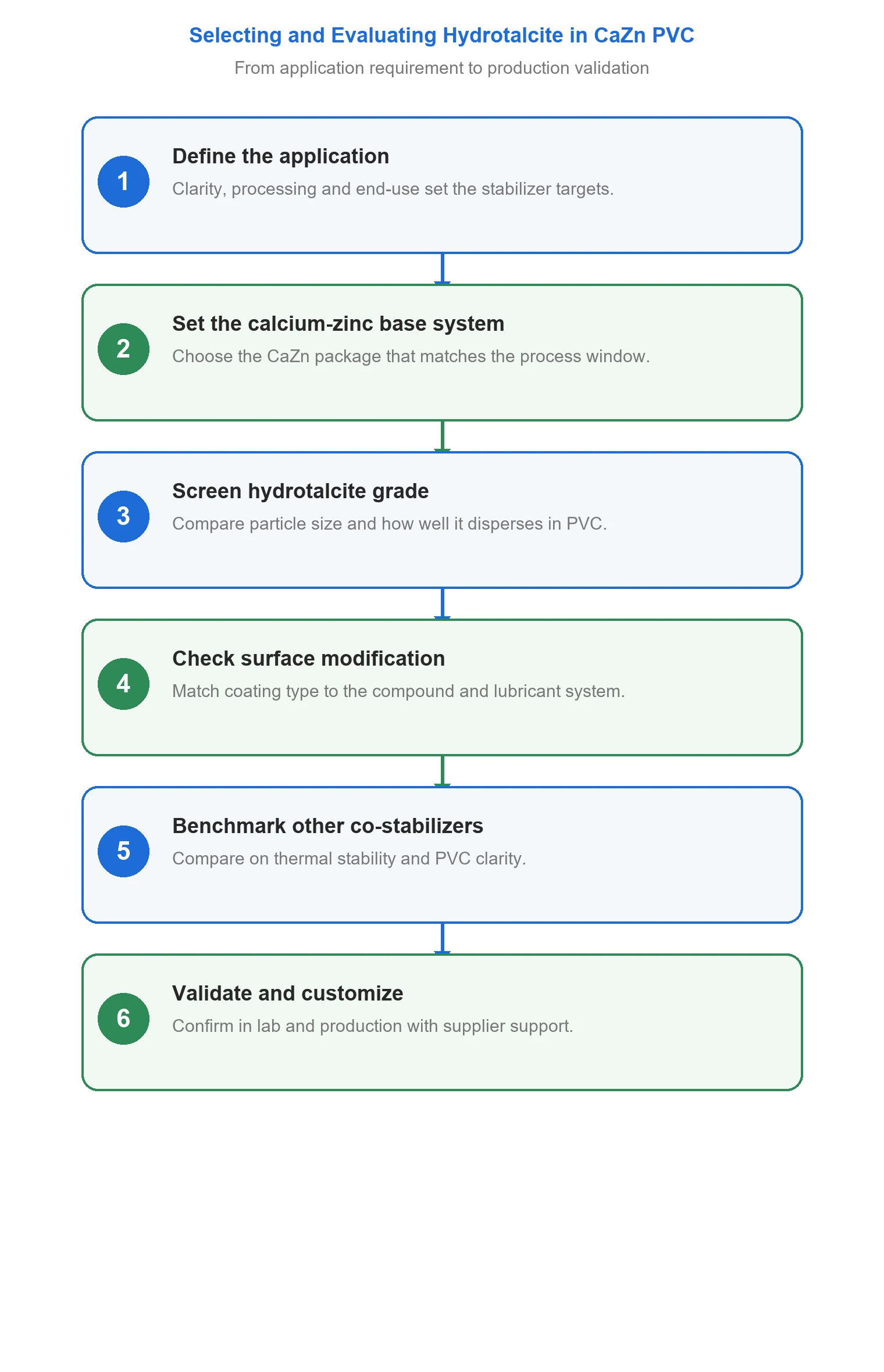
Figure 1. From application requirement to production validation when selecting hydrotalcite in calcium-zinc PVC stabilizers.
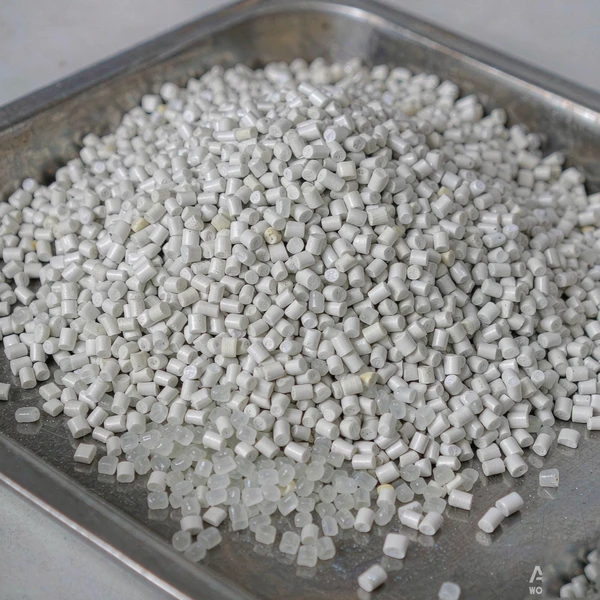
Figure 2. Calcium-zinc stabilized rigid PVC compound pellets used in clear PVC formulations.
Quick Answer
Hydrotalcite in PVC stabilizers acts as an acid scavenger and thermal stabilization component. Its layered double hydroxide structure can react with HCl released during PVC degradation, helping delay further deterioration. Performance depends on hydrotalcite chemistry, dispersion, dosage, and its interaction with other stabilizer ingredients.
Key Takeaways
- Hydrotalcite can contribute to PVC heat stability through reactions with acidic degradation products.
- Different hydrotalcite structures and metal compositions do not provide identical stabilization performance.
- Particle characteristics and surface treatment can influence dispersion, color, and optical properties.
- Hydrotalcite may complement calcium-zinc stabilizer systems, but cannot automatically replace every function of a complete stabilization package.
- The appropriate grade and dosage must be established through comparative tests using the intended PVC formulation.
What Is Hydrotalcite and Why Is It Used in PVC?
Hydrotalcite belongs to a family of materials known as layered double hydroxides (LDHs). These compounds contain positively charged hydroxide layers balanced by anions and water molecules within the interlayer regions.
Natural hydrotalcite is associated with magnesium and aluminum, while synthetic LDHs can be prepared with different metal combinations and interlayer anions.
This structural flexibility is significant for PVC stabilization.
During thermal degradation, PVC can release hydrogen chloride. HCl can accelerate further dehydrochlorination, increasing the likelihood of discoloration and deterioration.
Hydrotalcite-type materials can react with the released HCl through processes involving interlayer anions and hydroxide layers. The reaction capacity and stabilization effect depend on the LDH composition.
A study published in Applied Clay Science investigated hydrotalcite-like materials with different counterions and identified a relationship between their HCl reaction capacity and their effectiveness as PVC heat stabilizers [1].
This explains why hydrotalcite is considered in the development of certain PVC co-stabilizer systems.
However, hydrotalcite is not a universal solution to PVC degradation. Its performance depends on the surrounding formulation, the stability requirements, and how effectively the material is incorporated into the compound.
How Does Hydrotalcite Support Calcium-Zinc Stabilizers?
Calcium-zinc stabilization systems use combinations of stabilizing ingredients to protect PVC during processing and subsequent thermal exposure.
In these systems, different components can contribute to the replacement or stabilization of labile chlorine sites, the management of acidic degradation products, and the control of discoloration.
Hydrotalcite can provide an additional acid-scavenging function.
By reacting with HCl generated during degradation, a suitable LDH may help reduce the availability of acidic species that contribute to further deterioration.
Yet the benefit depends on how its activity complements the rest of the stabilization system.
Acid Scavenging and Long-Term Heat Stability
The HCl reaction capacity of hydrotalcite is particularly relevant when the formulation requires a longer thermal stability margin.
Different LDH compositions can provide different reaction capacities. The interlayer anion, metal composition, and material structure all influence the result.
Consequently, selecting hydrotalcite solely by weight or nominal active content may be misleading.
A candidate with favorable acid-scavenging capacity must still demonstrate adequate performance under the intended processing temperature and formulation conditions.
Synergy with Metal Soaps and Organic Co-Stabilizers
Hydrotalcite is often studied in combination with other stabilization ingredients rather than as a completely independent replacement.
A published investigation of Zn-Al hydrotalcites combined with calcium stearate and β-diketone demonstrated that the selected combination improved PVC thermal-aging performance under the researchers' test conditions [2].
The result highlights a useful formulation principle: different stabilization components can contribute complementary functions.
However, a particular laboratory composition should not be adopted as a universal industrial recipe.
The appropriate combination depends on the PVC resin, plasticizer or lubricant system, target properties, and operating conditions.
A formulator should evaluate both the contribution of the hydrotalcite and the behavior of the complete stabilization package.
Why Do Different Hydrotalcite Grades Perform Differently?
Two hydrotalcite products may share the same broad material classification while behaving differently in PVC.
Their differences can arise from metal composition, interlayer chemistry, crystallinity, particle morphology, surface treatment, and impurities.
The following characteristics deserve attention during material selection.
| Material Characteristic | Potential Influence in PVC | Evaluation Priority |
|---|---|---|
| Metal and interlayer composition | HCl reaction behavior and stabilizing activity | Acid-scavenging performance, thermal aging |
| Particle size and distribution | Dispersion and visible agglomeration | Particle analysis, compound appearance |
| Surface treatment | Compatibility with the PVC formulation | Dispersion, processability, color |
| Moisture and volatile content | Mixing and processing behavior | Moisture specification, storage control |
| Impurities and batch variation | Color and formulation repeatability | Incoming quality control |
| Additive concentration | Stabilization benefit versus formulation effects | Comparative dosage trials |
Particle Size and Dispersion
Particle size matters because hydrotalcite must be distributed throughout the PVC compound to provide consistent performance.
Fine particles can offer favorable dispersion characteristics when appropriately treated and mixed, but smaller particle size does not automatically guarantee better results.
Agglomeration, surface chemistry, and compatibility with other ingredients can change the outcome.
In transparent PVC, poorly dispersed inorganic particles may become particularly noticeable through haze, light scattering, or visible inclusions.
For this reason, transparency-sensitive formulations require optical testing rather than relying exclusively on heat-aging results.
Research on particle-size-dependent Mg-Al layered double hydroxides has reported differences in PVC thermal stability and discoloration behavior among modified materials of different sizes [3].
Those findings support the importance of particle characteristics, without establishing one universally optimal particle size for all PVC compounds.
Surface Modification and Material Compatibility
Hydrotalcite surfaces can be modified to change how the particles interact with the surrounding polymer formulation.
Surface treatment may influence dispersion, compatibility, and the balance between thermal performance and physical properties.
Studies of modified layered double hydroxides have reported improvements in selected PVC properties under specific experimental conditions [4].
However, surface modification can also alter material behavior in ways that must be evaluated for the intended application.
A modified grade should therefore be compared with an untreated reference using the same PVC formulation and test methods.
Can Hydrotalcite Affect PVC Transparency and Initial Color?
Yes. Hydrotalcite selection can affect more than long-term heat stability.
For transparent or lightly colored PVC, initial appearance is often just as important as thermal protection during extended processing.
An additive system may provide favorable heat-aging performance while introducing unwanted haze, a change in initial color, or visible particles.
The result depends on the hydrotalcite grade, dispersion, dosage, and interaction with other formulation components.
This creates a practical selection challenge.
A formulator should not evaluate hydrotalcite solely by the time required for a PVC sample to show severe thermal discoloration.
Initial color, optical performance, and the progression of discoloration should be considered together.
For transparent products, relevant measurements may include haze, light transmission, color difference, and the presence of visible agglomerates.
For opaque profiles or pipes, visual evaluation may instead focus on initial whiteness, color retention, and finished-product consistency.
The acceptance criteria should follow the actual product specification.
Hydrotalcite vs Other PVC Co-Stabilizers
Hydrotalcite is one of several materials that may contribute to a PVC heat stabilizer formulation.
Other co-stabilizing ingredients can include beta-diketones, polyols, epoxy compounds, phosphites, and selected inorganic acid scavengers.
Their stabilization functions are not identical.
| Co-Stabilizer Type | Typical Contribution | Key Selection Consideration |
|---|---|---|
| Hydrotalcite / LDH | HCl reaction and supplementary thermal stabilization | Structure, acid capacity, dispersion |
| β-Diketones | Support initial color and stabilization reactions in suitable systems | Compatibility and color performance |
| Polyols | Contribute to selected stabilization mechanisms | Thermal behavior and compatibility |
| Epoxy compounds | Can provide acid-accepting and other complementary stabilization functions | Formulation compatibility and end use |
| Phosphites | Support specific stabilization mechanisms | Stability, compatibility, regulatory requirements |
| Other inorganic acid scavengers | React with acidic species | Reaction behavior and physical dispersion |
These are broad functional descriptions. Actual performance depends on the chemistry and complete formulation.
The table does not imply that all co-stabilizers are interchangeable or that every PVC compound requires each category.
A particular formulation may benefit from one combination while performing poorly with another.
The correct comparison is therefore based on the functions required by the final PVC product rather than on the number of additives included.
How Should Hydrotalcite Be Evaluated in PVC Formulations?
Hydrotalcite evaluation should isolate its contribution while preserving the performance requirements of the complete PVC compound.
A practical study compares a qualified reference formulation with candidate systems containing different hydrotalcite grades or controlled dosage variations.
The reference should include the same PVC resin, relevant stabilizing components, lubrication system, and processing conditions wherever practical.
Several measurements provide complementary information.
| Test | What It Reveals | Why It Matters |
|---|---|---|
| Static heat aging | Color progression during thermal exposure | Compares thermal stability |
| Dynamic processing evaluation | Behavior under heat and mechanical shear | Indicates practical processing suitability |
| Initial color measurement | Color difference before extended aging | Important for white and clear products |
| HCl-related stability testing | Response associated with degradation products | Helps assess stabilization behavior |
| Haze or light transmission | Optical effect of the additive system | Relevant to transparent PVC |
| Particle dispersion analysis | Agglomeration and distribution | Identifies physical compatibility concerns |
| Finished-product testing | Relevant appearance and mechanical properties | Confirms application suitability |
The results should be interpreted together.
A formulation that performs well in a static oven test may not necessarily deliver the same advantage under extrusion or calendering conditions.
Likewise, a candidate with stronger apparent acid-scavenging behavior may not be acceptable if it compromises transparency or finished-product properties.
Long-term processing trials may be necessary when the application is sensitive to surface contamination or appearance changes during continuous production.
The purpose of testing is not to establish the highest possible hydrotalcite concentration. It is to identify a stable and reproducible formulation that meets the required thermal, optical, and processing specifications.
How AIMSEA Approaches Application-Specific PVC Stabilizer Formulation
Hydrotalcite research illustrates an important aspect of PVC stabilizer development: an individual ingredient must be evaluated for its contribution to the overall stabilizing system.
AIMSEA develops calcium-zinc heat stabilizers and customized one-pack additive systems for PVC manufacturing applications.
Its stabilizer range covers pipes, fittings, profiles, transparent products, flooring, cables, and other compounds with different performance requirements.
Rather than applying one stabilization formula to every product, AIMSEA offers different grades and formulation directions according to processing method, resin characteristics, and finished-product requirements.
Different Applications Require Different Stabilization Priorities
In PVC profile extrusion, initial color and thermal stability during continuous processing are important considerations.
AIMSEA offers application-specific stabilizers such as AIMSTA-5094 for profile extrusion, with a focus on heat stability and reduced plate-out behavior.
For pipe extrusion and injection-molded fittings, other grades are available to address their different processing requirements.
Transparent PVC applications introduce additional priorities, including clarity, haze, and color retention.
These differences demonstrate why the selection of stabilizing components must begin with the final product requirements.
Hydrotalcite may be considered as part of a formulation-development study when its properties are relevant, but the inclusion and concentration of any specific co-stabilizer depend on the actual product design.
Customized Calcium-Zinc and One-Pack Systems
AIMSEA's one-pack systems can combine calcium-zinc stabilizing ingredients with selected lubricants, co-stabilizers, and other functional additives.
The exact package is determined by the intended PVC application.
For manufacturers assessing a new stabilization system, the relevant technical questions include the required initial color, heat-aging performance, process temperature, formulation compatibility, and finished-product appearance.
AIMSEA supports formulation development and sample evaluation based on these requirements.
The company's product-selection process includes sample analysis, formulation design, testing, and technical review to help establish suitable stabilizer directions.
For customers investigating co-stabilizer performance, this provides a practical route to evaluate the complete stabilization package rather than treating a single ingredient as the finished solution.
Frequently Asked Questions About Hydrotalcite in PVC
Is hydrotalcite a PVC heat stabilizer or a co-stabilizer?
Hydrotalcite can contribute to PVC thermal stabilization and is commonly studied as a co-stabilizing component. Its role depends on the stabilization system and formulation design.
Does hydrotalcite absorb hydrogen chloride from PVC degradation?
Hydrotalcite-type layered double hydroxides can react with HCl released during PVC degradation. The reaction capacity depends on their chemical composition and structure.
Can hydrotalcite replace a calcium-zinc stabilizer?
Not as a direct universal substitute. Hydrotalcite can contribute acid-scavenging and stabilization functions, but a calcium-zinc stabilizer package may provide additional functions needed for processing and color control.
Does finer hydrotalcite always provide better PVC stability?
No. Particle size influences dispersion and performance, but surface treatment, morphology, chemistry, dosage, and formulation compatibility also matter.
Is hydrotalcite suitable for transparent PVC?
It may be suitable in selected formulations, but haze, light transmission, color, and dispersion must be evaluated. A grade that improves thermal stability is not automatically acceptable for transparent products.
How much hydrotalcite should be added to PVC?
There is no universal dosage for every PVC formulation. The appropriate level depends on the hydrotalcite grade, other stabilizing ingredients, processing conditions, and required properties. Controlled comparative trials are necessary.
Conclusion
Hydrotalcite contributes to PVC thermal stabilization primarily through its ability to react with acidic degradation products. Its effectiveness, however, is strongly influenced by the material's layered structure, chemistry, particle characteristics, and interactions with other stabilizing ingredients.
For formulation engineers, the most important decision is not whether hydrotalcite is generally beneficial, but which grade and combination can meet the required stability and appearance targets.
A suitable evaluation considers initial color, thermal aging, dispersion, transparency where relevant, and performance during actual processing.
AIMSEA develops application-specific calcium-zinc and one-pack PVC stabilizer systems and supports manufacturers in evaluating complete stabilization formulations for their production requirements.
Looking for a calcium-zinc stabilizer system tailored to your PVC application?
>Contact AIMSEA with your material formulation, processing method, and performance targets to discuss suitable stabilizer options and sample evaluation.
References
[1] On the Action of Hydrotalcite-Like Clay Materials as Stabilizers in Polyvinylchloride
Applied Clay Science, Volume 17, 2000, pages 25–34.
Research on the relationship between layered double hydroxide composition, HCl reaction capacity, and PVC thermal stabilization.
https://www.sciencedirect.com/science/article/pii/S0169131700000028
[2] The Effect of Zn-Al-Hydrotalcites Composited with Calcium Stearate and β-Diketone on the Thermal Stability of PVC
International Journal of Molecular Sciences, 2011, Volume 12, Issue 3, pages 1756–1766.
Study of stabilization synergy and color development in selected PVC formulations containing Zn-Al hydrotalcites, calcium stearate, and β-diketone.
https://www.mdpi.com/1422-0067/12/3/1756
[3] Size-Dependent Effect of MgAl-Layered Double Hydroxides Derived from Mg(OH)₂ on Thermal Stability of Poly(Vinyl Chloride)
Materials Today Communications, 2021, Volume 29, Article 102851.
Investigation of particle-size-dependent thermal stabilization and discoloration behavior in selected modified LDH/PVC systems.
https://www.sciencedirect.com/science/article/abs/pii/S2352492821008394
[4] Enhancing Mechanical Properties of Polyvinyl Chloride: Novel Organic-Modified Cinnamate-Intercalated Calcium Aluminum Hydrotalcite as a High-Efficiency Thermal Stabilizer
Journal of Vinyl and Additive Technology, 2024.
Research on modified hydrotalcite, thermal performance, transparency, and mechanical properties in specific experimental PVC formulations.
https://4spepublications.onlinelibrary.wiley.com/doi/10.1002/vnl.22111