

Posted by Ms.Yan
in blog
Technical Engineer
Updated 2026-01-21
Automotive Artificial-Leather Stabilizers
Read:1577
Source:
How modern calcium-zinc packages turn synthetic PVC leather into durable, low-VOC seat
Why Synthetic Leather Keeps Gaining Share
Fifteen years ago buyers equated “premium” strictly with genuine hide. Today the question “Are car leather seats real?” appears in every auto forum because many drivers can't tell the difference. High-grade artificial leather seat covers for cars now deliver the same upscale look while solving three pain points that plague natural leather:
Sourcing volatility. Genuine hides depend on livestock cycles; defect rates can exceed 20 %.
Colour limitations. Deep whites, vibrant blues, two-tone gradients, even back-lit logos—all are simpler with synthetic PVC leather or advanced PU microfibres.
Environmental scrutiny. Water-intensive tanning and chrome waste sit poorly with OEM ESG targets.
Market data underscore the shift: synthetic leather penetration in mid-segment SUVs crossed 60 % in 2023, while vinyl car seats re-entered high-volume fleets to slash warranty costs.
Advantages of PVC Artificial Leather at a Glance
| Advantage | Buyer Benefit | OEM Benefit | Keywords Embedded |
|---|---|---|---|
| High abrasion & scratch resistance | Seats look new after years of kids, pets, luggage | Lower warranty claims | artificial leather car seats, vinyl car seats |
| Chemical & water resistance | Coffee spills wipe off; doubles as waterproof back seat cover or auto seat back protector | Meets global stain-resistance KPIs | waterproof back seat cover |
| Customisable & cost-efficient | Perforated sports bolsters, diamond quilting, or vegan “suede” at 30–50 % lower cost | Protects margins amid rising raw-material prices | leatherette seat covers, imitation leather car seat covers |
| Rich colours & stable grains | No fade, no chalk—important when buyers weigh pros and cons of leather seats in cars | Consistent showroom quality, easier colour-matching across trim levels | synthetic PVC leather, artificial leather PVC |
Synthetic PVC artificial leather thus wins both emotional and financial arguments—provided the compound is stabilised correctly. That is where PVC stabilizers for artificial leather enter the story.
From Raw Materials to Finished Grain: The Manufacturing Workflow
Bill of Materials
PVC paste resin (K-value 62–68) — main polymer
Plasticisers (DOTP, DINCH, TOTM) — softness and low fogging
Calcium-zinc stabilizer (one-pack pellet) — heat, colour, ageing defence
Fillers (CaCO₃, barium sulphate) — cost control, hand-feel tuning
Processing aids & lubricants — fusion control, release
Foaming agent (optional) — microcell structure for weight reduction
Surface coatings (PU, PMMA) — matte, gloss or “silk” touch
Four Production Stages
| Stage | What Happens | Stabilizer's Job |
|---|---|---|
| 1. Raw-material batching | One-pack pellets, resin and plasticiser loaded into the mixer under recipe control. | Dust-free dosing locks in Ca : Zn ratio; no operator guesswork. |
| 2. Pre-plasticising mix (100 °C) | Ingredients shear together until homogeneous. | Early neutralisation of evolved HCl prevents premature yellowing. |
| 3. Forming (190–200 °C) | Knife-over-roll coating or calendering transforms the plastisol into a uniform sheet; optional foaming creates cushiony feel. | PVC heat stabilizer must hold ≥ 150 min Congo-Red to stop roller plate-out or brown streaks. |
| 4. Surface finishing | Sheets laminate to knit fabric, receive grain emboss, plus UV-tough top-coat. | Stabilizer maintains surface energy so coatings adhere and emboss remains crisp. |
End result: a supple, colourful roll of synthetic PVC leather headed for seat-cover sewing lines.
Where the Stabilizer Fits and Why It Matters
Heat history is brutal: a seat-cover sheet sees conveyor ovens twice, encounters 190 °C in the calender nip, then faces 80 °C summer cabin peaks for years. Without an effective stabilizer, PVC dehydrochlorinates; HCl triggers chain scission, causing yellowing, odor and brittleness.
Key stabilizer functions:
Heat-processing shield — stops dark specks in pale beige interiors.
Long-term UV & thermal reserve — maintains tensile and grain after 1 000 h Xenon.
Synergy with plasticisers — prevents fogging, a top complaint in are car leather seats real leather online threads.
Low VOC profile — essential for meeting China GB/T 37273, EU VDA 278, and US CARB interior requirements.
Stabilizer Chemistries Compared: Lead, Tin, Ca/Zn
| Attribute | Lead Salts | Organotin | Calcium-Zinc |
|---|---|---|---|
| Heavy-metal content | High (toxic) | Tin (regulatory pressure) | None |
| Processing window | Very wide | Wide | Wide |
| Odour / VOC | Moderate | Noticeable, sharp | Odourless, zero volatiles |
| Static heat stability | Excellent | Excellent | Very good (>= 150 min) |
| Long-term ageing | Good | Very good | Excellent |
| Regulatory acceptance | Banned in most car programs | Restricted | Preferred |
Conclusion: Ca/Zn is now the default for automotive upholstery material. Tin may survive in niche clear-film markets; lead is finished.
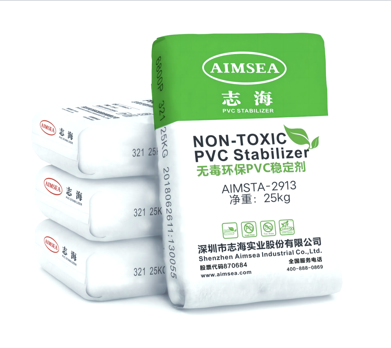
AIMSTA-2913 Calcium-Zinc Stabilizer
AIMSTA-2913 is a third-generation Ca/Zn one-pack engineered expressly for PVC seat-cover foams and skins.
Formulation Philosophy
Optimised Ca : Zn ratio — delivers early and mid-stage HCl neutralisation.
Phosphite & β-diketone co-stabilisers — recycle Zn complexes, extending thermal reserve.
Balanced internal / external lubricants — prevent die build-up, ensuring deep, clean emboss grains.
Micro-granule morphology — flows like PVC resin, integrates with automatic feeding.
Feature Summary
| Benefit | What It Means in the Cabin | Added Keyword |
|---|---|---|
| No heavy metals | Full RoHS & REACH compliance | lead free stabilizer for PVC |
| Odour-free | Passes VDA 270 ≤ 3; fresher “new-car smell” | PVC stabilizers for artificial leather |
| Zero volatiles | Fogging < 1.5 mg, no greasy film on windshields | synthetic PVC leather |
| Boosted surface tension | Crisper texture on leatherette seat covers; stronger adhesion of back-lit logos | imitation leather car seat covers |
| Superior weathering | ΔE ≤ 3 after 1 000 h Xenon > keeps bright whites in auto seat back protector inserts | artificial leather PVC |
Performance Validation: Lab Tests
| Test | Spec Limit | AIMSTA-2913 Result | Why It Matters |
|---|---|---|---|
| Congo-Red (200 °C) | ≥ 150 min | 165 min | Enough margin for 12 h continuous calender run. |
| Static heat-age @190 °C | Light straw after 150 min | Pass | No amber streaks in white PVC artificial leather. |
| Xenon Arc 1 000 h | ΔE ≤ 4; gloss ≥ 70 % | ΔE 2.8; gloss 74 % | Keeps light-coloured artificial leather car seats showroom fresh. |
| VDA 270 Odour (3 h, 80 °C) | ≤ 3.0 | 2.5 | Meets premium European OEM interior rule. |
| Fogging ISO 6452 | ≤ 2.0 mg | 1.2 mg | Windshield remains clear in tropical sun. |
Field tests in Arizona desert and Finnish winter confirm crack-free grains down to –30 °C and colour stability up to 105 °C cabin soak.
Regulatory & Sustainability Drivers
RoHS / REACH Annex XVII — eliminate Pb, Cd, Cr VI; Ca/Zn passes easily.
China GB/T 37273 (Interior VOC) — stricter limits on aldehydes and total VOC push OEMs toward low-odour stabilizers.
OEM IMDS declarations — global platforms require heavy-metal < 1 ppm.
Life-cycle assessments (LCA) — Ca/Zn lowers aquatic toxicity vs. tin, supports brand ESG statements.
Using AIMSTA-2913 helps answer sustainability audits, a key differentiator when bidding for EV interior programs.
uys regulatory certainty, lower scrap and brand-saving colour stability—an easy sell to finance.
Implementation Roadmap for Upholstery Converters
Audit current formula — measure odour, Xenon ΔE, Congo-Red.
Request pilot batch — AIMSTA-2913 at 4–6 phr; align with your PVC/resin grade.
Run lab batches — verify fusion torque, plate-out, odour and foaming behaviour.
Scale to production line — adjust oven zones ±5 °C; target peak torque 35–40 N·m (K-65 resin).
Validate interior VOC — VDA 278 & ISO 12219; refine plasticiser if needed.
Complete OEM submissions — IMDS entry, material data sheet, flame and fogging certificates.
Monitor first 30-day run — track scrap, emboss consistency, operator feedback.
Roll out across colours — darker grains usually need less TiO₂; stabilizer phr stays constant.
FAQs: Leather Seats, VOCs, and Consumer Perceptions
Q: Are leather seats in cars real leather nowadays?
A: On many models they are a high-performance imitation leather car seat cover built on synthetic PVC leather or micro-fibre PU. The surface feel is virtually identical, but cost, colour choice and environmental profile are superior.
Q: Does synthetic PVC leather smell like plastic?
A: Not when a modern lead free stabilizer for PVC such as AIMSTA-2913 is used; cabin odour scores rival natural hide.
Q: Is vinyl seating too hot in summer?
A: New perforation patterns, light-coloured pigments and reflective top-coats cut surface temperature by up to 10 °C compared with older vinyl car seats.
Q: How does a waterproof back seat cover stay flexible?
A: Calcium-zinc stabilizers maintain plasticiser balance, preventing shrink-back or stiffening after years of wet-dry cycles.
Key Takeaways
Synthetic PVC leather dominates next-gen interiors because it pairs luxury looks with production efficiency.
The difference between a premium and a problem seat often boils down to the PVC stabilizers for artificial leather hidden inside.
Calcium-zinc stabilizers—especially one-pack pellets like AIMSTA-2913—deliver odour-free processing, long-term colour stability and full regulatory compliance.
When total cost, scrap, downtime and warranty are tallied, high-grade Ca/Zn nearly always beats legacy chemistries.
Converters who integrate the right stabilizer early will answer both OEM ESG audits and driver expectations—turning artificial leather seat covers for cars into a true competitive advantage.
Ready to upgrade? Contact your PVC stabilizer partner for AIMSTA-2913 pilot samples and line-start support—so your next generation of leatherette seat covers meets every colour, cost and compliance target from day one.