
fajsdfjash ddsa dsa as sa sad sda sadfjsadjfl jsadjk fjasdlkfjaskdfdklsaj klf
jsadj
asjdklj falsdjf
jaklj
Request Sample
Organotin vs Organotin + Booster: How to Evaluate Cost, Clarity and Heat Stability
Read:10
Source:
Quick Answer
Organotin delivers strong clarity and heat stability, while organotin + booster can reduce tin dosage and cost if clarity, processing stability, and heat-aging tests remain acceptable.
Key Takeaways
·Organotin stabilizer is still valuable for clear, rigid PVC products where transparency and early color are critical.
·Organotin + booster should be judged by real production data, not only by lower formulation cost.
·The three key evaluation dimensions are clarity, processing stability, and total cost.
·Buyers should test haze, transmittance, Congo Red, oven aging, torque behavior, plate-out, and line output before switching.
·AIMSEA’s hybrid Ca-Zn/tin option is positioned for reducing organotin use while maintaining fusion speed and clarity in rigid films.
Abstract
Choosing the right pvc stabilizer for transparent PVC, rigid film, sheet, packaging, and calendered products is no longer only a question of heat stability. In 2026, many processors are also under pressure to reduce organotin use, improve compliance positioning, control material cost, and keep stable output. This article compares traditional organotin stabilizer systems with organotin stabilizer booster systems through three practical dimensions: clarity, processing, and cost. It also explains which tests matter most before replacing part of a PVC tin stabilizer package.
Why PVC Stabilizer Selection Is Changing in Transparent PVC
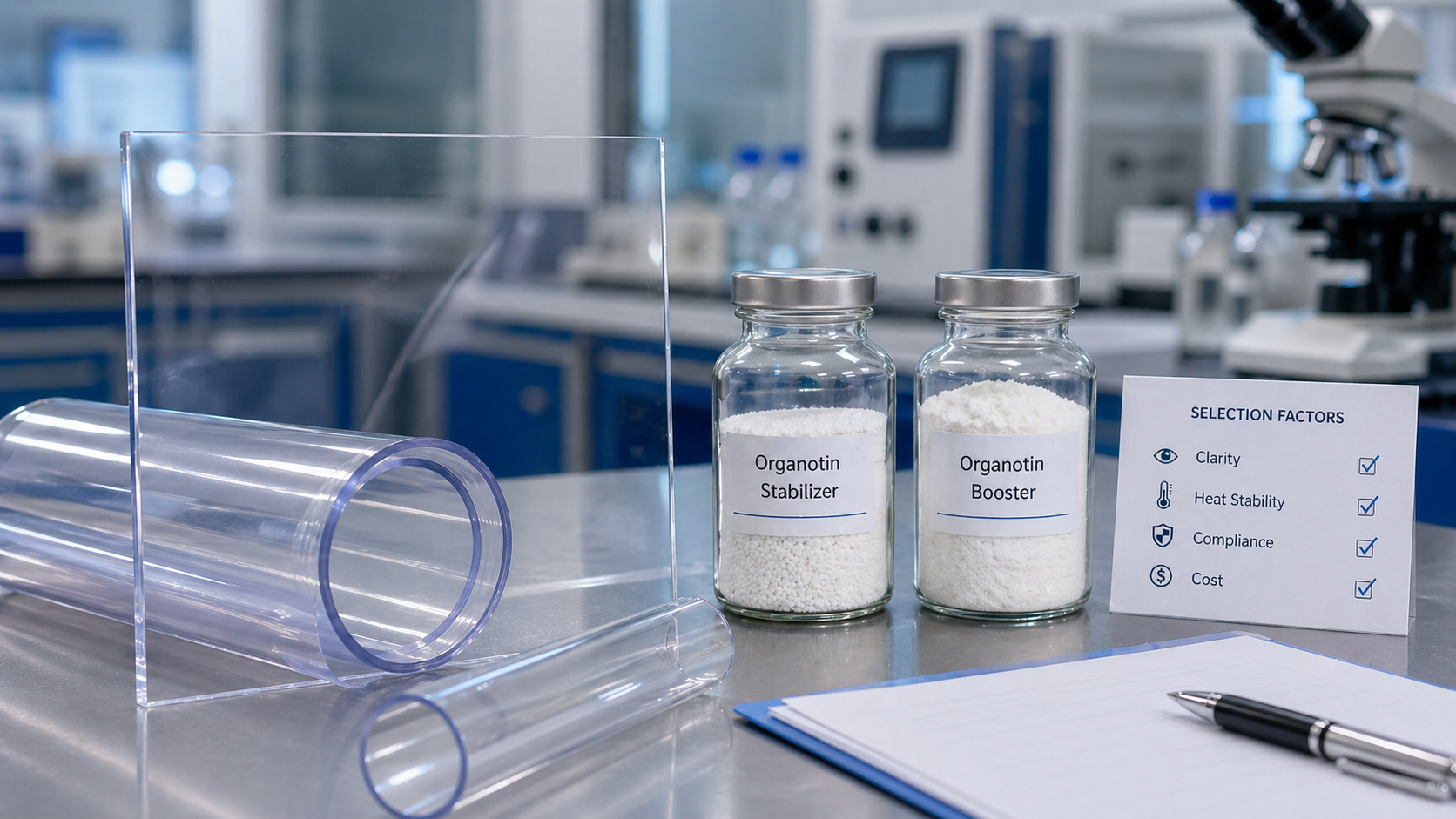
Transparent PVC products need a stabilizer system that can protect color, clarity, and surface quality during heat processing. PVC is thermally unstable at processing temperatures, so heat stabilizers are used to reduce degradation, neutralize hydrogen chloride, and protect the polymer during extrusion, calendering, molding, and later service life.
Compliance and cost pressure are rising
For many export-oriented PVC manufacturers, the decision is now influenced by cost control and environmental positioning. ECHA’s investigation into PVC and PVC additives notes that PVC additives, including stabilizers and other additive groups, have been under regulatory scrutiny, while lead- and cadmium-based stabilizers and certain phthalates are already restricted under REACH. SGS also reports that the EU expanded lead restrictions for PVC articles, with a less than 0.1% lead requirement for PVC polymer and copolymer articles from November 29, 2024.
For this reason, many buyers are asking a more specific question: can a PVC tin stabilizer be partially reduced without losing clarity, heat stability, or processing reliability?
Organotin Stabilizer vs Organotin + Booster: Core Difference
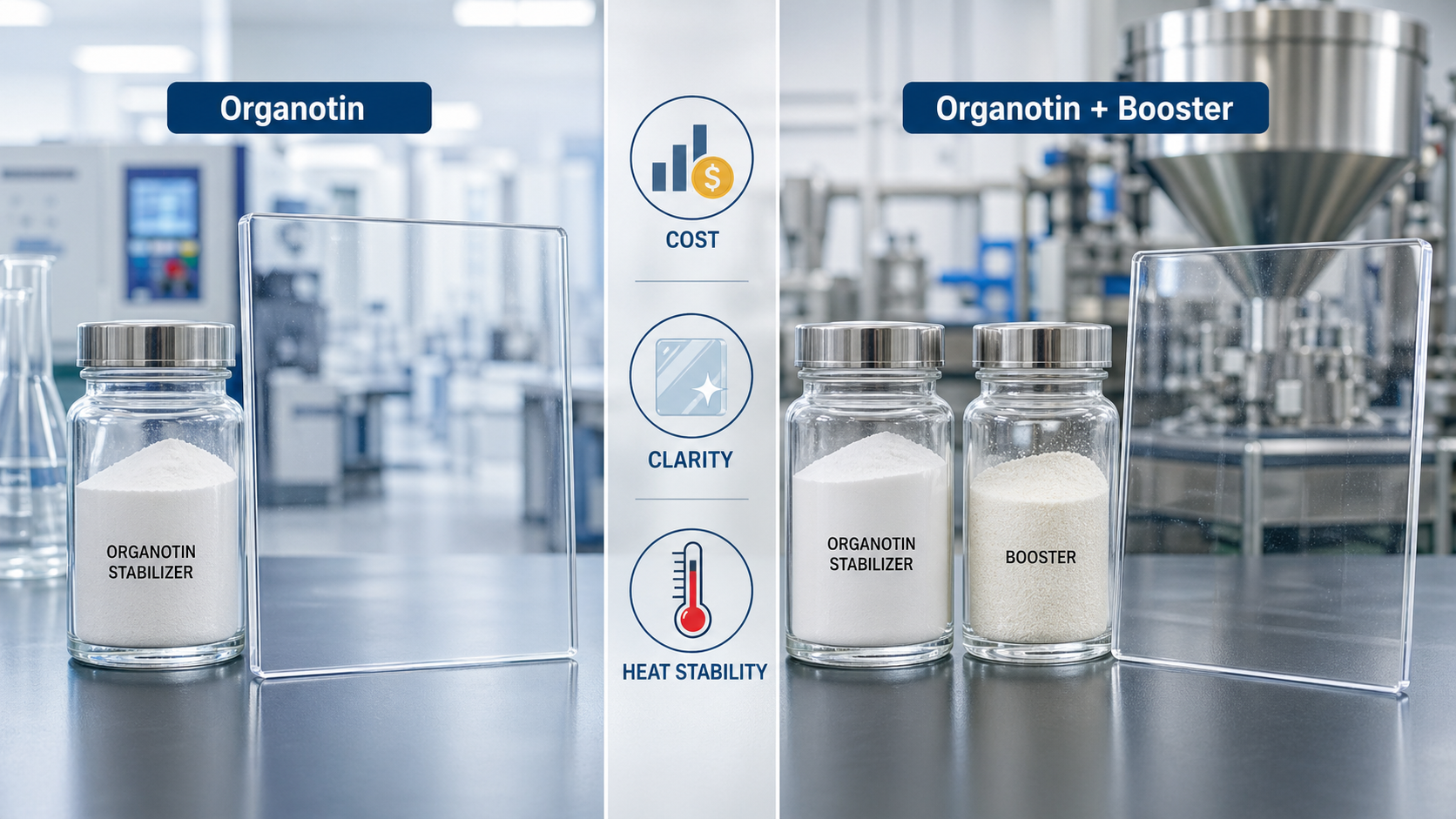
A traditional organotin stabilizer system relies mainly on tin chemistry to protect PVC during processing. Tin stabilizers are widely recognized for high transparency, good early color, color retention, and demanding processing performance in rigid PVC applications. AIMSEA also notes that PVC tin stabilizers are widely used where high clarity and strong heat stability are required, especially for rigid PVC products where transparency and color stability matter.
An organotin + booster system uses a booster or partner stabilizer to support the tin system. The goal is not simply to remove tin, but to create a balanced formula that can reduce organotin dosage while maintaining the target production result. A technical paper on PVC/CPVC pipe and fittings describes a booster used with tin stabilizer as having a synergistic effect, improving heat stability and reducing formulation cost.
Evaluation Point | Organotin Stabilizer | Organotin + Booster |
Clarity | Usually excellent for clear rigid PVC | Must be verified by haze and transmittance |
Heat stability | Strong initial and dynamic stability | Can improve cost-performance if synergy works |
Processing | Good fusion, color hold, and low plate-out | Depends on lubricant balance and compatibility |
Cost | Higher additive cost | Potential lower total formula cost |
Best use | High-clarity, high-performance PVC | Cost-sensitive clear or semi-clear PVC trials |
Clarity: How to Test Transparent PVC Stabilizer Performance
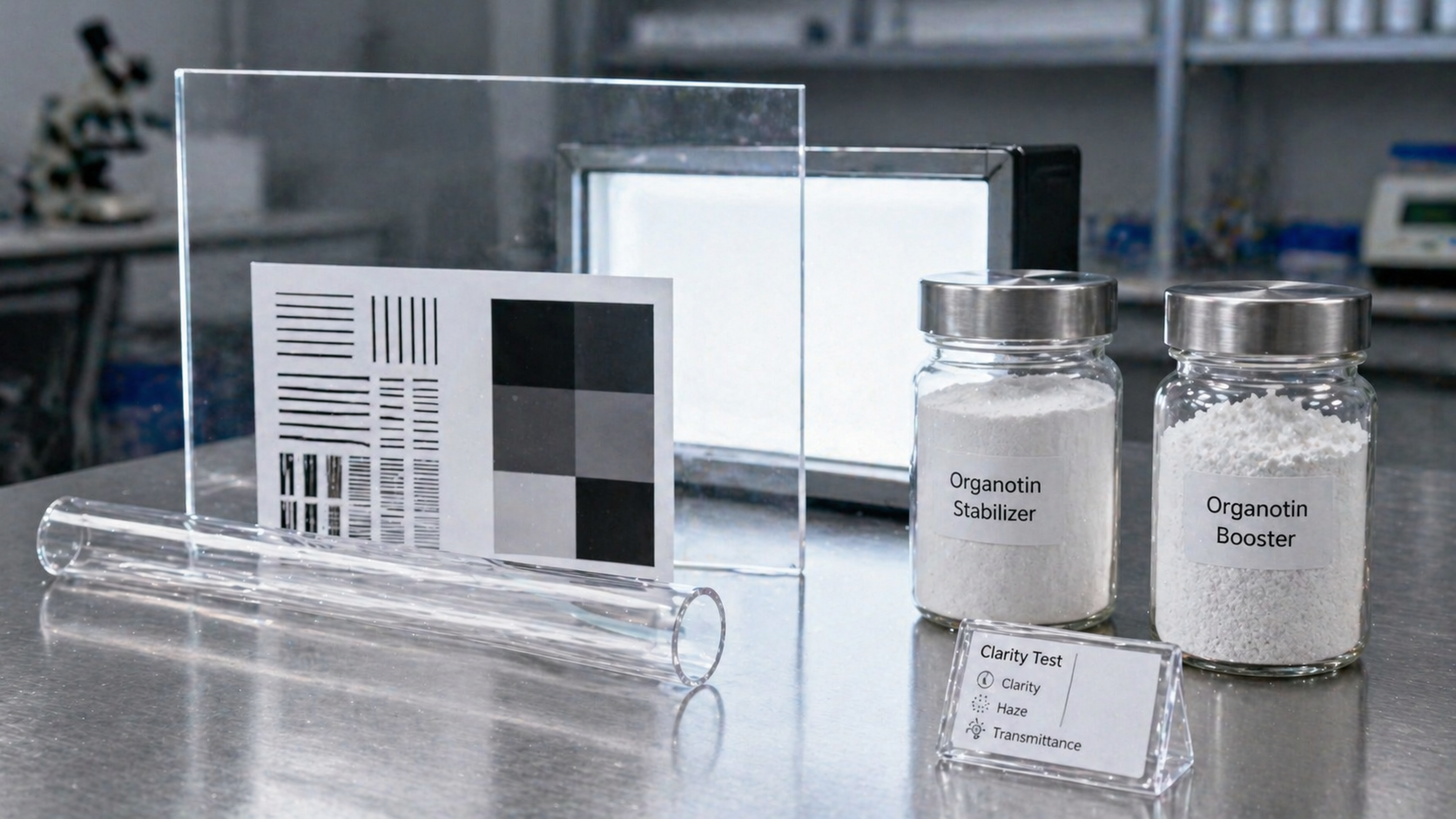
For transparent PVC, clarity cannot be judged by looking at one sample under factory lighting. A good transparent PVC stabilizer evaluation should compare the original organotin formula and the organotin + booster formula under the same resin, plasticizer, lubricant, filler, pigment, temperature, and residence time.
Use haze, transmittance and visual color together
The three basic checks are:
Test Item | What It Shows | Why It Matters |
Haze | Cloudiness or scattering | Reveals whether the booster affects optical clarity |
Light transmittance | Transparency level | Useful for sheet, film, packaging, and display products |
Yellowness index / visual color | Initial color and discoloration | Shows early color performance after heating |
AIMSEA’s transparent PVC application page positions optical-grade Ca-Zn stabilizers for clear sheet, film, and rigid packaging, emphasizing high transparency, low dosage, odorless performance, and tin-free environmental positioning. This angle can be used in the article to guide users toward application-based comparison rather than chemistry-name comparison.
Practical clarity rule
If the booster reduces cost but increases haze, the formula may fail in transparent packaging, clear film, lamp strips, or medical-style flexible transparent products. If haze remains stable and color hold improves, the booster system is worth a production trial.
Processing: Heat Stability, Plate-Out and Production Window
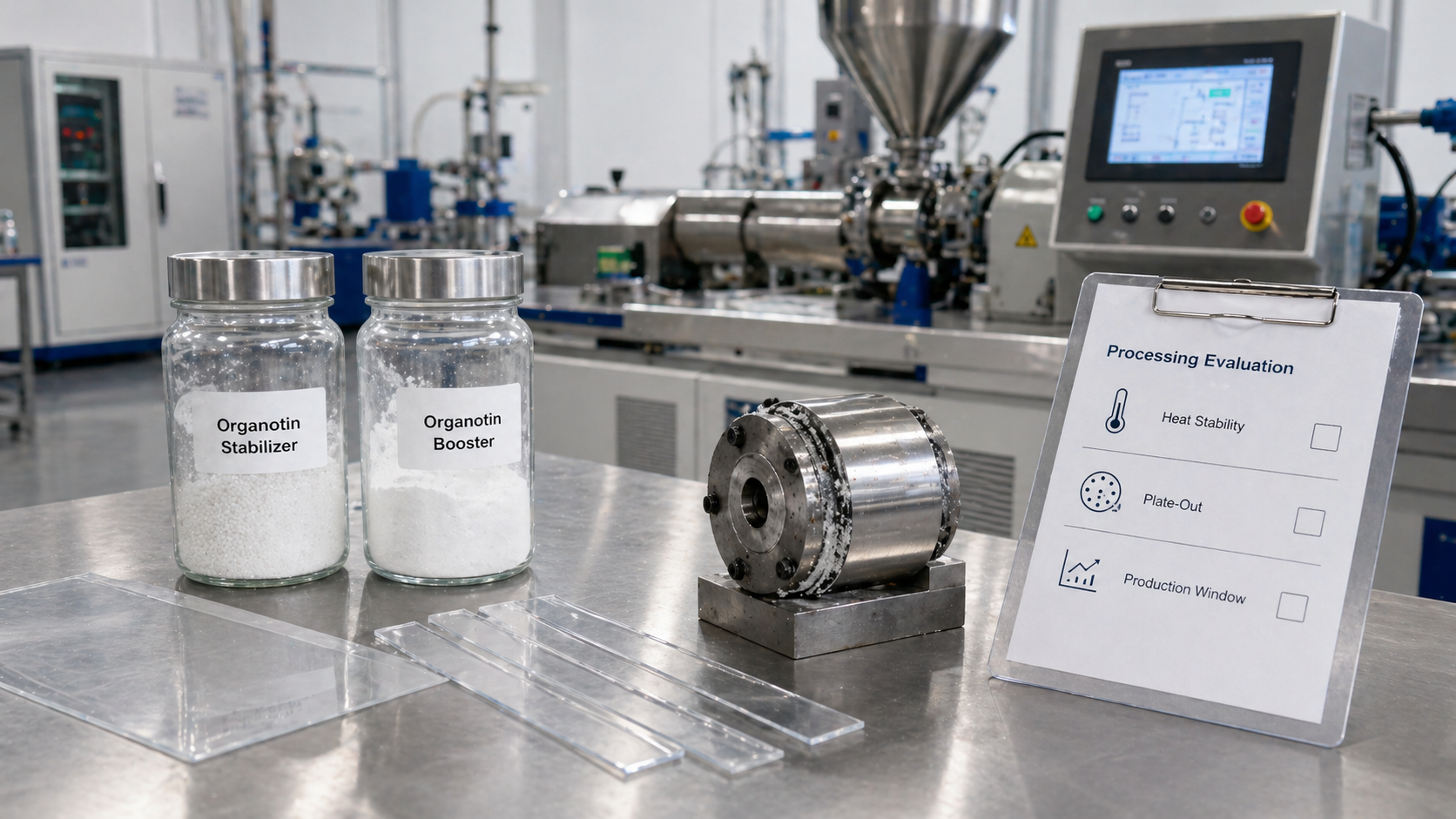
Processing performance is where many booster systems succeed or fail. A formula can look acceptable in a small lab sheet but still cause plate-out, die deposits, unstable torque, or color drift after long production.
Test heat stability with Congo Red and oven aging
Congo Red can help screen early thermal stability, while oven aging compares discoloration resistance under controlled heat. AIMSEA’s testing article recommends using Congo Red, oven aging, and plate-out together because each test answers a different question.
Watch plate-out and torque behavior
A suitable PVC heat stabilizer package should protect the material without disturbing lubrication balance. If the booster changes fusion too much, the plant may see:
·higher torque or unstable torque curve
·die build-up or roller deposits
·surface streaks or black specks
·shorter cleaning intervals
·unstable output during long runs
For calendering, AIMSEA highlights Sn/Pb/Cd-free stabilizers designed for surface quality, melt homogeneity, thermal stability, and reduced plate-out in PVC calendering lines. This makes calendered film and synthetic leather useful application examples for the processing section.
Cost: Why Lower Tin Dosage Is Not the Whole Answer
A common mistake is to compare only additive price per kilogram. The better metric is total production cost.
Calculate total cost by finished product, not stabilizer price
A lower-cost organotin stabilizer booster system is only valuable if it does not increase rejects, downtime, cleaning, odor issues, or customer complaints. The cost model should include:
Cost Factor | Why It Matters |
Tin dosage reduction | Direct formula saving |
Booster dosage | Added material cost |
Output rate | Affects cost per meter or kilogram |
Reject rate | Poor clarity or yellowing can erase savings |
Cleaning frequency | Plate-out increases downtime |
Requalification cost | Important for regulated or export products |
AIMSEA’s organotin stabilizer page lists a hybrid Ca-Zn/tin option that can cut organotin up to 60% in rigid films and keep fusion speed and clarity unchanged. This should be framed as a sample-testing direction, not a universal guarantee for every PVC formula.
Buyer Testing Matrix for PVC Stabilizer Selection
Before switching from organotin to organotin + booster, buyers should ask the supplier for a side-by-side test package.
Test Group | Recommended Test | Decision Question |
Clarity | Haze, transmittance, visual color | Does the booster affect transparency? |
Heat stability | Congo Red, static oven aging | Does the formula resist discoloration? |
Processing | Torque rheology, fusion time | Does the line run the same way? |
Cleanliness | Plate-out test, die deposit check | Will cleaning frequency increase? |
Long-run trial | 4–8 hour production test | Is the result stable at real output? |
Compliance | REACH, RoHS, heavy metal screening | Can the product meet target market needs? |
When to Keep Organotin and When to Use a Booster
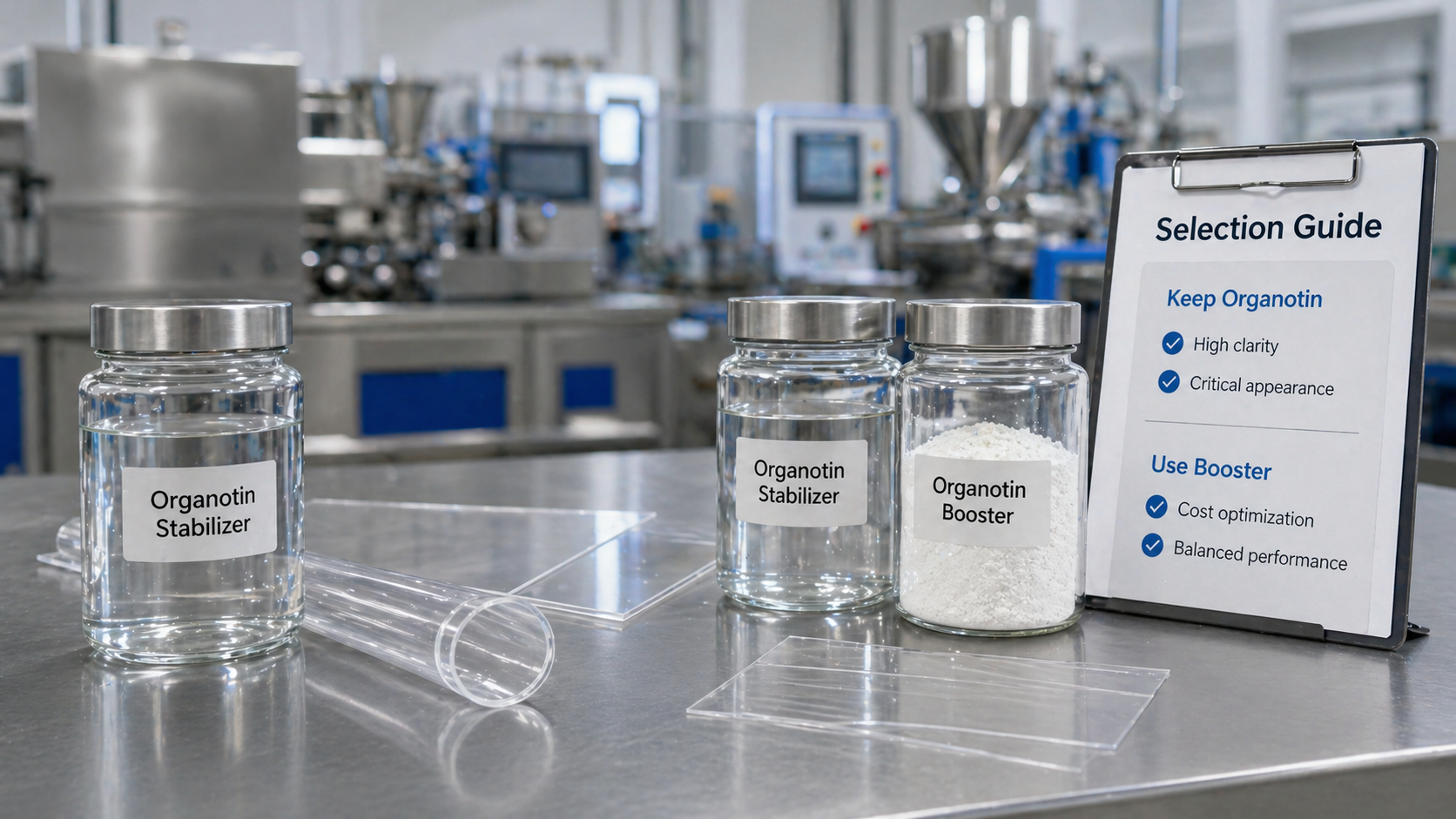
Keep full organotin when performance risk is high
A full organotin stabilizer system may still be the safer choice for premium clear rigid PVC, demanding medical-style transparent items, high-clarity packaging, or products where even slight haze is unacceptable.
Try organotin + booster when cost and compliance matter
An organotin + booster system is worth testing when the product allows a small formulation window, the customer wants lower tin usage, and the plant has enough testing capacity to verify clarity, heat stability, and processing behavior.
Good target applications include rigid transparent film, semi-rigid film, calendered sheet, decorative film, and some transparent profiles. AIMSEA’s CZ186 product information describes use in hard calendared sheet and rigid film with excellent transparency, used with methyltin mercaptan at 0.4–1.2 PHR.
FAQ: Organotin Stabilizer Booster Questions
What is an organotin stabilizer booster?
An organotin stabilizer booster is an additive or partner stabilizer used with organotin to improve heat-stability efficiency, reduce tin dosage, or improve cost-performance while keeping target PVC properties.
Will a booster reduce PVC clarity?
Not always, but it must be tested. Haze, transmittance, yellowness index, and long-run visual inspection are necessary before using the booster in commercial transparent PVC production.
Can a booster fully replace organotin?
In many transparent rigid PVC applications, full replacement is more difficult than partial reduction. A booster is usually evaluated first as a tin-reduction tool, not a direct one-step replacement.
What tests should I request from a PVC stabilizer supplier?
Request haze, transmittance, oven aging, Congo Red, torque curve, plate-out, recommended dosage, compliance documents, and a real production trial under your processing conditions.
Final Recommendation
The best pvc stabilizer choice is not “organotin” or “organotin + booster” in isolation. It is the system that keeps your required clarity, survives your processing temperature, runs cleanly on your equipment, and lowers total production cost.
For buyers making the first comparison, use this simple rule: keep organotin as the benchmark, test organotin + booster as the cost-optimization route, and approve the change only after clarity, heat stability, plate-out, torque, and long-run output are all verified.
For clear PVC film, rigid sheet, calendered PVC, and transparent packaging projects, AIMSEA’s hybrid Ca-Zn/tin and transparent PVC stabilizer solutions can be positioned as practical sample options when customers want lower tin usage, cleaner compliance positioning, and stable production support.
Table of Contents
Copyright © Shenzhen Zhihai Industrial Co., LTD.
Digital Marketing : CTMON


×
CONTACT US
×
fasdfasdfdsaf fsfsad dsa sadsda sad sdaadssdafshdafjhasdkhsadfhasdhfashkdfhask hdfjdskh
fkjashksah dkjh kdjsfhsakdhasjkhfsajkhfd jskdhf akshfjkash dkj hfdsajfh askjfh sdajfhsadjhf
kdsah fdkjsahf asjkh sjakdfhaskfdh asjkdfh jkdsafh asjdfhsajkdfhaskjdfhjk
fdaskfasdkjf kjsf sajkdf kjasdk jsa
fasdfasdfdsaf fsfsad dsa sadsda sad sdaadssdafshdafjhasdkhsadfhasdhfashkdfhask hdfjdskh fkjashksah dkjh kdjsfhsakdhasjkhfsajkhfd jskdhf akshfjkash dkj hfdsajfh askjfh sdajfhsadjhf kdsah fdkjsahf asjkh sjakdfhaskfdh asjkdfh jkdsafh asjdfhsajkdfhaskjdfhjk fdaskfasdkjf kjsf sajkdf kjasdk jsa fasdfasdfdsaf1 fasdfasdfdsaf2 fasdfasdfdsaf3 fasdfasdfdsaf5
fasdfasdfdsaf fsfsad dsa sadsda sad sdaadssdafshdafjhasdkhsadfhasdhfashkdfhask hdfjdskh fkjashksah dkjh kdjsfhsakdhasjkhfsajkhfd jskdhf akshfjkash dkj hfdsajfh askjfh sdajfhsadjhf kdsah fdkjsahf asjkh sjakdfhaskfdh asjkdfh jkdsafh asjdfhsajkdfhaskjdfhjk fdaskfasdkjf kjsf sajkdf kjasdk jsa fasdfasdfdsaf1 fasdfasdfdsaf2 fasdfasdfdsaf3 fasdfasdfdsaf5

loading...